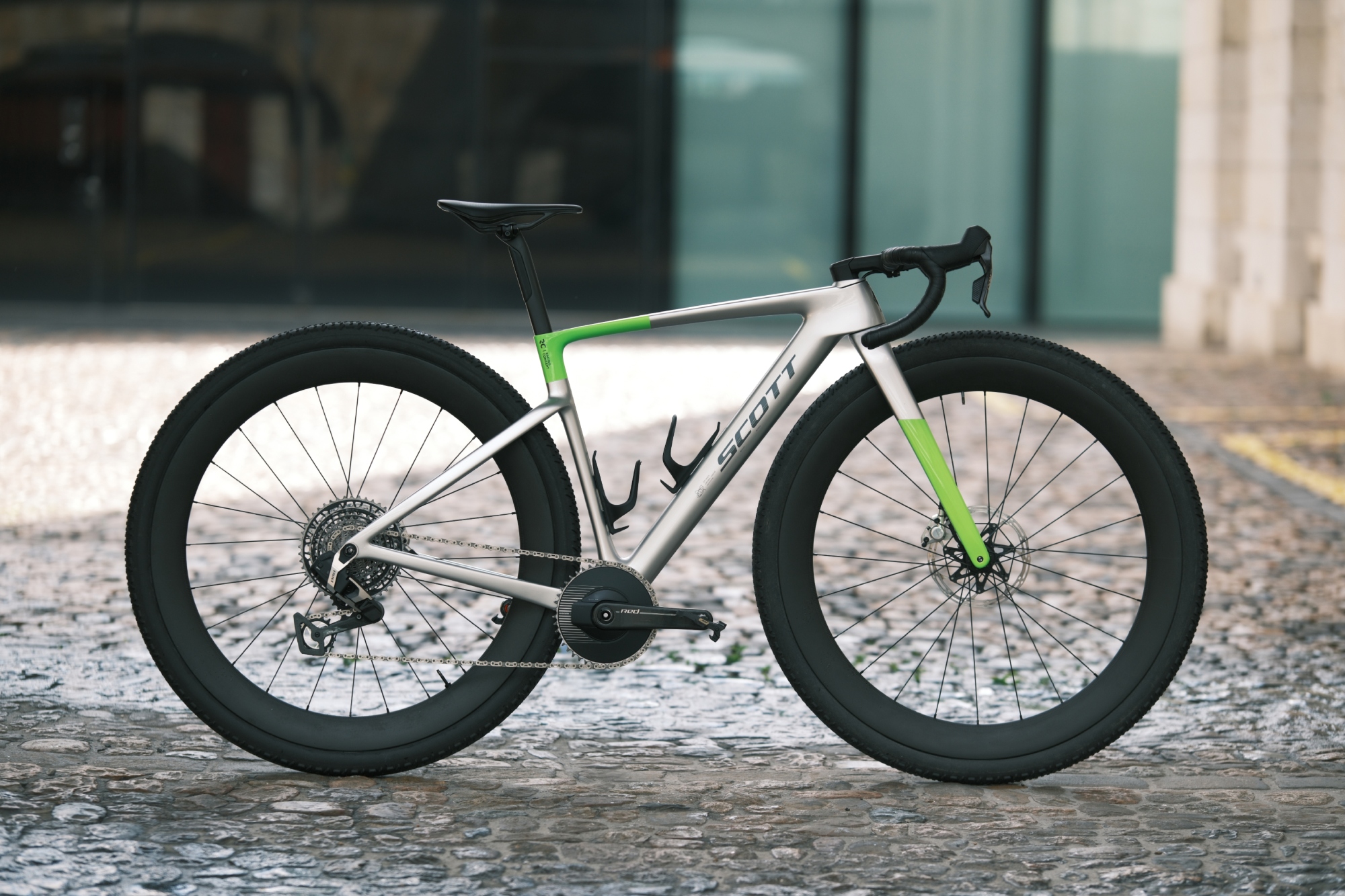
Schwalbe has announced it will launch new 32-inch versions of its G-One RS Pro and G-One RX Pro gravel tyres in April 2027, both in 50mm and 55mm widths.
The German brand says the move follows growing interest in 32-inch gravel bikes, with the first models expected to reach the market in autumn 2026. It says testing has shown benefits including improved stability, traction and comfort, and it points to evidence that Robin Gemperle won Unbound XL on 32in G-One RX Pro prototypes fitted to a prototype Scott gravel bike.
Gemperle himself was quoted as saying afterward: “This big boy is the actual size gravel racing and especially Unbound Gravel was waiting for.”
Latest Videos FromCycling Weekly
(Image credit: SCOTT Sports / Lukas Schumacher)
Meanwhile, from Schwalbe’s side, head of product management Felix Schäfermeier says: “At first, we were skeptical about whether 32 inches would be a meaningful addition. But the more we tested, the clearer the conclusion became: riders on 32-inch wheels definitely notice a difference.”
Schwalbe looks to be the first of the big brands to launch a gravel-specific 32-inch tyre with a ‘G’ printed on the sidewall, but US gravel and MTB specialists Teravail already offer both 32-inch tyres and rims for “service roads” while Silca’s Protocol 32in RCG-3 is also designed for gravel and comes in a massive 2.4in (60mm) width.
Maxxis’s Aspen ST 32 x 2.15in and Aspen AT 32 x 2.4in are mountain bike tyres that could double as gravel tyres while Vittoria and Kenda are expected to launch gravel tyres next year. The former showed off a new Peyote tyre at Sea Otter in April but would not be drawn over when they would go into production. The Kenda Dagger, a “cross country and light trail tyre” is expected to be available in 32 inches soon. There’s no word from Continental so far, but it’s clear the bicycle tyre industry as a whole is getting ready for the new standard.

(Image credit: Schwalbe)
Okay, but where are the 32-inch bikes to use them with? This one could be a bit trickier to answer.
Schwalbe might be the first mainstream tyre brand to release a gravel-specific 32-inch product, but the global bike brands are either noncommittal or playing cat-and-mouse to see who’s going to lead it out.
Earlier this month, NBA star and Canyon shareholder LeBron James rolled out on a one-off 32-inch Grizl but Canyon was quick to explain that the bike was neither a prototype nor a display model – it was a custom bike “engineered from the ground up for a 6ft 9in athlete whose size very few production frames are designed to accommodate.”
There’s no sign of Scott making a production version of the bike Gemperle rode to victory in Unbound – the Swiss brand stated at the time that it was a “pure prototype” that would never be released to the market.

(Image credit: Mosaic Cycles)
Right now, smaller, mostly US builders are leading the 32-inch charge. Last month, Colorado’s Mosaic released its GT i55 32, a handmade titanium gravel bike that owner Aaron Barcheck said was categorically “not a concept bike”. Stinner has already shown its Refugio 32, BTCHN’ has been preparing its Bandito for production, and Salsa has said 32-inch Fargo framesets will go on sale this summer, with complete bikes to follow later in the year.
So where are the 32-inch gravel bikes from Specialized, Trek, Giant, Cannondale et al? There’s no doubt they’re coming but, on the subject of big things, there’s still that elephant in the room that could be getting in the way: not every future rider of a 32-inch bike is going to be 6ft 9in, like LeBron James. What if they’re 5ft 2in? The diameter of a 32-inch wheel with a chunky tyre on it will measure over 80 centimetres, and obviously the smaller the frame size, the harder it becomes to adapt the geometry, particularly the steering, so that the bike still handles in a way that makes the most of the larger wheel size – as championed by Schwalbe – instead of being compromised by it.
Last week we wrote about British brand Hunt launching an upgraded version of its 650b gravel wheel – the size that played a major part in the early gravel boom a decade ago because the outer diameter of a 700c tyre (40-45mm) and a 650b tyre (2.0-2.2in) are very similar and wheelsets could be swapped for different types of terrain. That made sense – the bike’s geometry wasn’t dramatically altered. But with 32-inch wheels, the smaller the rider and frame, the more the geometry has to change to accommodate them.
Robin Gemperle said the larger wheel standard was the size gravel racing was waiting for, but as the 32-inch situation in the bicycle industry currently stands, it might have to keep waiting a little longer.
