Ridley has been making headlines recently and for all the right reasons. Not only did Torstein Træen earn the maillot jaune aboard a Ridley Noah Fast 3.0 at this year’s Tour de France, but the Belgian brand also just unveiled the ultra-aero Kanzo Fast 2.0 gravel bike.
While the Noah Fast 3.0 is one of the slipperiest bikes in the pro peloton, it’s also one of the heaviest. I personally weighed several of Uno-X Mobility’s team bikes at Opening Weekend in Belgium in February, where the lightest bike to tip the scales was Jonas Abrahamsen’s at 7.9kg fitted with a SRAM Red XPLR AXS one-by setup.
Despite having the outgoing Falcn RS at their disposal, Uno-X Mobility needed something lighter and with a tad more aerodynamic nous to compete in the high mountains at three-week-long Grand Tours. As an unapologetic non-believer in the ‘one bike to do it all’ approach, Ridley started work on a solution, and one that wasn’t a particularly well-kept secret.
Latest Videos FromCycling Weekly
We spotted the new bike at the Tour Auvergne-Rhône-Alpes and, a month later, again at the Tour de France, and, as it turns out, we were right to assume it was an updated Falcn RS.
The new platform is 12% lighter than its predecessor: a medium frame tips the scales at 705g, with the fork and seatpost coming in at 347g and 100g, respectively
(Image credit: Ridley Bikes)
The new Ridley Falcn RS was developed closely with Uno-X Mobility and completed just in time for what was one of the most grueling Tours de France in recent history, providing the team with a modern but, more importantly, competitive all-round climbing bike. In fact, even Tour de France race leader Torstein Træen of Uno-X Mobility opted to forgo riding his custom-yellow Ridley Noah Fast 3.0 in favour of the then still unreleased Falcn RS for mountainous stage 6 of the 2026 Tour de France.
According to Ridley, the new Falcn RS is a dedicated ‘aero-to-weight’ bike, engineered to balance climbing performance with aero efficiency. We were invited to test the new bike in the hilly terrain of Girona, Spain, and see for ourselves whether Ridley’s claims hold up.

The new tube shapes, particularly the narrower, deeper headtube, which doubles as both a lightweight and aero measure
(Image credit: Ridley Bikes)
Sub-7kg builds with aero touches
Instead of merely tweaking the outgoing Falcn RS, which was launched in 2023, Ridley’s design team totally overhauled the platform with a major focus on frame weight reduction. As a result, the new platform is 12% lighter than its predecessor: a medium frame tips the scales at 705g, with the fork and seatpost coming in at 347g and 100g, respectively. While the frame is around ±110g heavier than the Specialized S-Works Aethos 2 and Scott Addict Ultimate, the Falcn RS has some aero-optimised tubes dialled in for improved efficiency at typical average race speeds.
Look closely, and you’ll notice the new tube shapes, particularly the narrower, deeper headtube, which doubles as both a lightweight and aero measure. While subtle, Ridley says the “refined frame shapes reduce drag and use less material than before.” To ensure a more aero-optimised seatpost and also save weight, the Di2 battery has been relocated to the downtube.

A 48/35T, 10-33T gearing setup proved ideal for the gradients of Els Àngels in Girona
(Image credit: Ridley Bikes)
Of the three models available, each bike tips the scales at under 7kg. The range-topping Ridley Falcn RS SRAM Red AXS weighs 6.2kg, while the SRAM Force AXS and Shimano Ultegra Di2 come in at 6.65kg and 6.8kg, respectively (weights are quoted without pedals and in size medium).
For Ridley, the big savings started with the frameset design, which saw manufacturing improvements over the outgoing model.
Ridley has used EPS in the frame mould, so there’s less overlap in the carbon and smoother internal walls – Ridley describes the tube shapes as ‘fibre friendly’. It also benefits from hollow rear dropouts, a new seatpost clamp with carbon cradle, and titanium hardware.
Tyre clearance has been addressed, too. While the outgoing model’s 34mm wasn’t too shabby given many of the current all-rounders have provision for rubber as wide as 32mm, Ridley has increased the Falcn RS’s tyre clearance to 35mm. This helps future-proof the platform and improves utility on bumpier, more broken surfaces or terrain.
It’s also UDH compatible, offering a wide spread of 1x and 2x drivetrain options, and the front hanger is fully removable for a cleaner, even lighter setup.
My Falcn RS test bike was fitted with 30mm Vittoria Corsa Pro tyres, which proved more than capable on a route that took in a few – albeit very short – sections of cobbled roads.

The front-centre has increased from 590mm to 625mm, and the stack is up 10mm to help open the hip angle for optimal power delivery
(Image credit: Ridley Bikes)
Progressive geometry
As more professional riders and competitive amateurs have adopted forward-bias bike fits with slammed saddles and longer stems, Ridley was adamant about developing a progressive sizing chart with modern frame angles that centralise the rider’s position on the bike. The solution came in steepening the seat tube angle from 73.5-degrees on a size small to 76-degrees over the outgoing model across all sizes.
While the top tube numbers and headtube angle (73-degrees) remain the same across the board, Ridley increased the stack height by 10mm (dependent on size) over the previous model by lowering the bottom bracket and lengthening the reach. These changes were implemented not only to accommodate the steeper seat tube angle, but also to bolster overall stability and help prevent toe overlap. As such, the front-centre has increased from 590mm to 625mm.
Compared to the outgoing model’s 530mm and 380mm, stack and reach have increased to 538mm and 411mm. The chainstays are 3mm longer at 410mm, while the wheelbase has grown across all sizes, too – up 230mm to 1,000mm in a size small. These two measurements, in particular, have boosted stability and control on descents.

The exceptional bottom-bracket stiffness helps propel you forward with alacrity from the first pedal stroke
(Image credit: Ridley Bikes)
Ridley Falcn RS Force AXS – first ride impressions
My time with the Ridley Falcn RS was limited, but the 75km/1,300m route let me test it on the undulating terrain in and around Girona, Spain. As expected, it’s exceptionally light – 6.65kg in this exact specification.
For a bike that’s not a dedicated aero offering, it rides incredibly well and can comfortably munch away at the horizon line. In fact, on open roads, you’ll forget you’re not riding an aero bike – a sentiment shared across the group of journalists at the press camp. There were parts of the ride where we pushed it fairly hard on the flats, and the Falcn RS sat comfortably at 40km/h and above. I’d like to ride it on home roads and around the rolling topography of the UK’s Surrey Hills at the same intensity to get a better feel for its aerodynamics, but my initial impressions are positive. For context, the Falcn RS feels more at home at these speeds than the Specialized S-Works Aethos 2 and the Scott Addict Ultimate I recently tested.
Sure, for a bike with such a lightweight carbon layup, the ride quality is rather firm, but the upshot is exceptional bottom-bracket stiffness, which helps propel you forward with alacrity from the first pedal stroke. My size small test bike was fitted with 30mm Vittoria Corsa Pro tyres and TPU inner tubes – not quite my go-to setup, but given the relatively smooth road surfaces around Girona, the TPU configuration worked well. Even on the short sections of cobbled roads of Girona Old Town.

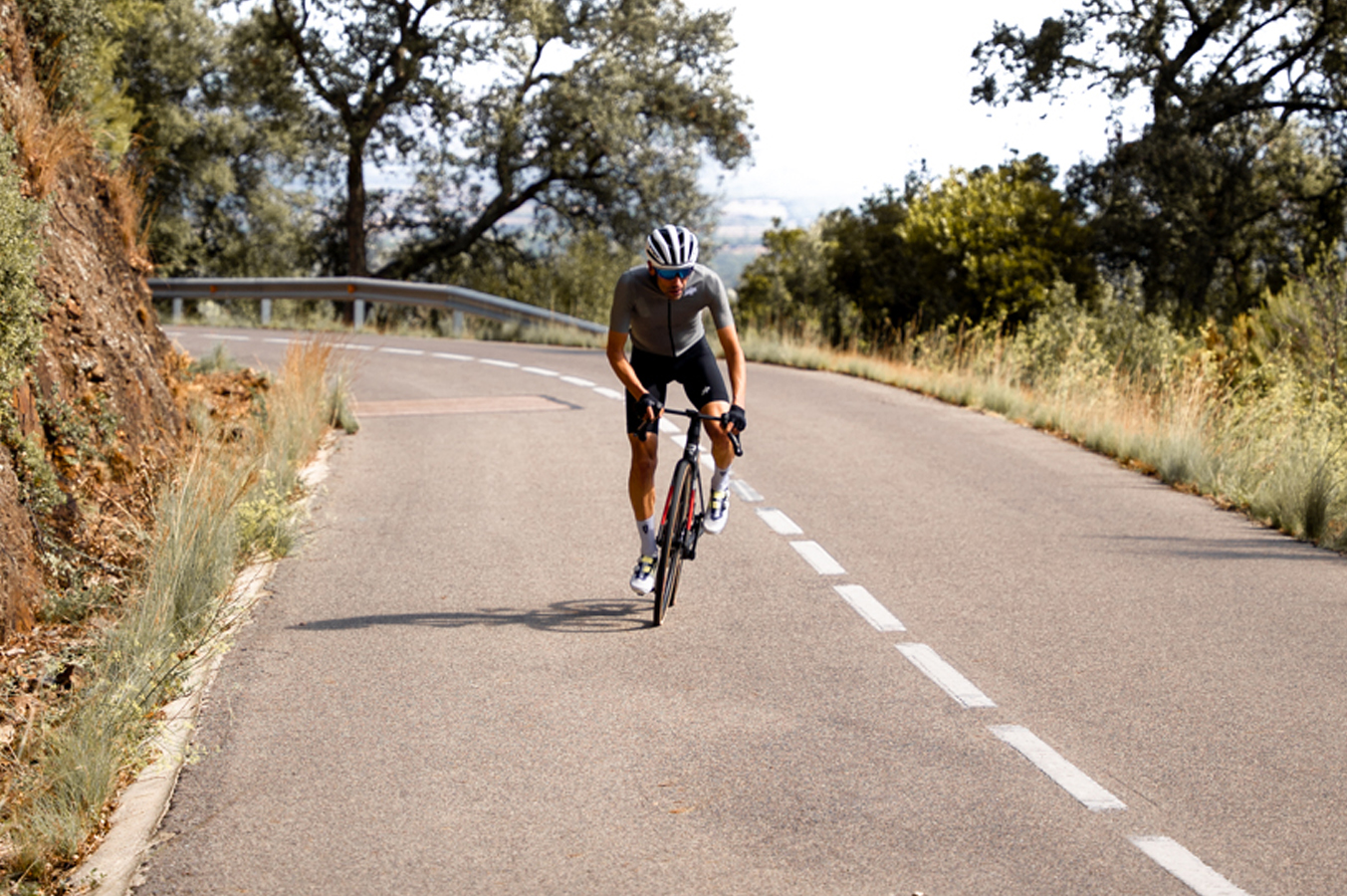
Despite its lightweight character, the new Falcn RS can hold its own on the flats
(Image credit: Ridley Bikes)
The new Falcn RS comes into its own the moment the road begins to tilt upward, and the infamous Els Àngles was the ideal setting to put its lightweight credentials and 48/35T, 10-33T gearing configuration to the test. The last time I climbed the 11km Girona side of Els was in 2023, riding the fourth-generation Cannondale SuperSix Evo, and I was amazed at how effortlessly the Falcn RS devoured the gradient. Even with a headwind, I was three minutes faster than before, a nod to the Falcn RS’s lightweight build and aerodynamics.
One area that bothered me was on the descents, where I struggled to find a rhythm – something I put down to the brake configuration, which was set up the other way around. This meant I found myself pulling the rear brake when I needed the front, unsettling the weight balance and throwing me off line during cornering. I’d like to revisit this when I sample the bike on home roads with the brakes the right way around (moto style for those wondering). On corners that didn’t require much speed scrubbing, the Falcn RS felt balanced and composed.
Overall, I was impressed by the new Ridley Falcn RS. It feels as Ridley describes it: an all-rounder that rides like a climbing bike, which bodes well for its success both in the professional rungs and in its appeal to the broader cycling demographic. While most aero bikes are a joy to ride on the flats and rolling terrain, they struggle on steep climbs, and during my brief test ride on the Falcn RS, I didn’t feel hamstrung in any of these areas – if anything, it felt more capable than any other lightweight all-rounder I’ve recently sampled.
I’ll reserve my final verdict for when testing commences on local soil, but initial impressions suggest a pretty impressive package.

Name stickers always add a nice personal touch
(Image credit: Ridley Bikes)
Range and pricing
As mentioned, the Ridley Falcn RS can be purchased as a complete build or as a frameset, both of which come standard with CeramicSpeed SLT headset bearings. To ensure the bike remains relevant and doesn’t age during its lifecycle, the Belgian company has introduced what it calls “Life Cycle Colour” (LCC). These include the launch colourways: Carbon-Matte Silver/Red and Silver/Black/Candy Red Metallic. Of course, the paint (as well as the entire build) is customisable via Ridley’s online configurator, too.
The range is topped by the 6.2kg Ridley Falcn RS SRAM Red AXS. Apart from the obvious, it gets AX Lightness Ultra SL 45 TLR CL wheels (950g total weight) and 30mm Vittoria Corsa Pro tyres with TPU tubes, 4ZA Nimbus Pro cockpit, and a lightweight Selle Italia Racing Replica saddle – yours for £11,299 / $14,999 / €12,499.
Next up is the Ridley Falcn RS SRAM Force AXS. Weighing just 6.65kg, it benefits from the same cockpit, tyres and saddle, but gets a 1,197g Forza Skiron RSR wheelset. It’s not as pricey as the SRAM Red model, but will still set you back £7,699 / $10,199 / €8,499.
The Shimano Ultegra Di2 version is the cheapest model in the range at £6,799 / $8,999 / €7,499 and, at 6.8kg, it’s bang on the UCI weight limit. The only difference between this and the other two models is the Mavic Comete Pro wheels.
There’s also a £4,499 / $5,999 / €4,999 frameset option available, which includes the aero seatpost and 4ZA Nimbus Pro cockpit.
Explore More
