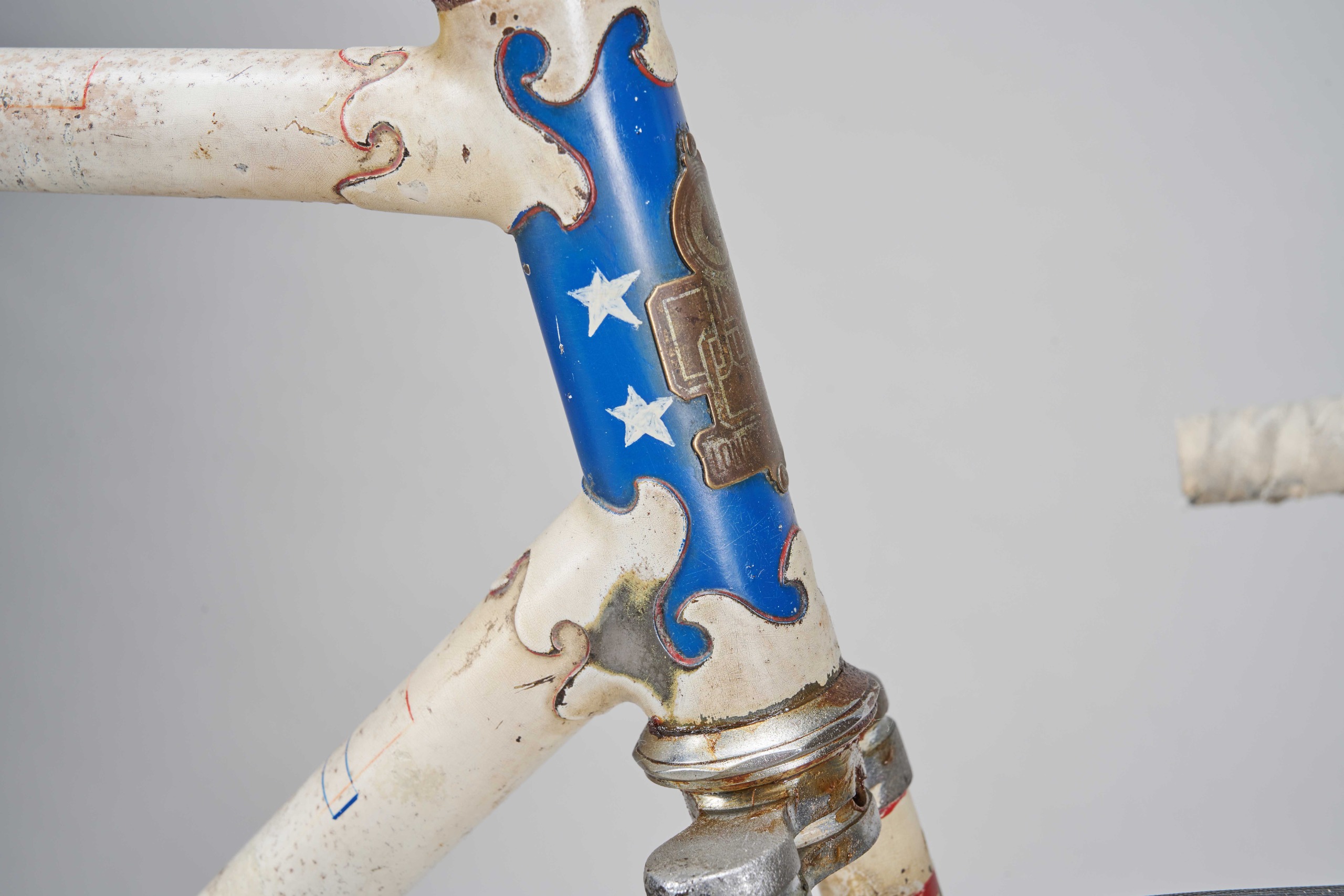
This enigmatic Claud Butler track bike is a period puzzle that only begins to reveal a version of its truth when associated with its likely rider, the colourful Jack Heid. On first inspection, the bike resembles a 1939 Champion Path model, with its period-correct oversized Chater-Lee bottom bracket and cast lugs. However, a closer look reveals a distinctive 1948 ‘Olympic rings’ head tube badge.
(Image credit: Future)
There’s no mistaking the livery, which boldly screams ‘USA!’ as only the Stars and Stripes can. Consider that Claud Butler had a close relationship with talented New Yorker Heid around this period, and pieces of the puzzle begin to fall into place.
Disenchanted with the East Coast racing scene, Heid flew to London for the 1948 Olympics, where he immediately became obsessed with European competition. Over the next few years, he successfully raced as an amateur across Belgium, France, England, and Scandinavia; unheard of for an American at the time.
Latest Videos FromCycling Weekly

Richard Hoddinott is the owner of one of the biggest classic bike collections in the UK, many of which he still rides. He has just returned from a tour across Iceland, all carried out using equipment from the 1980s or earlier
Despite minor celebrity status – the English media dubbed him the Yankee Clipper – his existence was, at least initially, hand-to-mouth, surviving on his winnings and the illicit proceeds of smuggling watches and bike parts into England from continental Europe. Did Claud Butler give this bike to a cash-strapped, opportunistic Heid?
“There are tantalising clues,” says current owner Richard Hoddinott of vintage specialists The Velo Pages. “The numbering on the BB suggests 1949, then there’s the head tube badge and the bold US livery. I believe this is a pre-war frame possibly refurbished in 1949 for the World Championships in Denmark, or a ’49 frame that’s been built with older parts due to post-war shortages.

(Image credit: Future)
Heid won bronze in the amateur sprint at the World Championships and continued racing successfully in Europe for several years, eventually earning a comfortable living. He returned to the US with his Belgian wife, Julia, in 1951. He died in 1987 and was inducted in the US Bicycling Hall of Fame two years later.
