Dates: 20 – 27 September 2026
Location: Montreal, Canada
No. of events: 13
TV Coverage: TNT/Discovery+, BBC (UK), FloBikes (US and Canada), Stan Sport (Aus)
Official website: www.montreal2026.org
There aren’t many bike races with enough cachet to keep the very best riders on the planet fully focused all the way to the very end of a season that kicks off in January and tests them all year. The World Championships, however, is one of those races. The lure of the rainbow jersey, beautiful and iconic that it is, is far too strong for anyone who thinks they have the remotest chance of victory to pass up. And besides, in a day job full of transient trade teams, representing your country remains the pinnacle for many.
This year the event returns to North America for the first time since 2015, when it was held in Richmond, USA. The French-Canadian city of Montreal is the host this time, with all of the road races using a well tested city-centre course, the heart of which many of the riders, as well as the fans, will be familiar with from the annual Grand Prix de la Montréal. There are eight days of racing to look forward to, with a range of riders from junior, through Under-23 and elite WorldTour stars all competing, first in the time trial events and then the road races, which culminate in what should be a brace of epic elite contests on the second weekend.
Latest Videos FromCycling Weekly
2026 UCI Road World Championships race schedule
|
Date |
Event |
Time (local) |
Distance |
Elevation |
|---|---|---|---|---|
|
Sunday, 20 September |
Women’s elite individual time trial |
09:00 – 11:20 |
39.2km |
220m |
|
Sunday, 20 September |
Men’s elite individual time trial |
12:45 – 15:15 |
39.2km |
220m |
|
Monday, 21 September |
Women’s U23 individual time trial |
09:00 – 10:40 |
20.3km |
145m |
|
Monday, 21 September |
Men’s U23 individual time trial |
12:00 – 14:25 |
31.3km |
197m |
|
Tuesday, 22 September |
Team time trial mixed relay |
08:30 – 11:15 |
40.6km |
290m |
|
Tuesday, 22 September |
Men’s junior individual time trial |
12:15 – 14:25 |
10.7km |
91m |
|
Tuesday, 22 September |
Women’s junior individual time trial |
15:15 – 16:45 |
10.7km |
91m |
|
Thursday, 24 September |
Women’s U23 road race |
09:00 – 12:45 |
134km |
2,690m |
|
Thursday, 24 September |
Men’s junior road race |
13:30 – 17:00 |
134km |
2,690m |
|
Friday, 25 September |
Men’s U23 road race |
09:00 – 13:20 |
174km |
197m |
|
Friday, 25 September |
Women’s junior road race |
14:15 – 16:35 |
80.4km |
1,614m |
|
Saturday, 26 September |
Women’s elite road race |
09:00 – 14:10 |
180.4km |
2,570m |
|
Sunday, 27 September |
Men’s elite road race |
09:00 – 15:40 |
273.7km |
3,808m |
2026 UCI Road World Championships: Road race riders to watch
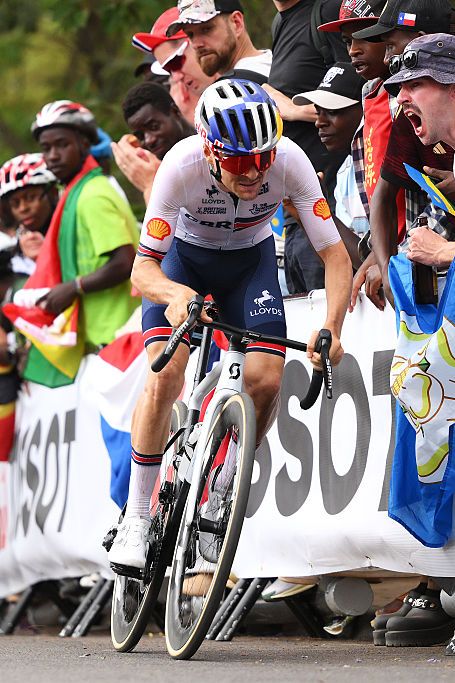
Tom Pidcock will lead the Elite Men’s team for Great Britain
(Image credit: Getty Images)
Tom Pidcock
Great Britain
27
Previous best: 6th, 2021
Just weeks after sealing a second career Worlds mountain bike title, Tom Pidcock is back on the road and on a mission to make history – to follow in the footsteps of Pauline Ferrand-Prévot, and become the first man to be crowned World Champion at mountain biking, cyclo-cross, and on the road. For many years we’ve known Pidcock to be one of the great multidisciplinarians in cycling’s history, but he’s yet to quite scale the great heights he has at the other two on the road, and that’s the title he needs to complete the set.
He’s due a big win on the road, having not won at World Tour level for almost 18 months, and there’s reason to believe that this year’s road Worlds might be the one. The form is promising, with a victory in his first race (GP Industria & Artigianato) back on the road since the Tour de France, and two top tens at the GP Québec and Montréal. The latter using a very similar course to the world champs.
Pidcock will be supported by Adam Yates, Fred Wright, Oscar Onley, James Shaw, Mark Donovan and Finlay Pickering
Isaac del Toro
Mexico, 22
Previous best: 7th, 2025
The only man to have won more races than Isaac del Toro since the start of last season is his trade teammate Tadej Pogačar, and the 22-year-old Mexican has rapidly established himself as one of the peloton’s elite. He has everything it takes to excel on a course like Montréal – proven by his win at the GP last weekend. With an explosive turn of speed and excellent climbing ability, the only question mark is whether his Mexican team of inexperienced, non-World Tour riders is strong enough to support him. If they can get him deep into the race with minimal energy expended, he has a great chance of becoming the first ever Latin American rider to win a World road race medal.
Paul Seixas
France, 20
Previous best: 13th, 2025
Set to compete a mere three days after his 20th birthday, if Paul Seixas wins in Montreal, he would become the youngest ever road world champion. The Frenchman has already made a mockery of conventional wisdom concerning what’s possible for so young a man to achieve, this season finishing second at both Liège-Bastogne-Liège and Strade Bianche behind Tadej Pogačar, and placing fourth on a Tour a France debut many believed he wasn’t ready for. The French have already masterminded two golds and a silver since the 2020 Worlds, plus an Olympic silver and bronze, and have a genuine shot at gold with Seixas.
Wout van Aert
Belgium, 32
Previous best: 2nd, 2020, 2023
Belgium will be the strongest team at the Worlds, and once again led by the deadly duo of Wout van Aert and Remco Evenepoel. The pair haven’t always got on swimmingly, but have developed their relationship over the years to combine with devastating effect, Van Aert playing a key role in Evenepoel’s golds at the 2022 Worlds and 2024 Olympics. Is this the turn of two-time silver-medallist Van Aert? Given the parcours, his recent fitness and winning form at the Vuelta, the absence of Tadej Pogačar, and the fact he’s now 32 years old, you sense this might be the best chance he gets.

(Image credit: Getty Images)
Demi Vollering
Netherlands, 29
Previous best: 2nd 2023
When Demi Vollering lines up in Montreal, she has the chance to elevate what has already been an exceptional season to one of the all-time greats in cycling history. Having cleaned up in the Spring Classics, where she won, among others, the Tour of Flanders and Liège-Bastogne-Liège, Vollering went on to claim both the Giro d’Italia and Tour de France titles, meaning she now has a shot at becoming only the fifth person and second woman (following Annemiek Van Vleuten four years ago) to win the Triple Crown.
The Worlds have never been the happiest of hunting grounds for Vollering, whose only medal in the road race came in 2023 when she was second behind Lotte Kopecky. Her frustrations have been part of a lack of cohesion in the whole Dutch squad, which, despite invariably boasting the most talented line-up, are now in danger of going four editions without a gold medal, which would be their longest streak since 2010. They’ve frequently let themselves down by failing to work as a team and playing too many games, but this year, given the parcours and the season she’s had, the tactics should be simple: all rally behind delivering Vollering gold.
Elisa Longo Borgini
Italy, 34
Previous best: 3rd, 2012, 2020, 2024
A rainbow jersey is threatening to become the white whale in the otherwise illustrious career of Elisa Longo Borghini. Though the 34-year-old has won the Tour of Flanders, Strade Bianche, Paris-Roubaix and the Giro d’Italia, and come home with a bronze medal three times, a Worlds gold medal remains elusive, and she’ll line up in Montreal for a 15th attempt. Backing her will be a strong Italian team, and the punchy terrain is in her favour, while she seemed to put the fitness problems that have plagued her for much of the season behind her at the Tour de France to make the podium.
Kim Le Court
Mauritius, 30
Previous best: 8th, 2025
Few if any riders competing in Montreal can claim to be in the running for an achievement that would not be the biggest for their nation in cycling, but of any sport. However, victory for Mauritian Kim Le Court would arguably be that. She’s already put the Indian Ocean archipelago on the map by wearing the yellow jersey at the Tour and winning Liège-Bastogne-Liège, and should excel on this route, where her punchy accelerations and quick finish will be lethal weapons. She’ll lack support from her team, but brings great form to the race having won the Tour of Britain.
2026 UCI Road World Championships: Road race routes
If you’re a fan of the annual GP Montréal men’s WorldTour race, much of the elite Worlds races are going to look very familiar. That’s because they will use the same Mount Royal course in the Quebecois city centre as the annual Canadian one-dayer.
It’s a lumpy 13.4km circuit around Mount Royal Park, which the women will tackle eight times, the men 12. Unlike the GP Montréal though, which was held last weekend, the Worlds courses have a significant lead-in before beginning the first full lap of Mount Royal. This amounts to around 60km for the women, 112km for the men and will bolster the full course distances to 180km and 273km respectively.
That is the longest ever women’s Worlds by some margin, following a UCI rule change last year allowing longer races for women.
The lead-in starts just across the city’s St Lawrence river in Brossard and loops north and back before crossing the water and meeting the finishing circuit. It’s almost pan-flat, with all of the considerable climbing metres to be done in the confines of Mount Royal Park. The only exception to this is the small climb of Mont Saint Hilaire, tackled by the men halfway through their lead-in.
The total ascent for both men’s and women’s is significant, with the women climbing 2,570m and the men, 3,808m – both comparable to a day in the mountains on a Grand Tour. But this is a different proposition, with the constant rising and falling meaning a constant on/off pressure that will slowly sap even the strongest of legs.
There are four of those ‘rises and falls’ in Mount Royal Park, the biggest being the Voie Camillien Houde, at the foot of which the race will finish. This will do much of the damage, but the smaller rises of the Chemin de Polytechnique, Avenue Pagnuelo and Avenue du Parc, rising to the finish, will undoubtedly sap the legs like only a major one-day race can.
It’s a course where climbers and big engines meet in the middle, meaning there is a wide spread of riders who will feel they have a chance to medal.

(Image credit: UCI / 2026 world championships)


2026 UCI Road World Championships: Time trial riders to watch
Marlen Reusser
Switzerland, 34
Previous best: 1st, 2025
It’s serendipitous, really, that Marlen Reusser’s 35th birthday falls on the day of the time trial, but what better way to celebrate than defending her 2025 crown?
The Swiss rider is undoubtedly the time trial favourite in Montreal. She’s won six of the last seven individual time trials she has competed in, and came second in the other, and only because it was all uphill. Victory in Canada would cap a fine season for Reusser, who had stitches in her knee after crashing in February, but went on to wear yellow for three days at the Tour de France Femmes, after she won the TT in Dijon on stage four. It wasn’t quite a crushing margin, just four seconds over Lieke Nooijen, but it didn’t need to be, she wins time trials. For such a dominant time trialist, it is odd, then, that the Swiss has only ever won one world title, after four European crowns; that has partly been down to misfortune and illness, with Reusser missing out on her home Worlds in 2024 due to a long-term virus.
Zoe Bäckstedt
Great Britain, 21
Previous best: n/a
She won the junior time trial world title in 2022, the under-23 one in 2025, and now Zoe Bäckstedt is looking to complete the set with her first elite rainbow jersey.
The 21-year-old proved her pedigree against the world’s best when she finished fourth in August’s Tour de France Femmes time trial, won by Marlen Reusser. That result came after four victories against the clock this season, including the national title at home in Wales. Realistically, a podium place would be impressive for Bäckstedt. Against a rider as dominant as Reusser, second might feel like a victory.

(Image credit: Getty Images)
Remco Evenepoel
Belgium, 26
Previous best: 1st, 2023,24,25
Perhaps the greatest time triallist of all time, Remco Evenepoel is going for his fourth world title in a row, and only a fool would bet against him. He’s a major contender for the road race too.
The Belgian comes into this year’s championships at the end of what has been one of the strongest seasons so far in his career. He has picked up major results all the way through; after winning the Amstel Gold Race in April, he went on to place second at the Tour de France, taking back to back stage victories along the way, including in the stage 16 time trial to Thonon les Bains, where he dished out a solid beating of Tadej Pogačar, putting 28 seconds into the Slovenian over 26.1 rolling kilometres. Evenepoel, who is still just 26, then went on to win the San Sebastian Classic in Spain, for the fourth time.
In a men’s cycling landscape so heavily dominated by the brilliance of Pogačar, Evenepoel is a rare beast in that, when it comes to time trials at least, the Belgian can be expected to prevail when the pair go head to head. He has made the discipline his own and can be expected to win on anything from hilly to flat courses. The Montreal course falls into the latter category – except perhaps, for the small rise up Avenue de Parc in the final two kilometres.
Filippo Ganna
Italy, 30
Previous best: 1st, 2020,21
Say the name Filippo Ganna, and immediately time trialling springs to mind. There is very little that the affable Italian has yet to win in the discipline. A former double world champion, he is also a perennial winner of Grand Tour TTs, and even holds the World Hour record – one of the most prestigious accolades a rider can pick up against the watch. However, unlike his rival – nemesis, even – Remco Evenepoel, he has yet to win an Olympic gold, something the Belgian beat him to last time out in Paris.
There will be those who point out that it has been five years since Ganna last won a time trial rainbow jersey, with Evenepoel since forcing him down the pecking order. He has come close to reclaiming the title more than once, but the Belgian has always been standing in his way, pipping him into second place at the Worlds in 2023 and 2024. However, this year’s route offers a chance for Ganna to get his own back; there are no significant climbs, and the long stretches on highways are ideal for his strong, rangey build. It’s almost as tailor-made for Ganna as a designer suit out of Milan.
The Italian has won five times this season, four of which came against the clock. At the Giro d’Italia, he set a new speed record for a Grand Tour time trial over 40km, barrelling at an average of almost 55kph. This course may be a few hundred metres shorter, but it suits him nonetheless.
2026 UCI Road World Championships: Time trial routes
For the first time in four years, both the elite women and men will race the same distance in the individual time trials at the UCI World Championships. Now, though, the organisers have decided to go longer, nudging the number of kilometres from 34.2 in Wollongong, Australia in 2022 to 39.2 in Montreal – it’s the longest course the women have ever faced since time trialling was introduced to the championships in 1994.
The elite women’s race against the clock once again acts as the curtain raiser, and will give us a first look at the route. Starting outside the Percival Molson Memorial Stadium, home to the Montreal Alouettes football team (that’s Canadian football, not soccer), the course tips downhill through the city’s old town and into the port. The riders will then head south on Highway 10 along the bank of the St. Lawrence River, before crossing over the narrow ‘Ice Control Structure’, a bridge built in 1965 to control the flow of ice blocks – temperatures may be in their mid-teens in Montreal in September, but they can drop to around -25°C in the depth of winter.
From kilometre 13, the next 3km north along the river come on a canal path that, unless its been relaid with tarmac, will give the riders an unwelcome gravel stint. This cramped road leads into the most technical part of the course: a twisting 8km loop around the Gilles Villeneuve motor racing circuit, with kinks and U-turns that will slow the most powerful riders down to a grind.
After tracing back up through the port, the course reaches its finale with its only significant climb. Unfortunately for the riders, this comes at the very end, when their energy reserves will be at their lowest. The 2km drag isn’t the steepest, barely eking over 7%, but as it creeps up to the line beyond the football stadium, it will feel like an eternity.
It’s the same finish for all the time trials, including the junior, under-23 and mixed relay events. The latter sees three men and three women take on a 40.6km course, each trio completing 20.3km.

(Image credit: UCI / Montréal 2026)


Explore More
