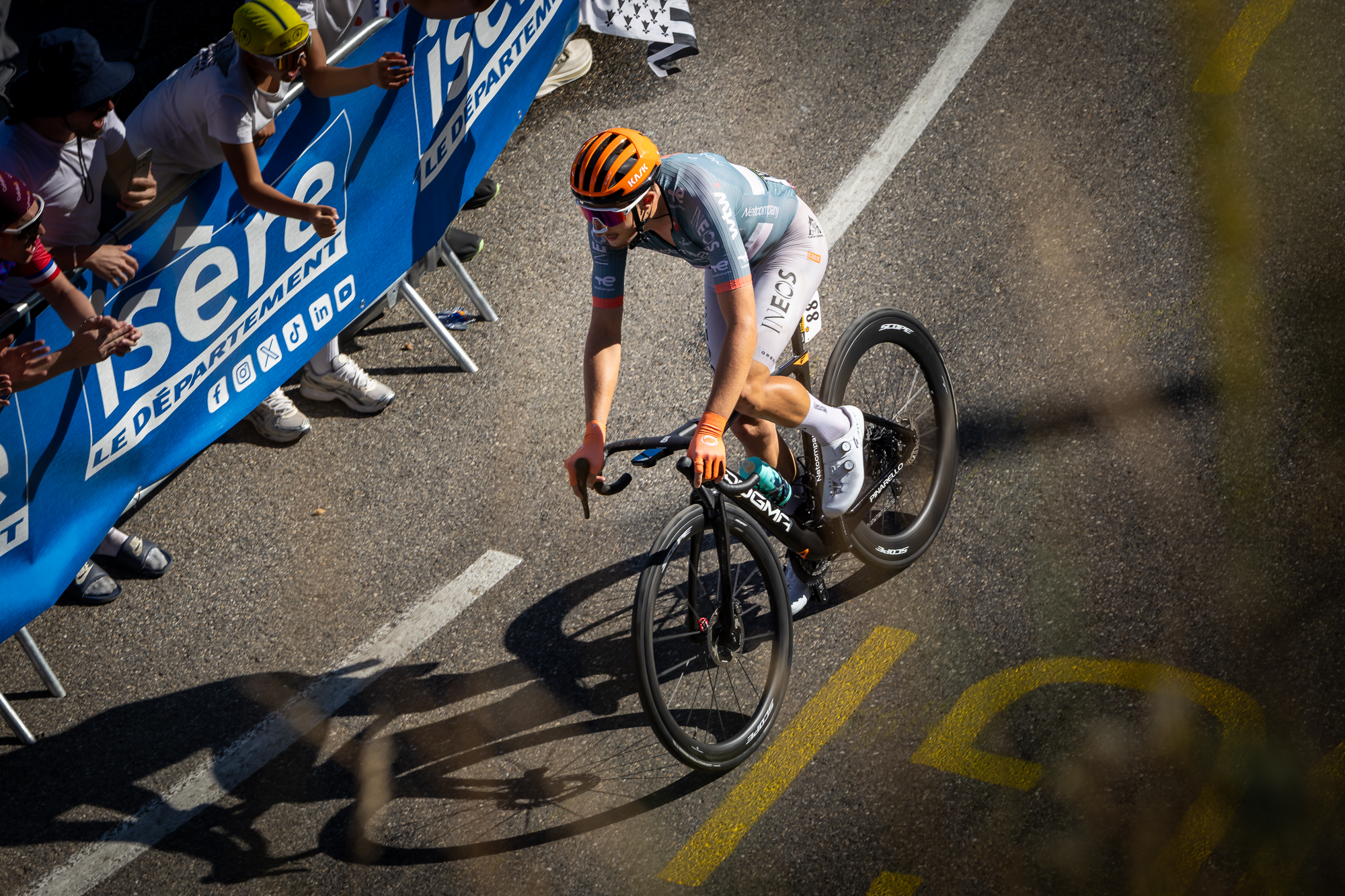
Not all of you will have heard of Scope Cycling, the Netherlands-based wheel brand, but it produces a range of premium-priced, high-quality wheels with lots of technical innovations intended to increase speed and lower weight, a goal most of the best road bikes wheels seek to achieve.
Scope offers three distinct road wheel ranges: Sport, Race and Artech in a variety of depths, with Artech being the most technologically advanced. Scope also makes all-road, gravel and triathlon wheels.
Ineos Grenadiers used Scope wheels in the 2026 Tour de France
(Image credit: Tim Russon)
It’s worth noting that Ineos Grenadiers, a team not known to take their equipment choices lightly, use Scope Artech wheels on their Pinarello bikes in the WorldTour, lending further cachet to the brand and its products.
Latest Videos FromCycling Weekly
Design details
As you’d imagine for a set of professionally endorsed wheels, there is a lot to talk about with the Artechs. The first thing that caught my eye on spec sheet was the rider weight limit, or the lack of it. Most high-end wheels I can think of have a system weight limit somewhere around 110-130kg, and super lightweight wheels are often less than this; for example Hunt’s 963g Hill Climb SL Disc wheelset is limited to 95kg (and is for tubular tyres), yet the Artech 2.0s have no weight limit at all and are tubeless-ready with hooked rims. Impressive.
Even more impressive is the wheelset’s claimed weight of 965g; the test set tipped the scales at 981g including rim tape, so the 965g claim is totally believable.
The Artech range all feature a very distinctive 3D ‘fish scale’ pattern on the rims, said to increase aerodynamic efficiency and reduce drag, although with only 22mm of rim depth to play with I’d imagine the effect on the Artech 2s is minimal. The blunt rims have an internal width of 23mm, and look almost semi-circular in shape, with their 28.8mm external width. Scope says that they are optimised for 28mm tyres.

Carbon spokes, recessed nipples and fish scale design all help reduce drag and weight
(Image credit: Tim Russon)
Straight-pull, bladed Carbonlite Aerospokes lace the rims to the hubs, with 18 at the front and 24 at the rear. These are laced in a radial pattern on the non-disc side at the front and crossed elsewhere and the nipples are hidden in the rim.
The hubs have a unique, almost organic look, with soft, curved spoke structures that reminded me of coral. Made from Scalmalloy, a high-strength aluminium-magnesium-scandium alloy, using 3D printing, the outer surface is textured rather than smooth. Internally, a 36T ratchet system provides the drive, with titanium parts to keep the weight down. Thirty-six teeth on the ratchet seems a bit miserly, though at this price, when rival wheelsets offer 54 teeth or more for quicker engagement, and if you want CeramicSpeed bearings, then you’ll have to dig a little deeper in your wallet to the tune of another £500.

Organic-looking Scalmalloy hubs and lightweight freehub
(Image credit: Tim Russon)
The wheels come with padded bags and a pouch containing cleaning products, a spoke/nipple key, and a 5.5mm wrench. All standard freehub options are available, and you can choose black or white decals.
For the same price and just a 30g penalty, the Artech 2.A (for All-road) wheels offer 3mm more inner rim width, designed for 30mm+ tyres.
Performance
A headline figure of 965g is obviously impressive on paper, but the reality of lifting the wheels out of the box was still incredible. I’m not a particularly heavy guy at 73kg, but it was hard to believe that these wheels would support me and my bike. They felt unbelievably light while still exuding quality, which eased most of my irrational trepidation.
A dream trip to France to ride a bunch of big cols and watch the Tour de France race up Alpe d’Huez twice was the ideal testing ground for the wheels, and while I was never going to trouble any KOM leaderboards, I hoped that the lightweight Artech wheels would offset a lack of fitness and training. As a comparison, I also took a set of still-light Oquo RP50LTD CS wheels, which, at just over 1,300g, still gave away almost 400g to the Scopes.

Perfect for the Col du Galibier
(Image credit: Steve Leyland)
With 28mm Pirelli Race RS tyres, TPU tubes and a 34T cassette fitted, the Aretchs dropped the weight of the Handsling A1R0evoS to a UCI-bothering, Alp-flattening 6.45kg! I was less taken with the aesthetic effect on my bike, though; skinny wheels on an aero-tubed carbon bike look a bit wrong and unbalanced, but hey, you can’t see the wheels when you’re riding it.
If I had to describe riding the Artechs in one word, it would be ‘lively’. Uphill, there is no substitute for carrying as little weight as possible, and with the Artechs, every pedal stroke, in or out of the saddle, caused a discernible acceleration; the steeper the road, the more noticeable the effect. Velocity changes were instant, even with my meagre power, and the rewarding feeling of each watt heading straight onto the tarmac was addictive, and even encouraged me to vacate my saddle and stand up just to enjoy the sensation further. The wheels didn’t make the Col de la Loze, the Galiber or Alpe d’Huez any shorter, but they certainly made them slightly less painful and more enjoyable.

Even I was encouraged out of the saddle by the Artechs
(Image credit: Steve Leyland)
The wheels were slightly less enjoyable when descending, as the liveliness continued. This isn’t Scope’s fault, but that of physics: a very light wheel provides less gyroscopic stability than a heavier one, and this was noticeable when riding downhill. Small inputs affected the bike more than they did with the deeper, heavier wheelset. The handling never became problematic, but the difference was tangible, and I preferred the feel of the heavier wheels when heading down; these aren’t wheels that carve or flow easily downhill. Of course, the 22mm rims don’t catch the wind, though, so there is a potential handling benefit there to offset the lack of mass.

Riding downhill took a little more concentration due to the low weight
(Image credit: Tim Russon)
While the wheelset’s stiffness helped on climbs, it was also a bit less compliant than I expected. With a shallow rim and long spokes, you’d expect lots of comfort, but the carbon rim/carbon spoke combo of the Artech 2s proved to be pretty stiff, especially combined with the 28mm tyres.
I think if I were buying these (or any of the Artech range), then I’d look at the All-road versions for the extra rim width and consequent tyre volume in order to better combat ‘modern’ road surfaces. This would allow for all the performance inherent in a structurally stiff wheel but add in some extra compliance for comfort on poor roads – Andy Turner tried the deeper, 1,200g Scope Artech 4.A wheels with the extra width and found them to offer plenty of comfort.

(Image credit: Kim Russon)
For such a light object, the rear wheel doesn’t half make a racket. The freehub is, without doubt, the loudest I’ve encountered, knocking Chris King, Hope, DT Swiss and Scribe into a cocked hat. While riding, the choice was clear: freewheel or chat; you couldn’t do both. Ineos Grenadiers group training rides must be deafening!
As well as riding them in the high Alps, I also managed to fit in a quick test on the more prosaic hills of the Peak District on my usual Tuesday night group ride. Here, the wheels continued to impress with their responsiveness and ease of acceleration on steeper gradients, but the poor UK road surfaces emphasised their relative lack of compliance, and there were a few comments about the volume of the freehub.
Value
Riding the Artech 2s in their natural home was amazing and underlined the tangible difference between light and really light wheels. When climbing, the instant response each pedal stroke elicited was amazing, and when descending, the extra friskiness was exhilarating but not necessarily relaxing.

(Image credit: Kim Russon)
While I doubt the small area of fish scales afforded by the shallow rims benefited me much, the innovative design and construction of the hubs help explain the £3,500/ $4,398 asking price. Add in the incredibly low weight and lack of rider weight limit, and the Artechs are undoubtedly an impressive set of wheels.
At this price, value is almost irrelevant, but for the record, Princeton CarbonWorks, Lightweight, and Enve all make more expensive wheels. I suspect that if you are considering spending the price of a decent bike on a set of fairly specialised wheels, then you are well aware of their value to you, but the Scope Artech 2s are clearly well made, super light and very strong with some interesting tech.
Necessary? No, but lovely nevertheless.
Tech spec
- Price: £3,500/ $4,398
- Weight: 981g (actual, w/ rim tape)
- Hubset: Artech 3D printed
- Freehub options: Shimano HG11/12, SRAM XDR, Campagnolo
- Rim depth: 22mm front/rear
- Rim width: 23mm internal
- Spoke count: 18/24 front/rear
- Rim: Hooked
