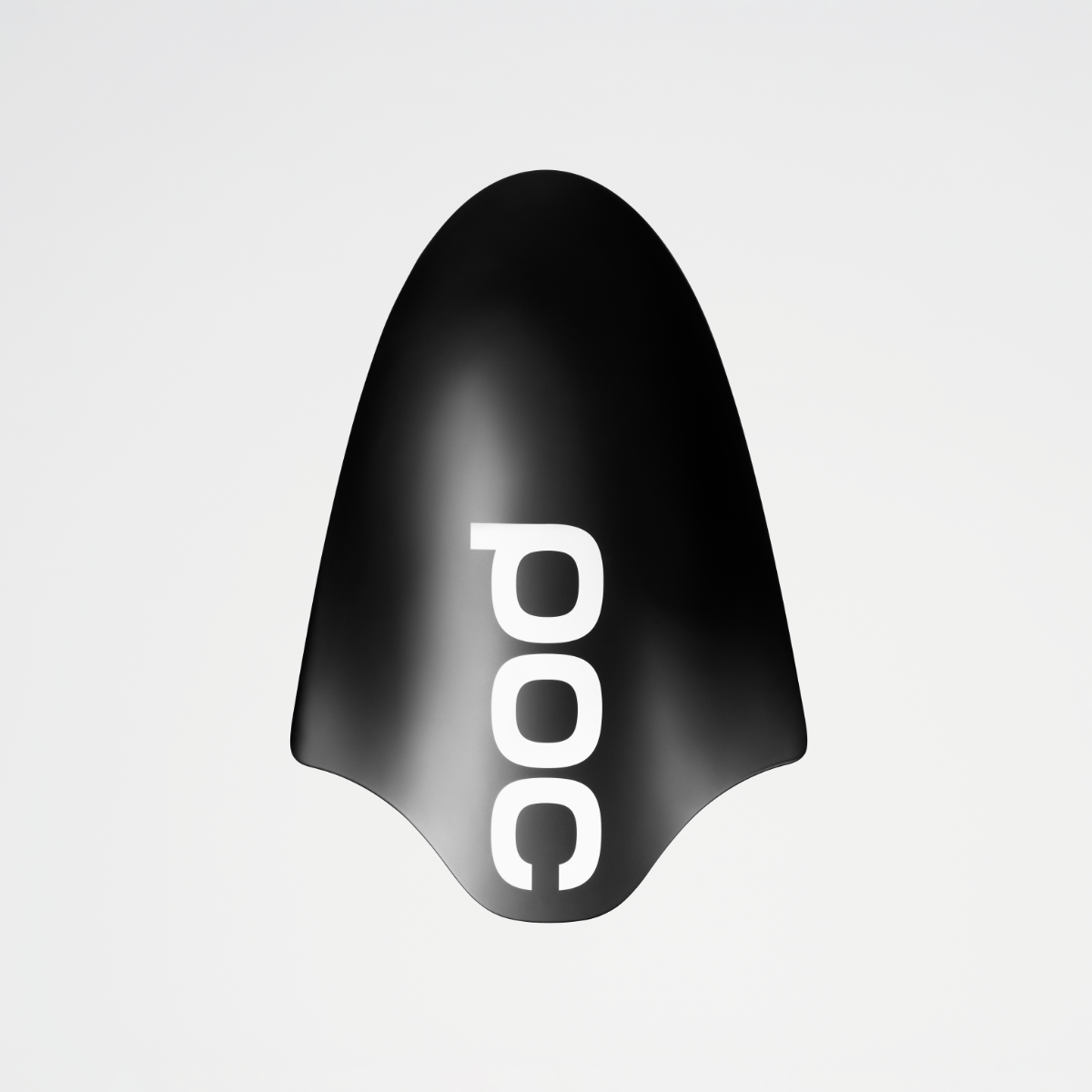
POC has finally launched a suitably radical successor to the Tempor, the time trial helmet that started an aerodynamic revolution when it debuted at the London Olympics back in 2012 – and was possibly the first to be compared to Spaceballs on social media.
The Swedish brand’s headline claims for the new Sonal, which was used by EF Education-EasyPost in the Tour de France, are a 15-20 watt saving at 60km/h and a lower weight, but the most groundbreaking is that it comes in two shell widths so that both narrow- and wide-shouldered riders can achieve as optimal an aero profile as possible.
POC doesn’t claim it, but this must be the first TT helmet that comes in different shell sizes for the same head circumference. Our Tech Editor Aaron Borrill has been riding the medium over the tail end of his TT season.
Latest Videos FromCycling Weekly
(Image credit: POC)
There will be more Spaceballs comparisons, but POC is better than most people realise at explaining the real science behind the sci-fi aesthetics. Before the Tempor, time-trial helmets were teardrop-shaped almost without exception, with long, tapered tails that released airflow smoothly off the back of the rider’s head. Additionally, a lower-volume helmet was considered to be better simply because it was a smaller object to push through the air. But POC’s approach with the Tempor was to make the helmet an integral part of the rider’s overall profile rather than treating the head as an isolated object.
It was big and bulbous instead of sleek and long, and POC admits it took time for the Tempor to win over doubters. It was ridiculed, and Gustav Larsson, with whom it was developed, finished only 16th in the 2012 Olympic time trial, four minutes behind gold medallist Bradley Wiggins, who was wearing the classic teardrop design.
The Tempor seemed in danger of falling out of favour with the pro racing world (although it was always loved by the UK time trial scene) and POC played it safe with the stubby, more versatile Cerebel in 2014. Then Dan Bigham revived the Tempor in the latter half of the decade with his HUUB-Wattbike track team, winning national and international team pursuit titles and then using it with the Danish quartet when he masterminded their world record-breaking ride in 2020.
So POC relaunched the Tempor and rival helmet brands responded with similar designs with larger frontal profiles as the idea of making the head an integral part of the rider’s whole profile became mainstream.
The next giant leap came when Giro unveiled the Aerohead II at Paris-Nice in 2024: an enormous nosecone design that pushed the outer limits of the UCI’s bounding boxes and elicited a similar reaction to the POC Tempor 12 years earlier.

(Image credit: POC)
Perhaps POC should have been first to punch that particular missile-shaped hole through the air, but the Sonal looks likely to have made up any lost ground with its elongated front and contours at the side and rear, which closely follow the human body, and it may well have gained some ground by offering two shell widths.
As is now well understood, there’s no absolute fastest helmet – their aerodynamic performance is very dependent on the rider’s individual body shape and position on the bike. A helmet that’s fastest in the wind tunnel for one rider might not be fastest for the next, but by offering two shell widths, the Sonal is designed to test faster for a broader range of riders. POC says: “Results from testing with the [EF Pro Cycling] riders show that with both widths of the Sonal there was a significant improvement in aerodynamic performance. Tested against the already very fast POC TT helmets and at speeds we typically see in modern TT and track events, 60kph, the Sonal delivers average savings of 15 to 20 watts.”

(Image credit: POC)
POC advises riders with shoulders narrower than 37cm to choose the narrow size, while those with shoulders wider than 37cm should choose the regular size. Measurement is taken at the outer shoulders in a TT/aerodynamic position.
Both the narrow and regular width shells share the same internal helmet size, spanning head circumferences 51-59cm – covering most small to medium-size heads. This means riders get a shell matched to their shoulder width without worrying about head-size fit separately.
The Sonal is built to international protection standards and certified to EN and CPSC. POC also says that the wider form and internal structure, which are optimised for deformation in a crash, also provide an additional safety buffer. There’s no Mips rotational impact protection system.

(Image credit: POC)
Despite the larger surface area, the Sonal is relatively lightweight at a claimed 440 grams for the narrow and 490 grams for the large. The Tempor is 520 grams and the Giro Aerohead II 570 grams.
It’s available in ‘Hydrogen White’ and ‘Uranium Black Matt’ and it’s priced at €600/ £550 / $660. That’s a little bit more expensive than the Aerohead II but below the Kask Mistral 3.0, as worn by Filippo Ganna.
POC Sonal – first ride impressions
Tech Editor Aaron Borrill has been testing the POC Sonal – here are his initial thoughts.

(Image credit: David Collard-Berry)
I first caught a glimpse of the POC Sonal at the Tour de France Grand Départ, where it was being field-tested in the wild by EF Education-EasyPost on Stage 1’s team trial in Barcelona. As an ardent time triallist and resident tester here at Cycling Weekly, I managed to twist POC’s global director of PR Damian Phillips’ arm and had one delivered to my house just a few days later.
Having spent much of the early TT season using the Giro Aerohead II Mips, it was an easy transition as the two share some design similarities – the front overhang and elongated proportions. The big difference between the two helmets is the weight: the Sonal is lighter (my medium weighed 435g) and doesn’t feel as pronounced or weighted when lifting the head or moving side to side. The fit is good, too, and tailorable via the retention dial at the rear.
Damian made a point of emphasising the two size options – regular and narrow (riders with shoulders narrower than 37cm), which has aerodynamic and fit implications should you get that wrong. With medium-sized shoulders, I opted for the regular version, which fits my shoulders and back almost perfectly. It’s worth noting that time trial helmets don’t fit like regular helmets, and you’ll need to position it so that you’re looking just over the bottom of the visor when in the time trial position. Often, this means the visor is sitting well above your field of view when you’re standing, almost tilted backward. You’ll need to experiment with this so the tail and shoulder interface aligns as intended when stretched out in the extensions.
If there’s one area I’d like improved, it’s the helmet strap and buckle system. I’m a big fan of magnetic buckles and would like something like this included on the Sonal in the future. That said, the straps are easy to manage with no flappy ends – once you’ve arranged the straps to fit your chin, any excess strap can be doubled over and inserted into the fabric keeper.

(Image credit: Dean Johnston)
In terms of performance, it’s hard to quantify whether the helmet truly is as fast as claimed. Without empirical testing in a wind tunnel, this would be guesswork, but it does require a disciplined position, as the long tail and elongated front/rear design will act as an airbrake if you’re moving about and not locked in. Of the six open time trials I’ve used the Sonal for, all of them (bar one) felt incredibly fast. I’ve managed a 25-mile personal best and recorded four sub-20 10-mile times, including two course personal bests and my first sub-20 minute Bentley 10 on the H10/8 in Hampshire, known for its wind-exposed layout and grippy and challenging surface. The one occasion I struggled was in heavy, turbulent crosswinds where I felt the helmet catching the wind. As such, I’d personally only use the Sonal in conditions where there’s a block head or tailwind, or if the wind is calm to mild.
I’ve got two more time trials remaining, including some testing with AeroSensor in the coming weeks, after which I’ll file my final thoughts and write the review.
