The Garmin Forerunner 970 is described on the brand’s website as a premium running watch. In big letters. Accompanied by prominent images of athletes running. So, why am I reviewing it for Cycling Weekly? Well, despite its name and Garmin’s product positioning, it’s actually a highly capable multisport watch, so I was curious to discover whether we can judge it one of best smartwatches for cyclists.
Launched in May 2025, it’s certainly not just a running watch that happens to support a few other sports as a token gesture. Without exception, its sports profiles reach far and deep; including every activity you can think of from sail racing to snowmobiling. In fact, as I’ll come on to, its cycling profile has pretty much the same functionality as one of Garmin’s high-end Edge head units, such as the 850.
The Forerunner 970 is much more than a runner’s watch that happens to support a few other sports. Its capabilities as a cycling computer run deep.
(Image credit: Simon Fellows)
However, what makes 970 especially compelling is how it tracks your performance, recovery and wellness when you step away from the bike to dive into the pool, sprint on your favourite running trail or collapse into bed. It promises to monitor, support and coach you holistically 24/7, which is appealing for those who throw themselves into multiple sports, triathletes especially. There is a catch, though – to get the most from this watch, you have to commit to wearing it all the time. That makes daily comfort and styling less of a preference and more of a non-negotiable.
Latest Videos FromCycling Weekly

It offers what no head unit can: it tracks your performance and recovery needs 24/7.
(Image credit: Simon Fellows)
As well as cycling, I swim on a daily basis and hill walk two or three times a week, so despite not being a runner, I’m a good candidate for the Forerunner 970. Up until recently, its predecessor, the Forerunner 955 Solar, remained on my wrist, day and night, for more than two years.
Design details

There are a large number of ‘watch face’ designs available via Garmin and third-party designers. These can be a veritable dashboard of metrics, but I like to keep things simple, with a classic analogue-style display.
(Image credit: Simon Fellows)
The Forerunner 970 packs such comprehensive functionality that calling it feature-rich is like calling Jeff Bezos comfortably off. There’s an absolute wealth of utility here. The full list of activity profiles – sports modes – is so comprehensive it verges on the ridiculous. In a good way, of course. The primary categories are Running, Cycling, Swimming, Multisport, Gym, Outdoor, Winter Sports, Water Sports, Team Sports, Racket Sports, Motorsports and Other.

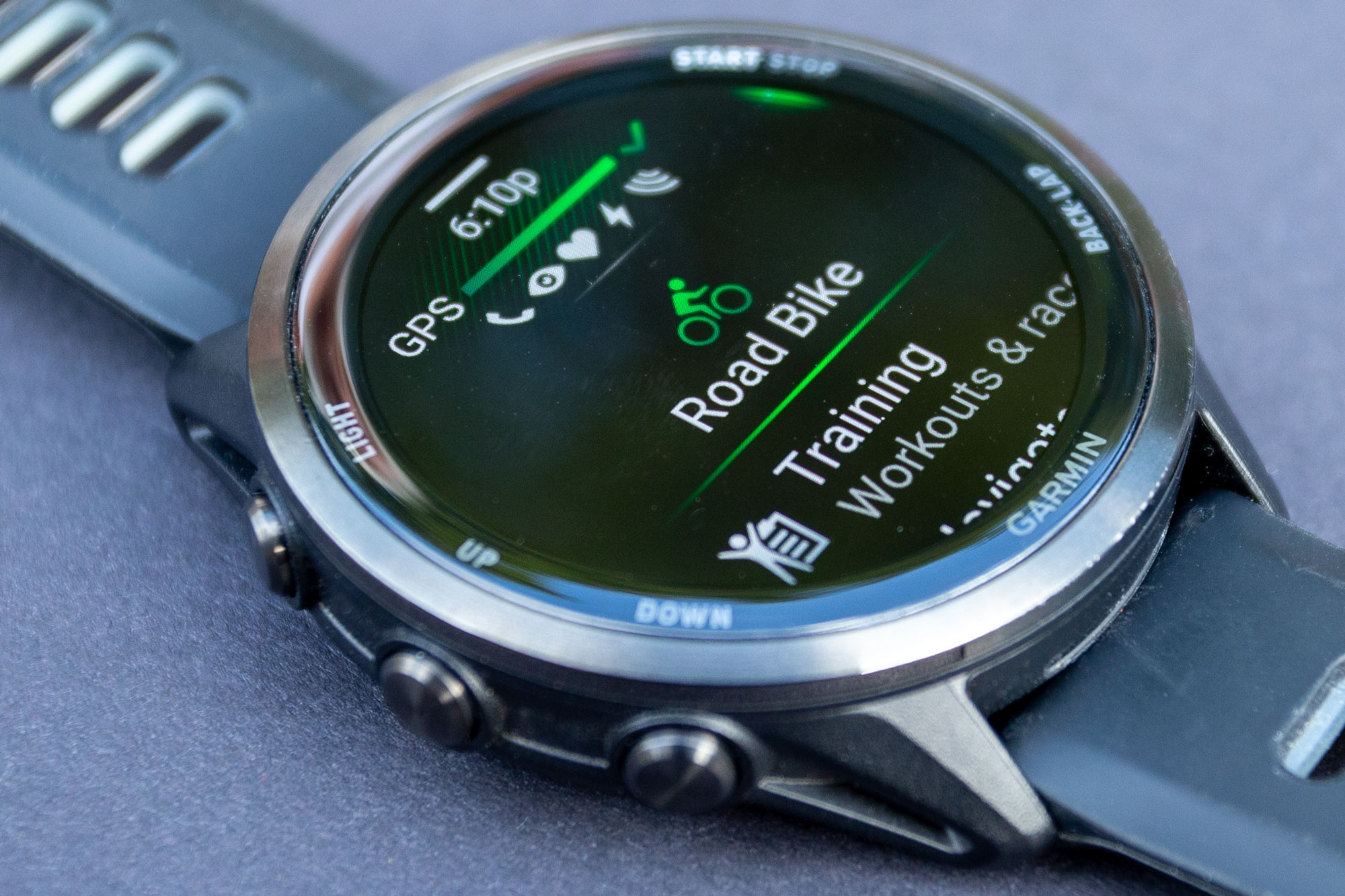
My most-used activity profiles. The UI is slick, and the bright, colourful screen is legible under any conditions.
(Image credit: Simon Fellows)
Within each category sit a plethora of sub-categories. Under Cycling, for example, you’ll find Bike, Bike Commute, Bike Indoor, Bike Tour, BMX, Cyclocross, eBike, eMTB, Gravel Bike, MTB and Road Bike. Each has associated data fields, some specific – grit and flow for mountain biking – and some shared. Naturally, metrics such as Time, Distance, Elevation, and Heart Rate are core to many activities. Garmin occasionally adds profiles as part of its regular firmware rollouts, so it’s hard to be definitive about the absolute number that exists. However, when I last counted, there were 99.
Data can be analysed on the watch or using Garmin Connect – the brand’s combined analytics engine and user dashboard – on mobile or desktop devices. The Forerunner 970 is great at reporting a week’s worth of data, but with Connect, or the paid-for Connect+, it’s possible to reach back years. If benchmarking performance over time is important to you, Connect enables much deeper analysis.
The watch case is made from fibre-reinforced polymer, with a titanium bezel, sapphire crystal lens and a silicone strap. Generally, the look is very understated, but to appeal to the more flamboyant cyclist, Garmin produces three colour variations: Carbon (charcoal black), with a carbon grey DLC titanium bezel and black/Whitestone (off-white) strap; Whitestone, with a natural titanium bezel and Whitestone/yellow strap and French Grey with a gold titanium bezel and a French Grey/indigo strap. The secondary strap colours are translucent and sit beneath the band, next to the skin, so providing the merest hint of colour.

The 970 is a relatively plain-looking watch. More flamboyantly coloured straps are available and, of course, you can customise the face.
(Image credit: Simon Fellows)
If you want to pimp your 970 further, Garmin offers a huge number of coloured strap options, either at point of sale or as an aftermarket upgrade. Last time I checked, it listed 69 on its site, mostly silicone but with some cool nylon webbing options available, too.

The Forerunner 970 features a sapphire crystal lens, which gives it a glossier appearance than its predecessors. The bezel is metal – titanium, in this case – too, which does exhibit minor scuff marks.
(Image credit: Simon Fellows)
Multiple upgrades mark the 970 as a cut above its immediate predecessor, the Forerunner 965 (circa 2023) and my Forerunner 955 Solar (circa 2022). Firstly, the touchscreen is now made of sapphire crystal rather than Corning Gorilla Glass. I found the Gorilla Glass on my 955 to be extremely resilient, but sapphire crystal is virtually scratchproof, even if it is slightly more reflective in harsh sunlight. Garmin, of course, dropped solar from the Forerunner range with the introduction of the 965.
A more significant upgrade is the display technology. Garmin received a lot of flak for embracing a supremely colourful Amoled display for the 965, because many found it much harder to view in bright conditions than the 955’s transflective memory-in-pixel (MIP) display. The 965 may have been richer in colour and more vivid, but ultimately less legible in testing conditions. Garmin has countered such complaints by maintaining the 965’s 454 x 454-pixel resolution but significantly increasing the 970’s display brightness.

The 970 has Garmin’s Elevate Gen 5 optical heart rate sensor array, which provides enough accuracy for it to function as an ECG monitor. Note the proprietary power socket.
(Image credit: Simon Fellows)
Another headline upgrade is the inclusion of Garmin’s Elevate Gen 5 optical heart rate sensor array with integrated metal sensors, which fully supports FDA-cleared/medically certified ECG recordings directly on the watch, as well as skin temperature readings. Flip the watch over, and you’ll find an array of six LED’s, up from four. This development promises to deliver more dependable heart rate readings. It has always been a challenge for wrist-based sensors to match the performance of highly accurate yet unwieldy chest straps.
It’s worth noting that although the Elevate Gen 5 optical heart rate sensor can detect and report episodes of Fibrillation (AFib), this only occurs during a manual trace. Unlike some of its competitors, it cannot detect or warn of rhythm irregularities on the fly.

The Forerunner 970 benefits from a proper speaker, which, in combination with its mic makes voice calls possible.
(Image credit: Simon Fellows)
The Forerunner 970 now features a built-in speaker and microphone, bringing voice calls, voice commands, and access to a voice-activated smartphone assistant to your wrist. It doesn’t work as a standalone cellular device in the way that cellular Apple iWatch models do, but you no longer have to fish your phone from your jersey back pocket to answer a call. The speaker also enhances spoken navigation prompts.

The flashlight is one of my favourite features. I use it frequently.
(Image credit: Simon Fellows)
Perhaps not quite as technically impressive, yet nonetheless a bright idea from Garmin, is the tiny LED flashlight that’s integrated between the lugs at the top of the case. It’s positioned here so that it shines forward when you raise the watch in front of your body. The light can be programmed to emit white light during daylight hours and red light at night to preserve natural night vision. Many Garmin watches feature a ‘flashlight’, but they tend to rely on illuminating the face bright white at maximum power. This is a far more elegant and powerful solution.
Robust environmental sealing gives the 970 a 5 ATM rating, making it watertight to 50 metres. This is so good it’s almost overkill for rainy rides, swimming, pool diving, snorkelling and so on – after all, most recreational scuba divers won’t go much deeper than 30 metres.
Annoyingly, Garmin uses a proprietary charging lead to juice up the 970, via a small port on the rear of the case. However, at least it is USB-C at the power source end. Connection to the watch is solid, and charging is fast, about two hours from flat as a pancake to 100% peppy. More on this later. Quoted battery life is also decent, especially considering the 970’s bright display. Garmin reckons it will last for 15 days in smartwatch mode, falling to 12 hours with pretty much every feature active, including multiband GPS and music playback. This compares well with the dimmer 965, which boasted 23 days and 8.5 hours respectively.

A variety of sensors can communicate with the 970 over ANT+ or BLE. In this case, a bike radar unit is connected.
(Image credit: Simon Fellows)
Finally, just like a Garmin Edge, and most other cycling computers, the Forerunner 970’s feature set can be augmented with sensors over ANT+ or BLE, such as power meters, cadence sensors, bike radar and chest strap heart rate monitors (useful for swimming). It can also be customised and enhanced with any number of widgets from the Garmin Connect IQ store. These add-ons include everything from alternative watch faces to wind data.

Should you ever need it, sensor information is extensive.
(Image credit: Simon Fellows)

The Forerunner 970 is an outstanding travel companion, logging ride data pretty much as effectively as any Edge head unit. Shown here are the stats from a brief gravel ride in Istria, rendered in Garmin Connect.
(Image credit: Simon Fellows)
Performance
First, let’s run through some everyday fundamentals. The Forerunner 970 is so laden with customisable features, you’d be forgiven for thinking it would be challenging to navigate its vast menu system. It’s not. The 47mm touchscreen, which is super responsive, together with five physical buttons, makes short work of everything from recording an activity to checking the weather forecast. The UI is so slick, I can start logging a road bike ride with just a couple of clicks and taps.
Similarly, Garmin’s clever ‘Glances’ feature – a customisable, scrollable dashboard of metrics – enables me to check my training status, my HRV, my endurance score and so on with just a flick of my index finger. The interface is magnificently accessible and polished.

Five large, physical buttons – there are two around the other side – plus a touchscreen equals tactile precision that won’t get confused by rainy conditions or sweaty hands.
(Image credit: Simon Fellows)
Battery life may be slightly less impressive than its predecessor, the 965, but rather than bore you with precise figures that may have little bearing on your own experience, I can tell you that I rarely think about charging it. Usually, my 970 gets a quick charge while I’m taking my morning shower, and that’s it. If I miss a day, it’s no drama; the 970 just ticks on and on. Unlike the notorious Apple iWatch of a few years back, which could barely make it through to tea time, the 970 is an absolute powerhouse day in, day out.
Battery life is highly individual, depending on the sports profiles you activate and the sensors you have attached. If, like me, your daily activities rarely top three hours and you only rely on a couple of sensors, there will always be plenty in reserve. Ultra competitors will have to be a little more cautious, especially those who like to listen to music while they race.
GPS capability
GPS accuracy is integral to the functioning of a watch such as the Garmin Forerunner 970, so it’s worth running through the modes on offer. The watch can access the following Global Navigation Satellite Systems (GNSS) networks: GPS (United States), Galileo (European Union), GLONASS (Russia), BeiDou (China) and QZSS (Japan). Its multiband capability enables it to run in five distinct satellite modes:
Auto Select (SatIQ™): This default setting dynamically switches between single-band and multi-band tracking on the fly for maximum accuracy.
All + Multi-Band: Locks onto multiple satellite networks across dual frequency bands (L1 + L5) simultaneously. Best for challenging environments.
All Systems: Connects to all major satellite constellations (GPS, GLONASS, GALILEO, BeiDou) using a single frequency band for lower battery draw.
GPS Only: Communicates strictly with the primary GPS network. Good for extending battery life.
UltraTrac: Periodically turns off GPS and samples position and sensor data at much longer intervals. This is designed specifically for multi-day ultra-endurance events where battery life can be more important than pin-point accuracy.
One way to conserve power is to ensure the display is set to Gesture mode rather than Always On Display. In Gesture mode, aka Raise to Wake, the screen stays completely dark until you perform a wrist-turn gesture toward your face, at which point the display instantly wakes up to full brightness. In my experience, this works well most of the time, but it can be a bit sluggish. Occasionally, despite giving it a long, contemptuous look, it does fail to wake, which can be frustrating.
Another way to save power is to reduce GPS sampling by selecting a conservative setting such as UltraTrac. This may be helpful for ultra runners, because they’ll be moving relatively slowly. In my experience, faster pursuits such as cycling demand greater accuracy, so my advice is to leave it in default AutoSelect mode and forget about it. GPS accuracy in this mode is exemplary, even under tree cover, in the mountains or surrounded by tall buildings. Acquisition is fast, and it tracks just as well as my Edge 1050 head unit.
Talking of accuracy, the Elevate Gen 5 optical heart rate sensor is still a bit hit and miss, especially if the strap isn’t tightly secured on the wrist. It needs to be snug even during sleep, which won’t suit everyone. Cycling, in common with other sports that involve flexing the wrists, presents several challenges for watches such as the Forerunner 970. As hands grip, muscles contract, restricting local blood vessels, which makes it harder for the optical sensor to detect blood volume pulses. Additionally, when the wrist twists, the watch case can lift very slightly from the skin, flooding the sensor with ambient light, making it impossible to record accurate readings.
During my riding, false readings were particularly noticeable when sprinting. At the start of an effort there was often significant lag, when compared to using Garmin’s HRM 600 chest strap. This would settle down once I maintained a more regular pace, but for the first few seconds the readings were often all over the place. So, if you require absolute precision, I recommend pairing the 970 with a compatible ANT+ or BLE chest strap.

An ECG trace recorded via the Forerunner 970 and displayed in Garmin Connect. It’s a welcome addition, but it’s a shame it cannot recognise Afib passively.
(Image credit: Simon Fellows)
The addition of ECG generation on the 970 is a welcome update for Atrial Fibrillation sufferers like me. In truth, it’s arguably even more valuable for those yet to be formally diagnosed, as the intermittent nature of AFib makes capturing a reading notoriously elusive. By the time you’ve reached medical help, the rhythm will often have returned to normal. While capturing, saving, and exporting a reading is straightforward, it’s a pity the watch can’t continuously monitor for irregular rhythms without initiating a manual test. Recording a trace is simply a matter of launching a dedicated ECG app on the watch, which will instruct you to sit still and rest your thumb and forefinger on opposite sides of the metal bezel. Once complete, the ECG is saved to Garmin Connect, from where it can be shared with your cardiologist.
All the derogatory comments you’ll find online about Garmin ditching memory-in-pixel (MIP) displays for AMOLED are no longer justified. I found the Forerunner 970’s vivid screen effortlessly legible, whether under bleak, late-winter Cotswold skies or the blazing summer sun on a Porquerolles gravel track. As noted, battery life is a non-issue.

The 970 very nearly matches an Edge head unit feature for feature.
(Image credit: Simon Fellows)
It still seems incredible to me that the little Forerunner 970 very nearly matches a modern bike computer, such as a Garmin Edge 850, feature for feature. It is missing a few high-end tricks, such as smart fuelling alerts, gear ratio analysis for those with electronic shifting, advanced power guidance and very high frequency GPS recording, but frankly, these features are pretty niche.

Its raison d’être is to track your performance and wellbeing 24/7. Sleep monitoring plays an integral part, it’s when HRV data is captured.
(Image credit: Simon Fellows)
The benefit of a watch such as this over a bike computer is that it can monitor your performance and recovery 24/7. Garmin does this with features such as Sleep Coach, Sleep Alignment, Nap Detection, Women’s Health Tracking (menstrual cycle and pregnancy monitoring), Body Battery Energy Monitoring, Training Status (exercise history, VO2 max and so on), HRV Status, Skin Temperature, Breathing Variations and Recovery Time.
In short, it’s a bit like having your own medical team continuously monitoring you before feeding back whether you should be pushing more or recovering more. Most of these programs use your HRV status to calculate just how much you should and shouldn’t be doing, but I’m being over-simplistic – the results and recommendations are more detailed and more nuanced than that.

It doesn’t always get it right, but on the whole, its sleep metrics match my own experiences of wakefulness and intense dreaming (REM).
(Image credit: Simon Fellows)
Your sleep patterns and exercise history inform Garmin’s suite of Daily Suggested Workouts, together with any of the brand’s coaching plans that you’ve signed up to. Overdo it, or if your HRV shows signs of you falling ill, and efforts will be scaled back until you’re fully recovered. Fail to turn up, and the 970 will gently cajole you into doing a bit more. Some people may hate this level of nagging, but others, like me, will doubtless find it motivating. Certainly, watching your FTP and VO2 max scores improve over time is encouraging.

A bout of illness – a common cold – hit my HRV, but I kept going, which triggered the 970 to report I was ‘overreaching’. Consequently, it reduced my training readiness score. Crucially, the HRV readings may indicate something is wrong before you recognise it, enabling you to take preemptive action.
(Image credit: Simon Fellows)
Key reports to keep your training on goal include Acute Load (which compares your recent training load to the optional range), Endurance Score (your ability to sustain prolonged efforts), and Training Effect (how efforts influence endurance, speed and power).
Some of these programs and metrics will be familiar to Edge users, the difference being that with a head unit they’re only current and valid when on the bike. With the 970 on your wrist monitoring 24/7, the data environment is far richer.

Curly bars or flat, the 970’s little screen will always be pointing away from you. This is one of the reasons why it makes a better companion to a head unit, rather than an alternative.
(Image credit: Simon Fellows)
There are, of course, drawbacks to using the Forerunner 970 as a bike computer. The glaringly obvious issue is that, well, the 970 is just not obvious enough. Whether you’re riding flat bars or curly bars, the watch face will always be pointing anywhere but straight at you, making it impossible to steal a glance. You’re welcome to lift your hand away from bars to take a proper look, but this quickly becomes tiresome when you’re trying to monitor metrics such as heart rate or power.

GPS accuracy is first-rate. and navigation, with its uncluttered screens, is very well implemented. However, while the small display is fine for hiking and running, it is challenging to use on a fast-moving bike.
(Image credit: Simon Fellows)
Secondly, it goes without saying that the screen real estate, all 47mm x 47mm of it, cannot compare with even the smallest Garmin bike computer. This is especially an issue when trying to navigate. That said, I have on occasion found the 970’s focussed, uncluttered nav screen easier to navigate complex urban routes than a larger Edge with its more distracting level of detail.

I’ll often cycle to the pool on my gravel bike or Scott XC bike. This is an excellent use case for the Forerunner 970.
(Image credit: Simon Fellows)
Where it excels, beyond its wellness, recovery and performance monitoring features, is as a multisport watch. It’s a fact that active people tend to enjoy a range of activities, a phenomenon sociologists call an ‘active lifestyle cluster’. Often, participants give little thought to this – they just like being active, so they end up enjoying a variety of stuff. The more competitive-minded, however, will be actively seeking other activities that support and enhance their primary sport. A good example of this is the relatively recent trend of competitive cyclists building gym and pool sessions into their training routines. The logical extension of this multisport overlap is, of course, triathlon, where cross-training evolves into a sport of its own.

If you enjoy a variety of activities and want to monitor your performance and recovery across all of them, then the 970 is a great solution. However, don’t expect it to replace your head unit.
(Image credit: Simon Fellows)
If, like me, you enjoy a range of activities and feel you’ll benefit from analysing the data generated, a bike computer alone isn’t going to cut it. For example, I often cycle to the pool, take a swim, and cycle back. By creating a custom Multisport mode, I can program the 970 to report on this as a combined effort, as opposed to three separate sessions. Alternatively, if you prefer, it’s also possible to manually change sports mid-session.

The Forerunner 970 can broadcast heart rate data to an Edge head unit. Alternatively, the head unit can act as a dumb monitor for the 970, a useful feature for tri athletes.
(Image credit: Simon Fellows)
Unfortunately, if you plan to use a Garmin bike computer for a cycling leg before switching to the 970 for a run, Garmin hasn’t yet come up with a seamless way to hand over from one device to another. However, the workaround is to use ‘Extended Display Mode’ on the Edge, which essentially turns its screen into a dumb monitor for the 970. Incidentally, when you are recording a ride with an Edge but don’t want the hassle of wearing a chest strap, the 970 can broadcast your heart rate to it.

It’s a fantastic travel companion for trips that don’t warrant a full-blown head unit. Here, I was loading a course that would take me on a short gravel ride in Istria, part of the Parenzana route.
(Image credit: Simon Fellows)
The 970 makes a compelling, compact travel companion too, for those trips when you may occasionally swing a leg over a saddle, but not often enough to warrant taking a full-blown bike computer. There’s the convenience of not having to charge an additional device and not having to worry about whether your hire bike or bikes will have compatible mounts. In fact, if you’re trying to rationalise the sheer amount of tech that we now bolt to our bikes, purchasing a ‘do-it-all’ 970 may help you streamline your rig, counterintuitive as that sounds.

Generally, the data screens are beautifully designed. This ‘daylight hours’ display packs a lot of information, yet it’s easy to decipher at a glance.
(Image credit: Simon Fellows)
For risk-averse riders, the Forerunner 970 is also well-suited to gnarly gravel or MTB rides, where a sticky-out head unit is perceived as a readily damaged, expensive liability. The reality is that crashes of this severity are pretty rare, and head units are pretty tough. So, make up your own mind on this one.
One small feature has had an astonishing impact on my everyday life. I’ve found the flashlight remarkably useful, from searching the dark depths of bikepacking bags in the wilds to illuminating dim, hard-to-reach DIY jobs at home. Beamed directly from my wrist, it frees up both hands – a massive advantage over the torch on my iPhone.

By running the numbers on past performance, the 970 can work out your strengths and weaknesses. In theory, at least, I should be good over long, flat courses. In practice, I live in a hilly district and enjoy short, punchy rides. Fortunately, the 970 can help you train to maximise your performance over your chosen parcours.
(Image credit: Simon Fellows)
Value
At £629/ $699, the 970 sits at the top of Garmin’s Forerunner line, with a price tag to match. Yet, it’s actually a bit of a bargain when compared with the brand’s range-topping Fenix 8 adventure watch, which carries a 20 percent price premium. In terms of feature set and display quality, they’re almost indistinguishable, with the Fenix edging ahead only because it offers a scuba diving profile and a 100-metre depth rating. The real difference is in the Fenix’s construction, which is chunkier and heavier.
In my opinion, the svelte 970 fits more comfortably beneath tight, Lycra sleeves and, who knows (or cares), it’s probably more aero too. So, if you’ve been gassing for a Fenix 8 but aren’t a diver, save your money and consider the 970 instead.
Or you could save yourself some cash by stepping down a rung and buying a Forerunner 570 (£439/ $499). Many of the core features are the same but you’d have to forego onboard mapping – the 570 is limited to basic ‘breadcrumb’ line nav – and the built-in LED flashlight.
Stepping away from Garmin, the Apple Watch Ultra 2 is a premium all-rounder, but the battery life is poor in comparison, and its capability as a cycling computer is more limited than the 970. At £799/ $799 it is expensive.
Which is something that can’t be said of the Coros Pace 3, a multi-sport watch that offers 38 hours of GPS usage (15 days smartwatch usage) for just £219/$229. Unfortunately, it doesn’t have the same detailed level of mapping as the 970.
The Suunto Vertical Solar is comparable in price to the 970 at £525/ $599 and boasts a comprehensive feature set and class-leading battery power, part-fuelled by the sun.

Garmin’s ecosystem is seductive. The 970’s ‘morning report’ is a great example of how Garmin pools data from multiple devices to deliver a daily, personalised activity roadmap the moment I get up. Here, I’m still recovering from a cold virus.
(Image credit: Simon Fellows)
The elephant in the room for competitor brands is Garmin’s ecosystem – a sticky web of interconnected metrics it has been shrewdly weaving for years. Once a user is caught in it, escaping is remarkably tough. Because Garmin devices integrate so seamlessly via Garmin Connect, once you’ve invested in your first device, brand loyalty becomes the path of least resistance. For example, if you ride with a Garmin Edge and swim or run with a Forerunner, Connect automatically merges the data into a single, unified score for Recovery Time, Acute Load, and HRV Status. To achieve anything close to that, rival brands rely on third-party ‘bridges’ such as Strava or Apple Health, but the integration is rarely as slick and reporting rarely as insightful.

Evidence of a nasty cold. You can clearly see my HRV bombed late in the week, recovering over the weekend. This matches my experience exactly.
(Image credit: Simon Fellows)
Somewhat ironically, if you rarely participate in sports other than cycling but are considering the Forerunner 970 for its sleep and wellness tracking, Garmin has just launched the 970’s most compelling alternative. The Garmin Cirqa smart band (£179/ $199) is a headless tracker that records a similar suite of wellness and sleep metrics as the 970, together with a more limited set of fitness and activity metrics. Just like the 970, it seamlessly harmonises this data across all your Garmin devices via Garmin Connect.
In fact, the Cirqa supports a surprising number of sports activities, including running, swimming, and horseback riding; the catch is that it requires you to view progress and reporting on your smartphone. But, this may be enough. The Cirqa and an Edge head unit will prove a powerful combination for many cyclists, especially those who choose to wear a fancy dress watch or sports watch – Tag Heuer, Breitling, Omega, Rolex – over a plastic smartwatch.

The 970’s ability to track nuanced metrics like stress is impressive, but worth interpreting with care. Your body can experience physical strain – such as after an intense ride or a blow-out meal – even when you feel completely relaxed. Because it measures HRV rather than mood, physiological stress won’t always tally with how you feel.
(Image credit: Simon Fellows)
Two final considerations. Wearing a watch 24/7 will potentially expose it to a lot of wear and tear. After less than three years (and directly post a firmware upgrade) my Forerunner 955 stopped recording HRV data, which essentially rendered it useless. It was out of warranty, but as a goodwill gesture Garmin offered me a reconditioned replacement for £150. Nevertheless, the original outlay combined with the replacement cost was a steep price to pay per year of use.
Secondly, accurate sleep tracking via wrist-based tech is notoriously difficult to achieve, so it’s wise to take any data with a few grains of salt. In many ways, this undermines the whole purpose of smartwatches like the Forerunner 970. Are they simply trying to be too smart for their own good? As a reassurance, the times I have had my VO2 max tested (not a sleep metric, I appreciate) in a sports lab, the results have been uncannily similar to Garmin’s numbers. So, I’m not saying these devices are wholly unreliable, but do bear in mind that they can be fallible.
Tech spec
- Price: £629/ $699
- Weight: 56g (without band)
- Display type: 1.4-inch AMOLED
- Water rating: 5 ATM (50 metres)
- Battery life: Up to 21 hours (All Systems + Multi-Band)
- Charger type: Proprietary USB-C cable
