Asian Games, Day Two Finals: Tie for 100 Breaststroke Title; China Sets Asian Record in 800 Freestyle Relay
The second night of the Asian Games was full of stellar performances, headlined by an Asian record and world-record threat from 13-year-old Yu Zidi in the 200-meter individual medley. Yu’s effort came in the final individual event of the session and followed up her gold medal in the 200 butterfly from the opening night of competition. However, Yu’s outing was preceded by several other top-flight performances.
China’s 31-year-old Xu Jiayu continued to put his veteran talent on display, as he won the 50 backstroke as an encore to his triumph in the 100 backstroke on Night One. Meanwhile, Hong Kong’s Siobhan Haughey added another Asian Games title to her career collection when she bested the field in the 200 freestyle. On Night One, Haughey helped her homeland win the silver medal in the 400 freestyle relay.
Here is an event-by-event recap of the Night Two action:
Men’s 50 Backstroke
Riding the momentum of a victory in the 100 backstroke from Night One, veteran Xu Jiayu dominated the field in the final of the 50 backstroke, as he blazed his way to the wall in 24.04. That mark handed the 31-year-old Chinese star a convincing decision over runnerup countryman Wang Zicheng, who stopped the clock in 24.49 for the silver medal. The bronze went to Korea’s Yoon Jihwan (24.54).
A major factor on the international scene for a decadem, Xu has shown no signs of slowing down on the way to the 2028 Olympic Games in Los Angeles, where the debut of the 50 backstroke will give him an addition chance at hardware. His time on Monday night wasn’t far off his Asian record of 23.92, which he produced earlier this year. In the 100 backstroke, Xu went sub-52 to push his personal best in that event.
Women’s 50 Backstroke
China registered its second straight gold-silver finish when Wan Letian and Wang Xueer swept the top-two positions in the 50 backstroke. The event was relatively weak compared to the status of the discipline on the worldwide scene, but Wan did enough to prevail, going 27.47. Her teammate, Wang, followed in second place with a swim of 27.66, which was .06 quicker than the bronze-medal time of Korea’s Kim Seungwon.
Men’s 50 Freestyle
After setting an Asian Games record of 21.71 in the prelims, Korea’s Kim Youngbeom was even faster in the final, as he sped away from the competition in the 50 freestyle to win in 21.66. Kim’s time pushed the Asian record of 21.64, which belongs to Japan’s Shuya Matsumoto. Matsumoto was well off that effort in the final, finishing seventh in 22.17.
Grabbing the silver medal was Hong Kong’s Ian Ho, who turned in a swim of 21.76. Also dipping under the 22-second barrier and taking the last podium position was Korea’s Ji Yuchan (21.94).
Women’s 200 Freestyle
Hong Kong’s Siobhan Haughey defended her title in the 200 freestyle without much of a challenge, as she narrowly dipped under the 1:55 barrier. Haughey earned her 11th Asian Games medal when she stopped the clock in 1:54.96. Haughey led wire to wire to claim what could be the first of three solo crowns at the Tokyo Aquatics Centre. Haughey still has the 50 freestyle and 100 freestyle ahead on her schedule.
China added two more medals to its growing collection as Li Jiaping (1:56.58) and Liu Yaxin (1:57.53) were the respective silver and bronze medalists.
Men’s 100 Breaststroke
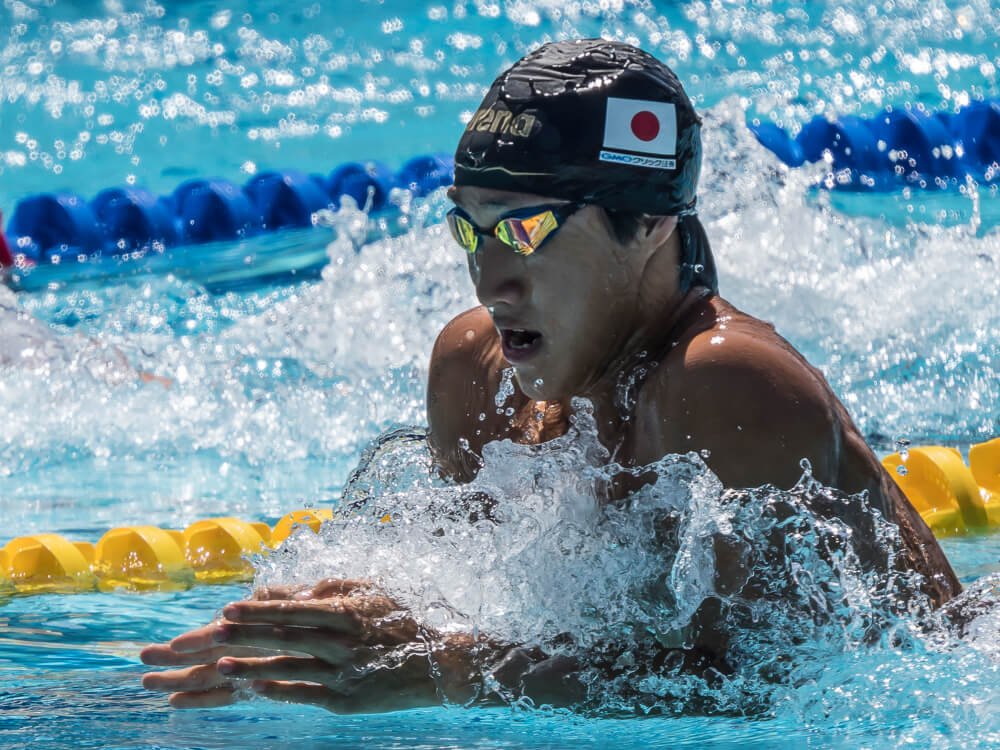
There was no separating Japan’s Shin Ohashi and China’s Dong Zhihao in the final of the 100 breaststroke, as they recorded matching times of 58.64. The world junior record holder at 58.54, Ohashi was just off his personal best and had the lead at the halfway point of the race. Ohashi touched at the 50-meter turn in 27.56, with Dong heading into the second lap after a split of 27.74. Over the last lap, Dong split 30.90, compared to the 31.08 of Ohashi.
Ohashi and Dong are expected to duel again in the 200 breaststroke, which is widely considered the better event for both men. They were followed for the bronze medal by former world champion Qin Haiyang of China, who clocked in at 59.01.
Women’s 200 Individual Medley
China’s Yu Zidi, a 13-year-old star, was nothing short of sensational as she posted the second-fastest time in history with a performance of 2:06.10. That time wasn’t far off the world record of 2:05.70, which belongs to Canada’s Summer McIntosh. Yu moved into the No. 2 slot in the all-time rankings by jumping ahead of Hungarian Katinka Hosszu, who went 2:06.12 for a then-world record at the 2015 World Championships in Kazan.
Men’s 800 Freestyle Relay
China narrowly missed becoming just the fourth country to break the seven-minute barrier in the 800 freestyle relay, thanks to an Asian record of 7:00.17. Only the United States, Great Britain and Russia have ever gone under 7:00, and China made a push en route to the gold medal. Japan had the lead for the majority of the race, but China’s Zhang Zhanshuo was spectacular to rally China to the title. Japan finished in 7:01.05 while Korea was the bronze medalist in 7:06.76.
Japan took the lead on the opening leg, as Tatsuya Murasa delivered a split of 1:44.70, compared to the 1:46.27 of China’s Xu Haibo. A 1:44.84 split from Katsuhiro Matsumoto extended Japan’s lead on the second leg, where China received a 1:46.74 split from Fei Liwei. On the third leg, Japan received an effort of 1:45.82 from Kazusa Kuroda, but China made a dent when Pan Zhanle checked in with a leg of 1:44.24.
The difference arrived on the anchor leg, where Zhang split an incredible 1:42.92, compared to the 1:45.69 of Tomoyuki Matsushita, the Asian Games champ in the 200 individual medley.
