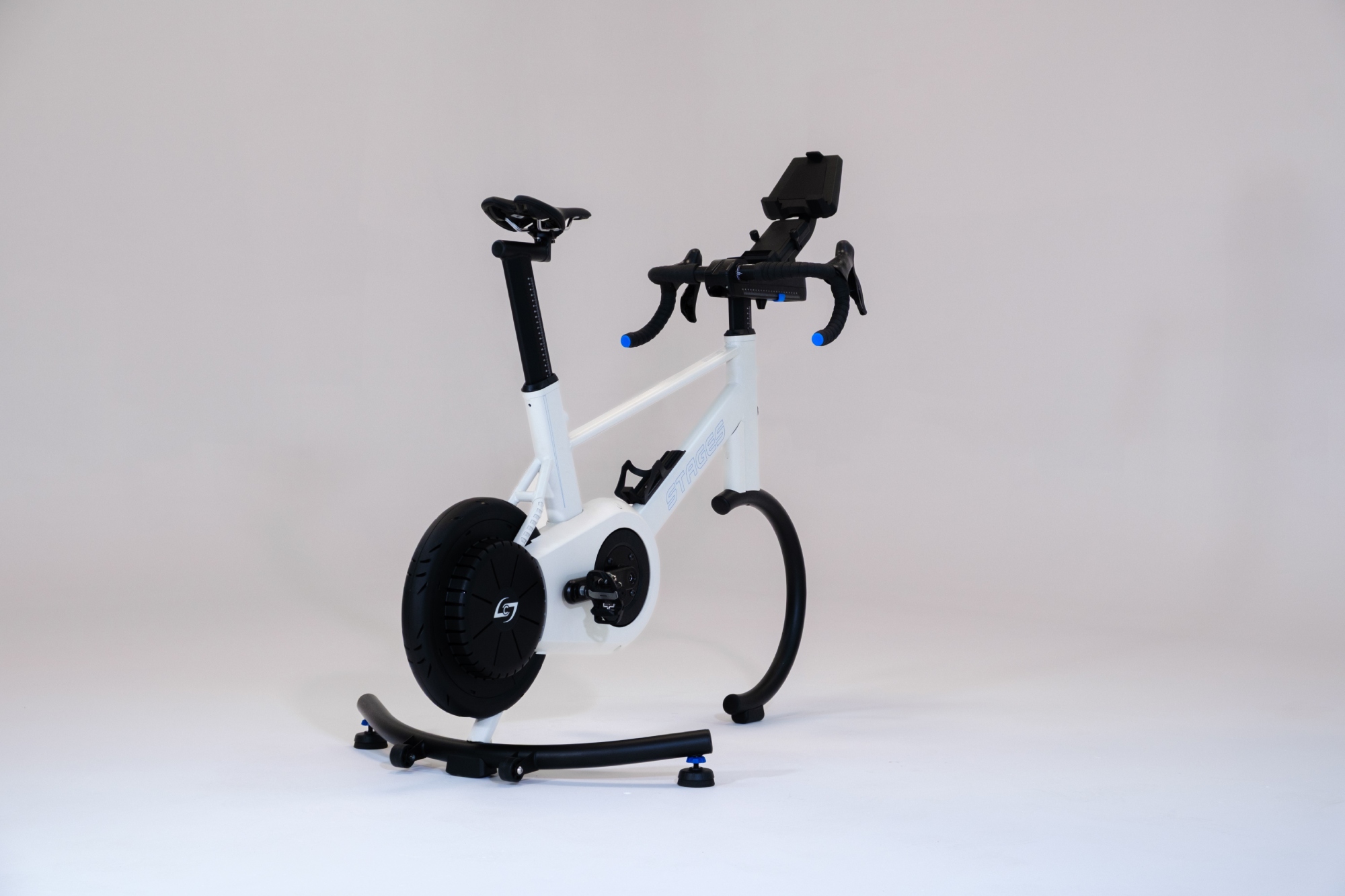
The Stages SB200 earned its name because the Stages team believes it is “10 times better” than its predecessor, the SB20.
The SB200 is Stages’ first indoor smart bike since the SB20 was released in 2019, and it’s seen updates in several areas, from aesthetics to a new display screen and an updated Stages app.
The SB200 product development team said that the focus was on creating a bike which would suit a wide range of riders, from the recreational fitness buff to the pro-level rider.
Latest Videos FromCycling Weekly
“You can just get on this bike and ride,” says Pat Warner, vice president of research and development at Stages. “We want people to ride bikes, and the SB200 allows everyone to simply get on and ride.”
The bike maintains its existing quiet drivetrain – as noted in the 4.5/5 star review it received from CW’s digital editor – but key updates include dropping a whopping 25kg (55lbs) from the previously hefty frame and adding an integrated display screen.
(Image credit: Stages Cycling)
What’s new?
The SB200 adds new features, reportedly without sacrificing quality and functionality.
One of the most notable changes is the fully built bike’s weight. The SB20 weighed about 62.5kg (138lbs), while the SB200 shaves off 25kg (55lbs) and weighs 37.5kg (82lbs).
Most of the weight savings came from the frame and the flywheel. The Stages team stressed that heavier flywheels, which mean more inertia, are a thing of the past.
Stages prefers to describe “max output” as a function of how well the bike handles torque.
The Stages team cited pushing 400w at 40rpm to demonstrate the SB200’s high resistance and torque-handling capability; if a rider pushed those watts at that rpm, the bike would still be responsive and usable.
However, depending on cadence, the SB200 has a max wattage of about 2,500 watts.
Speaking of cadence and output, those two metrics can be greatly influenced by crank length. The SB20 allowed for an adjustable crank length via a clubbed crank arm with four different holes for changeable crank lengths.
The SB200 improves on the “clubbed” crank arm design with a patent-pending, sleek crank-length adjustment system using flippable brackets that slide into place at the end of the crank arm. The bracket orientations correspond to four crank lengths: 165mm, 170mm, 172mm, and 175mm.
The adjustable crank brackets and all other adjustable parts of the bike – seatpost and handlebar height and handlebar fore/aft – are all controlled with one eight mm Allen bolt. The hex key for the Allen bolt is built into the rear seat stay and clips in and out via a magnet.
Additionally, the front and rear of the SB200 got major upgrades from the SB20.
The front features a unique semi-circle design meant to encourage movement like the real road. The SB20 had a rigid, straight front end that created a more rigid ride, and if that’s your preferred riding style, you can purchase the Rigid Ride front end and swap out the curved option on the SB200.
The rear of the SB200 now features two plush rubber feet to create a gentle side-to-side motion while riding, easing low back strain and once again fostering that “real world” feel.
The SB200 also has two wheels at the rear, replacing the pair at the front of the SB20. The Stages team says putting the wheels in the back makes more sense, since most of the bike’s weight is toward the rear.

(Image credit: Stages Cycling)
Key specifications
|
Specification Category |
Metrics |
|
Bike length |
137.3cm (with tablet holder) |
|
Bike width |
80.4cm |
|
Bike weight (net) |
71lbs |
|
Power accuracy |
+/- 1% |
|
Max system capacity (Wattage) |
2,500W |
|
Rider height range |
147cm to 208cm |
|
Rider max weight |
300lbs |
|
Crank lengths |
165mm, 170mm, 172.5mm, 175mm |
|
Handlebar width |
40cm |
|
Sensor communication |
BLE Smart, FTMS, Wi-Fi |
|
Built-in display |
2.23” 128×32 dot matrix |
The last visible hardware change is that the SB200 adds a small display screen beneath its phone and iPad holders (the iPad holder is fully removable).
The display screen lets a rider “just get on this bike and ride.” When not synced with a third-party training app, the display shows workout stats that the everyday fitness buff is interested in: cadence, calories, control mode (erg vs. simulation), distance, gear, heart rate (with connected heart rate monitor), power, profile, speed, time, and firmware update status.
With a third-party indoor training apps such as TrainingPeaks Virtual, Zwift, MyWhoosh, or Rouvy involved, the display screen will sync with the app’s stats and reflect your power, rpm, and more as reported in the third-party app.
The Stages app also got a makeover in the SB200 process.
Riders can now sync workouts from TrainingPeaks into the app, or choose from about 40 pre-programmed workouts in Stages’ small but growing free workout library.

(Image credit: Stages Cycling)
Real-world feel meets real-world shifting
Stages notes that a lot of thought went into improving the SB200’s shifting experience. The shifters operate like a standard road bike, with noticeable tactile feedback as you move through your drivetrain of choice. You can shift one gear at a time with the shifter closest to you, or jump five gears in either direction with the second shifter.
When you reach the end of the cassette you’ve chosen, an audible “beep” will let you know.
Plus, there are eight total buttons – four on the inside of each hood – that are fully programmable and control the built-in display as well as features of virtual riding apps.
The SB200 gives riders multiple drivetrain options, all customisable in the Stages app.
A rider can choose SRAM or Shimano 1X and 2X cassettes with a variety of gearing options right in the free app.
The real “secret sauce” of the Stages SB line, though, is its Dream Drive. Dream Drive is a fully customisable 1x system with up to 30 gears (from easiest to hardest gear).
You can get extremely specific with your gear configuration, creating “half gears” not available on a real-world cassette. If you want, you could create a Dream Drive with only five gears, creating huge torque jumps between gears.
If you’re training for a specific terrain or course, Dream Drive is one way to hone your efforts, especially if you upload a GPX file to TrainingPeaks Virtual and then adjust Dream Drive to match the ride profile’s demands.
Stages SB200 – first ride impressions
My first ride on the SB200 lasted about two hours and included everything from low-cadence, high-power efforts to crit-style virtual racing on the TrainingPeaks Virtual platform.
Before the ride began, though, I was pleased with how easy the bike was to adjust. The built-in Allen key at the rear seat stay was easy to pop in and out, and all changeable aspects only took a few minutes to adjust in total.
The SB200 doesn’t offer saddle fore/aft adjustment.
Additionally, you can put on your own saddle if you want. I thought that the Stages-designed saddle that comes with the bike was comfortable enough, but the standard cinched rail design means you could swap in your preferred seat.
Once I got my fit dialed in, I started to ride. I was immediately struck by how realistic the bike felt, from tactile shifting to just the right amount of movement to be road-like.
The shifters’ tactile feedback was noticeable, but not overly so. I switched between a SRAM 2X 12-speed setup and Dream Drive; you can switch between drivetrains mid-ride using the buttons inside the hoods or via the Stages Cycling app.
The bike’s curved front, combined with the SB200’s spongy rear feet, provides just the right amount of movement as you pedal. The gentle side-to-side motion mimics riding on the road accurately without ever feeling unstable, even during standing efforts.
A huge plus is that, thanks to the poly V-belt drive, the bike is whisper-quiet.
I also appreciated the narrower handlebars. Stages says they opted for a narrower handlebar design on the SB200 to reflect the style many are choosing on their road bikes today. I thought it was nice to have narrower handlebars, as I have had countless experiences with stationary bikes offering absurdly wide handlebars, which makes for an uncomfortable ride.
What I found difficult to get the hang of were the buttons inside each shifter. The buttons control things like avatar movement in TrainingPeaks Virtual (the only platform that syncs with the SB200’s hardware without a third-party app or modification) and navigating within virtual cycling platforms.
With practice, I’m sure I’d get the hang of the buttons, but memorizing the functions of eight total buttons right off the bat and syncing my thumbs to remember where each button is was quite the mental exercise.
Despite some challenges wrapping my mind-body connection around the buttons, the rest of the ride was smooth, quiet, and realistic.
The SB200 is now available directly from Stages at $2,399.
