Want a job? Know how to fix a bike? Then you might be in luck.
A brand new report suggests that Europe is suffering from a dearth of bike mechanics, with 105,000 new ones needed by 2032 to meet demand and prevent people abandoning their bikes.
The report, published by NextGen Mechanics initiative and European Cycling Industries (ECI).
Latest Videos FromCycling Weekly
The shortage is already reportedly changing how people travel. Shimano’s State of the Nation 2026 representative survey of 25,000 respondents found that 212 million people across Europe experience barriers to maintaining their bikes. Of those, 121 million cycle less as a result, and 7.6 million have stopped cycling altogether.
There’s already a shortage with 45,000 needed right now to meet current demand, the report says, with the additional numbers needed as the market continues to expand thanks to e-bikes, leasing and fleet models such as London’s Lime bikes.
The report comprises a map illustrating levels of accessibility to mechanics across Europe. The Netherlands leads the way, with only 34.92% of cyclists reporting barriers to maintaining their bikes, and the UK is also among the least troubled countries in this respect; 40.92% of people, however, respondents still reported issues with getting their bikes repaired. Perhaps more surprisingly, that number was significantly higher again among French and Italian riders. Eastern European riders experienced the most difficulty, with 55% of Romanian and Turkish riders reporting issues.
Director of the Association of Cycle Traders and Cytech, Jonathan Harrison, was a significant contributor to the report, and he told Cycling Weekly he hoped it would help to improve the perception of what a bike mechanic does – both in the eyes of the public and those in the role or considering it – and make it a more attractive career. At the moment, he said, mechanics often saw the job as a stop-gap with too few prospects for good pay and progress.
“We’re hoping that this project will be the start of work to raise the level of professionalism as a mechanic,” he said, “[and that] the perception of a bike service and repair will raise in value, and therefore the wages of mechanics will follow and subsequently more people will consider it as a career.”
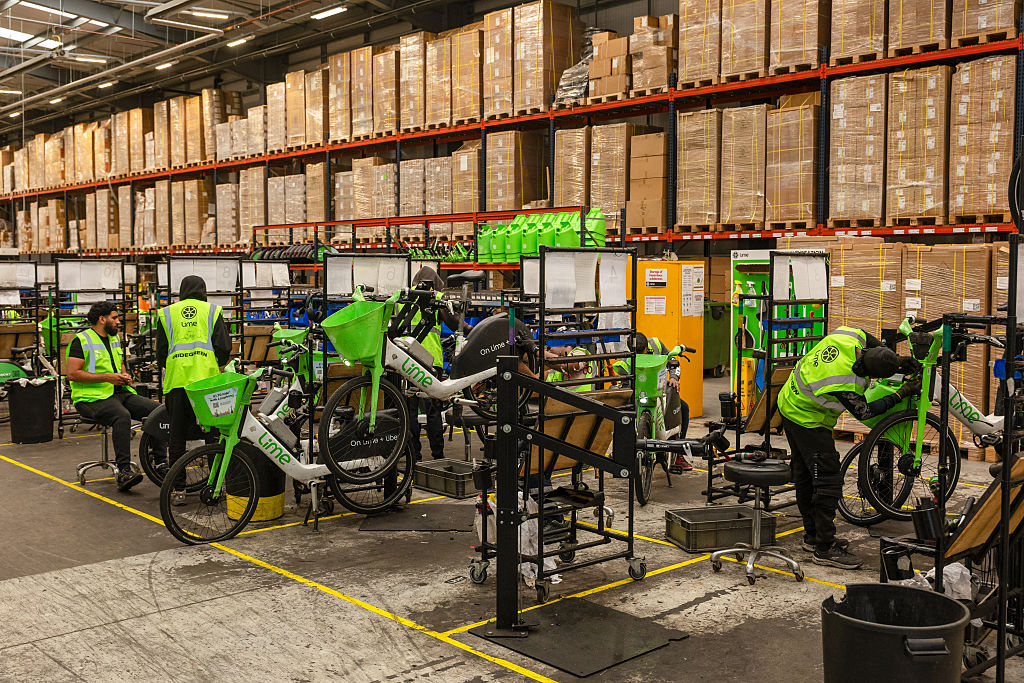
Mechanics working on London’s Lime Bikes: more are needed
(Image credit: Getty Images)
Mechanics not only deserved to be paid more, he added, but because working on bikes was becoming increasingly technical, the job itself deserved a perception shift.
Not only, that, he said, but it was also, on paper, safe from AI. Always a plus: “It’s really hands-on… it’s a really skilled job, and people overlook that a bit,” he added. “I personally always take my bike to a mechanic because they sort it out, and if I tried to do it, I’d make a mess of it. But yeah, hopefully it’ll be a safe job from AI.
“We’ve got to try and change it, because actually technology on the bicycle now is not that simple anymore. We’ve got e-bikes, electrical systems, software, diagnostics… you know, really complex components, hydraulics. You know it’s so much more complicated now to work on a bike than it was, say, 30 years ago,” he told CW.
Giving the example of fleet bikes such as those available for public hire on city streets, Harrison pointed out that they required many mechanics, without whom, potential bike riders would end up back in their cars.
“People would go back to public transport; public transport gets overcrowded; they jump back in their cars. They do all these things. We’re trying to work towards a better, clearer, cleaner cycling ecosystem,” he said.
There was one strand of good news underlying the shortfall of mechanics, Harrison added, which was that the rate of bike shop closures had fallen significantly, and that new ones were starting to open – bringing with them, of course, demand for new mechanics.
Henry Silvester of Silvester Bros. cycles in Farnborough, Hants (UK), said he’d yet to see the report but that the figures did not surprise him.
“We’ve got growth in that sector of the business in that people now don’t do their own repairs,” he said. “A lot of them now will come to cycle shops for pretty much 90% of bike repairs.”
The jobs his workshop would often carry out included puncture repairs, inflating tyres, adjusting handlebars, and fitting grips, he told Cycling Weekly. Not because bike owners would necessarily be unable to do it themselves, he said, but because they just don’t have the time.
“Bikes are getting more technical – that definitely is one reason. But I also think people are busy in their lives now, and you know both parents or both people are working in a family. There’s less spare time for jobs like that to be completed. So I think a lot of the time they just pop it into the shop. It’s a service. A bit like getting their boiler checked every year, or getting their car looked at or MOT’d. It’s another extension of those.”
The future is, in theory, promising for mechanics, estimated Silvester. With so much work coming in and jobs becoming ever more technical, salaries should increase. Like many such things, though, it’s likely to take time.
“All of this will help the industry,” he said. “But I think it is just something that is going to take a bit of time to sort of get rolling, really.”
As well as being pretty much AI-proof, the often-humble LBS workshop remains a huge part of the bricks and mortar industry, and feels as though it’s likely to remain so for some time.
As Silvester says: “The workshops have helped keep local bike shops running really. Without a workshop, if you had to just rely on bicycle sales or P&A [parts and accessories] sales, you’d be in trouble.”
