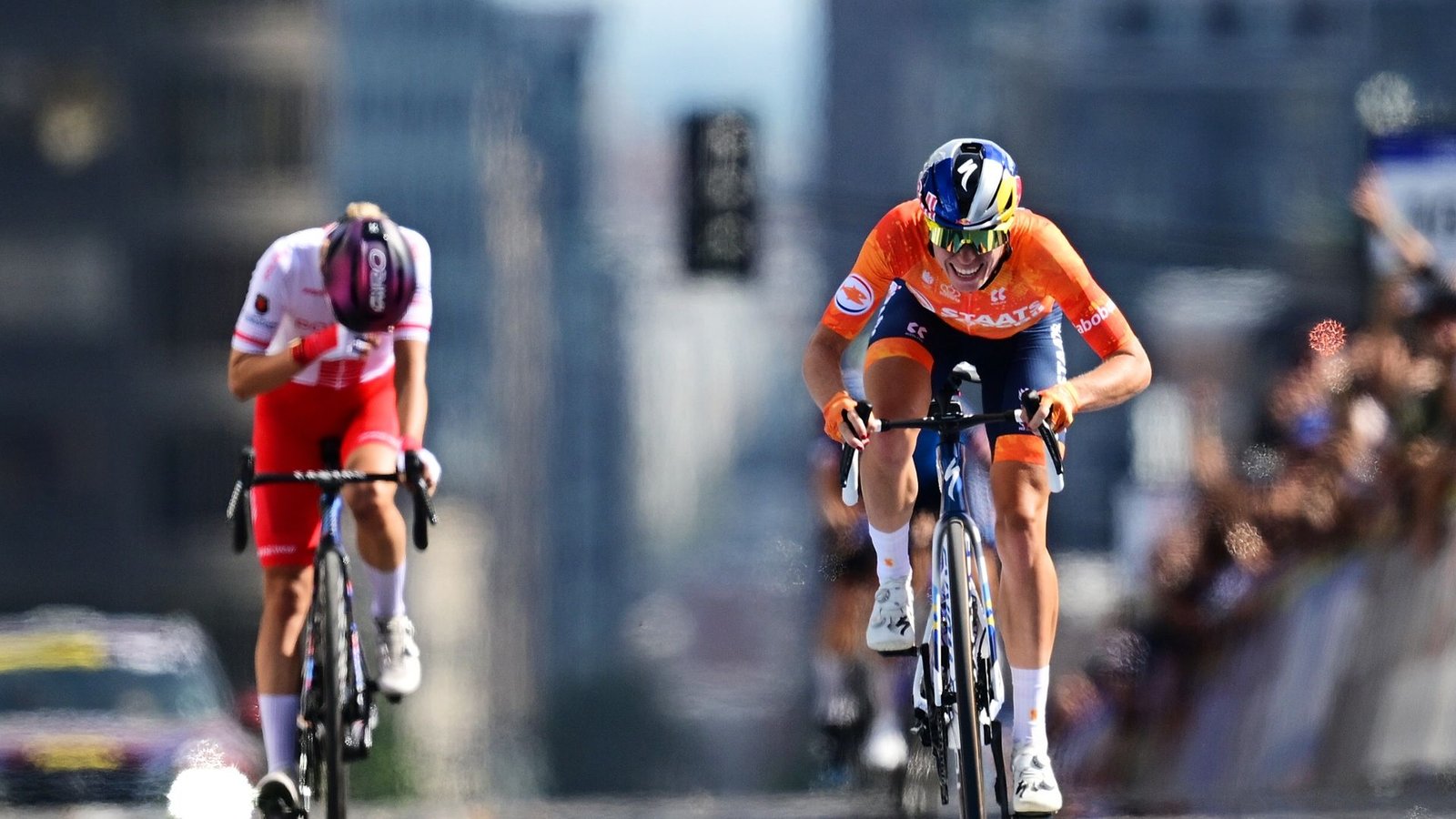
Kasia Niewiadoma-Phinney had given everything. Demi Vollering still had the rainbow jersey. The silver medallist’s first reaction?
“It wasn’t ‘oh yay, silver!’,” the Pole said dripping with sarcasm. “It’s like ‘Fuuudddgeee'”
In the final 50 metres up the Avenue du Parc, she was empty, her leg had cramped, and she could not finish her sprint as she had wanted.
Latest Videos FromCycling Weekly
Demi Vollering had won the rainbow jersey, and while Niewiadoma could accept that she had been beaten, that acceptance came with a promise.
“It just means that I will now come home and work harder to beat her next time,” she said.
This rivalry between Vollering and Niewiadoma-Phinney has been growing with each season. In 2023, Vollering passed Niewiadoma on the Tourmalet on her way to winning the Tour de France Femmes avec Zwift; later that year, Niewiadoma took the gravel world title with Vollering finishing in third. In 2024, the Pole beat her on the Mur de Huy to win Flèche Wallone, then held her off by just four seconds to win the Tour de France Femmes.
This August, Vollering turned the tables, reclaiming yellow with Niewiadoma in second. The tension of that contest gave their rivalry an edge, but in Montréal both described a respect rooted in knowing how hard the other makes them work.
“In the end, your greatest competitors are also your greatest motivation,” Vollering said. “When Kasia is chasing me, then next time you’re like, ‘I need to train harder.'”
Niewiadoma shared that in the lead up to the World Championships, she was revisiting all their head-to-heads.
“I was reminding myself in the last four or five weeks when preparing for today that once I beat Demi and I won the world champion jersey, so why not do it again?,” she said of the times she came out ahead.
At this level, she explained, belief can determine whether a rider makes use of the strength she has. The opponent who creates the doubt can also provide the evidence needed to overcome it.
“Maybe [in the Tour de France Femmes] I cracked slightly mentally,” she said. Confidence was fleeting, she explained. “You constantly have to work for it.”
The Worlds offered an opportunity to put that lesson into practice. She wanted to reach the finish knowing she had used everything available to her. And she did. She had left it all out there.
She could take satisfaction in the racing they had produced. She called it one of the hardest races they had done, and was proud that it had shown women’s cycling so well.
“You accept the fact that somebody was faster, stronger than you, and once you gave your absolute best, there are no what-ifs, and then it’s kind of just easier to move on,” she said.
Just metres past the finish line, Niewiadoma-Phinney was among the first to congratulate Vollering. When asked about this moment in the press conference later, Vollering said she would have done the same if the roles had been reversed.
“If Kasia would be world champion here, I also think it’s very deserved,” she said.
Vollering won the day’s contest, but both leave Montréal wanting the same thing: to beat the other next time. Their mutual respect only sharpens that ambition. For everyone watching, the next encounter cannot come soon enough.
