“Being on the podium was a little bit sad, just seeing photographers and a few people,” said Tadej Pogačar after stage three of this year’s Tour de France. The subdued finish at Les Angles, the race having just crossed from Spain into France, proved that even for the sport’s biggest champions, racing just isn’t the same without the fans. As a precautionary response to nearby wildfires, French authorities had banned spectators from attending; while many risked prosecution to line the roadside, the Tour’s usual thronging crowds were nowhere to be seen.
It was a bitter blow for Les Angles. The Pyrenean outpost had spent months preparing to host the finish, with hoardings, posters and infrastructure all in place. Local cafes and restaurants were stocked to the brim for their busiest day ever – only for the spectacle to fizzle out. The empty town recalled the lonely races of the Covid lockdowns, illustrating in stark relief the vital role of crowds. As Pogačar implied, take away the noise, colour and sheer human energy of cycling’s roadside devotees, and the sport simply isn’t the same.
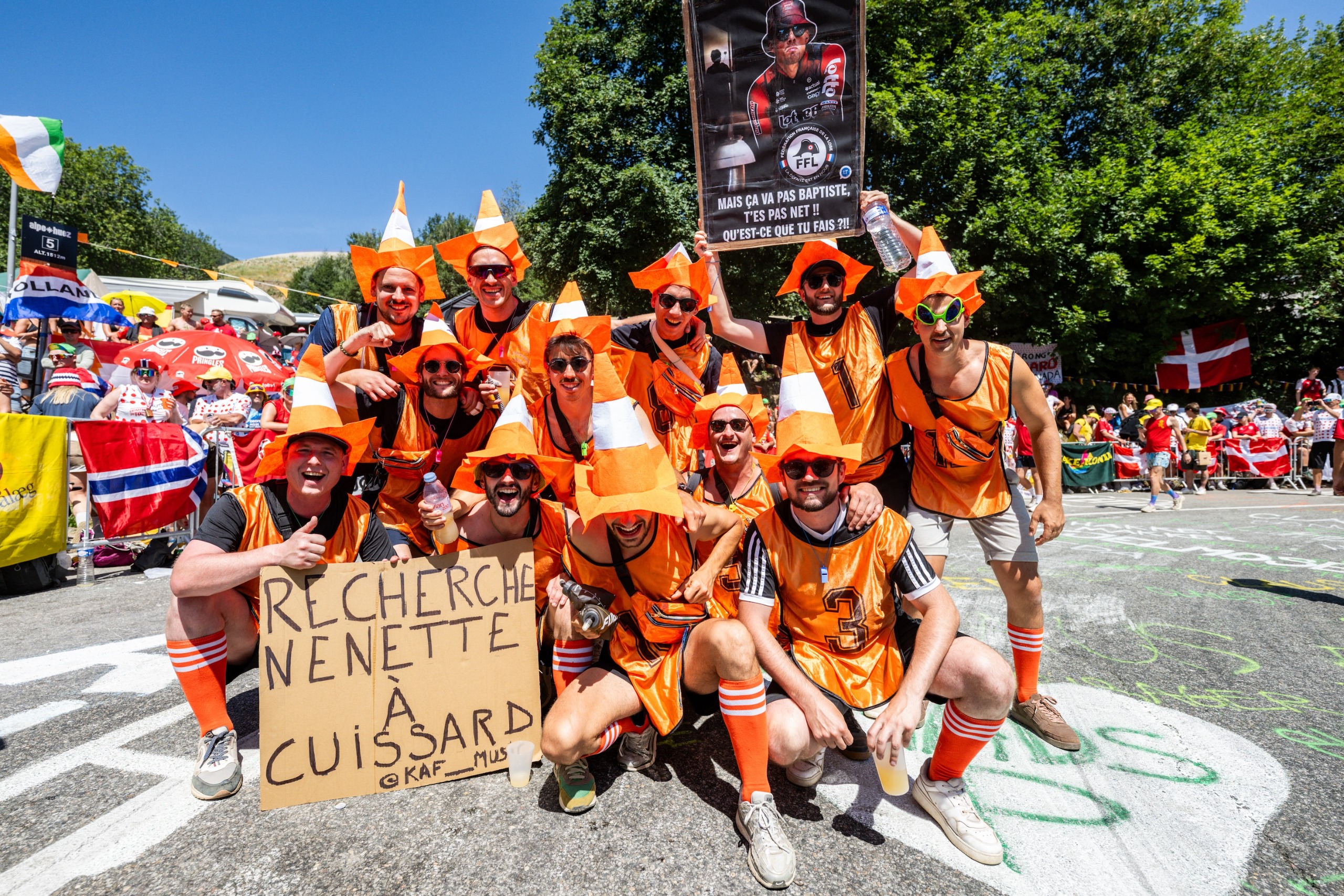
At the same time, bike racing has an often fractious relationship with its followers. Riders are regularly forced to dodge projectiles of various, sometimes unsavoury, kinds. They must breathe in smoke from flares and suffer half-cut, over-eager cosplayers running dangerously close alongside them. They have been knocked off their bikes at high speed in the throes of peak exertion, and punches have been thrown in both directions.
Latest Videos FromCycling Weekly
Fans are undeniably the sport’s lifeblood, but the frequent chaos they bring makes them an ever-present threat. This paradox poses the question: is cycling’s greatest asset – unrestricted fan accessibility – also its biggest liability?
The cycling fan experience extends far beyond the racing itself. Spectators can mingle with riders and team bosses outside the team buses before and after a stage, and, if they’re fit enough, even invade the pros’ training arenas to ride alongside them on the open road. That isn’t to say barriers don’t exist-certain scenarios demand that riders and fans are protected from one another. Usually, though, they share the same space on the road. Unsurprisingly, this unrestricted access doesn’t always end well, especially when alcohol is involved.
(Image credit: Getty Images)
“Most fans are great,” says Matej Mohorič of Bahrain Victorious. “It’s really cool that they take the time to come out and cheer us on. I will do so myself, and show my kids, once I stop cycling. We’ll go and see the Tour de France. The roads are our stadium, and it’s probably the sport where you can get the closest to the big champions, so it’s special in that regard.”
It’s not just at the road side when fans are getting too close to the riders
THE FAN’S EYE VIEW
We found three spectators at the Tour de France and asked them how important they thought the fans were to the sport-and whether the mountaintop crowds needed regulating.
Laia Bertran, from Taragona, Spain
“For cycling, fans are very important, because fans support sponsors and sponsors have money. For me, being a fan is about cycling, and seeing the riders suffering under the sun – because I am a cyclist. When I see [fans endangering riders] on television, I think, please don’t do that. Give space, let the riders breathe, because it’s very important. I understand that people are encouraging them to go faster, but please give them space and don’t touch them. That’s important – they are suffering.”
Donato Genovese, from Italy
“Fans are essential. If you see how many people are here today in Tarragona under this heat to see their cyclists from many different teams, it’s quite telling. You wouldn’t see it otherwise. The Tour de France is the third-most-important sporting event after the World Cup and the Olympics. It adds to the importance of the event today.”
Hughie McCooey, a member of the Ben Healy Fan Club
“The importance of the fans is massive. Although the riders get paid a fortune, they still need the fans to cheer them, the madness, everything that goes with cycling. Fans have just got to police themselves and do their best, because if you have too many regulations, it’ll kill the sport.”
Both Jonas Vingegaard and Tadej Pogačar have made headlines this year following clashes with fans. Vingegaard was the first, involved in what was ultimately a rather humiliating incident. The Dane crashed on a descent in southern Spain after attempting to drop an amateur rider who had latched on to his wheel.
Though he avoided serious injury, his Visma-Lease a Bike team issued a statement urging fans to be mindful. “In general, as a team we would like to urge fans on bikes to always put safety first,” read the missive. “For both your own and others’ wellbeing, please allow riders to train and give them as much space and peace as possible.”
Only two weeks later, Vingegaard’s chief rival Tadej Pogačar had his own run-in with a fan, prompting him to take to social media. “If you find me in conversation with someone and you ask me for photo, I ask you to give me two minutes to finish talk,” he wrote. “Do you wait two minutes or show me middle finger and take off angry? Long day ended with losing biggest fan.”
While training incidents are an occupational hazard for world-famous riders, the most volatile flashpoints are usually crowded mountain passes. “You always have those few who take it a step too far and start to be a bit over the line,” says Mohorič.
“Especially with the smoke, or sometimes by running next to the riders, or by just being surprised by the sheer force and speed we travel at. Sometimes they want to take a photo with their smartphone, and they turn their backs to us, and then it can get really dangerous.”

(Image credit: Getty Images)
Lotto Intermarché mechanic Rhune Clynen echoed Mohorič, even suggesting that smoke bombs and flares should be banned. “It has pros and cons,” he said of the fans massing on the mountainsides. “For sure the ambience is a pro, but the risk of having an accident is also a possibility.
I think [the smoke] could be forbidden, because of the inhalation… and also the running with the riders.” Given the unpredictability of the crowds, he admitted that teams can offer riders very little actionable advice. Ultimately, it comes down to common sense: “Just be careful with the crowds, and look in front of you, though it’s not always easy.”
Balancing act
Over the years, teams, riders and race organisers have repeatedly tried to discourage the dangerous behaviours Clynen highlights, though whether these efforts have had any real effect is debatable. While the number of spectators running alongside riders may have dipped, the experiences of Pogačar, Vingegaard and others demonstrate that unruly crowds are far from a thing of the past.
Roadside harassment continues to plague the peloton. Just ask Mathieu van der Poel, who has been pelted with beer, urine and water bottles, had a cap thrown into his wheels, and suffered a full lungful of vape smoke blown directly into his face all within the past few seasons.
Ultimately, managing fans at bike races is a balancing act between keeping riders safe and preserving the vibe of the occasion. Mohorič understands both sides of the equation, having raced to an empty house at the 2023 Tour de France. He finished third on a highly anticipated stage to the Puy de Dôme, which fans were barred from attending owing to logistical restrictions. It was an experience he called “pretty miserable”. Even watching on TV, the spectacle lacked soul.

(Image credit: Getty Images)
As Mohorič admits, the fan conundrum remains “quite a challenge, and it’s become more of a topic in the last few years”. “[Race organisers] are doing their best… on Mont Ventoux, they fenced off the top four or five kilometres, but then the fans just move further down the mountain.” Despite the hazards fans sometimes cause, he acknowledges their vital role: “They remind you of why you’re doing it – it’s a crucial part of the race… This is why we do it – to inspire people and to put on a show.”
His Puy de Dôme experience serves as a stark warning. The unparalleled accessibility cycling offers is a precious thing that risks becoming its biggest liability if abused – a golden goose we need to take care of. If the risk from fans endangering riders continues to increase, it may threaten to lock away the spectacle of bike racing for everyone.
When riders and fans collide: Five times when fans definitely got too close
The Eddy Merckx punch (1975)
This incident from more than 50 years ago remains one of the most notorious fans-gone-wrong moments. Merckx, gunning for his sixth Tour de France win in 1975, was punched by a roadside wrong’un on the Puy de Dôme. He lost the race lead the following day and never regained it.
Allez Opi-Omi (2021)
So read the sign held out by a roadside fan on stage one of the 2021 Tour de France. “Go Grandpa-Grandma” being the literal translation. So eager was she to have her message caught by the camera bikes, she apparently didn’t spot the onrushing bunch, who ran her down. A huge crash ensued that took several riders out of the race. The fan became something of a pariah and was ultimately fined in court.
Laurent Jalabert cops it (1994)
This crash, which changed the course of a career, was caused by a police officer, no less. Just metres from the line, the gendarme stepped out of an alcove in the barriers with his camera raised, and into the path of a bunch sprint approaching at full speed. French rider Jalabert was the most seriously injured of those that came down, and the incident saw him change tack, becoming more of an all-rounder. He rarely participated in bunch sprints after that.
Lance Armstrong on Luz-Ardiden (2003)
When the strap of a fan’s shoulder bag snared Armstrong’s bars and brought him down on Luz-Ardiden, it looked as though it could have been the end of his already faltering challenge against rival Jan Ullrich. But the American only seemed to derive strength from the incident. Catching the front group, which had sportingly slowed, he attacked almost immediately to win the stage and extend his GC lead, which he held to Paris.

(Image credit: Getty Images)
Chris Froome runs Mont Ventoux (2016)
One of the most memorable fan-related incidents in modern Tour history. Froome, wearing yellow, was reduced to running uphill after massing fans brought a race moto to an abrupt stop and Froome plus fellow GC hopes Richie Porte and Bauke Mollema crashed into it. His bike broken, no team car in sight and his yellow jersey disappearing up the road, Froome began running. Eventually, neutral service issued him with an ill-fitting bike, with which he made do until his own Team Sky car appeared with his own spare.
Explore More
