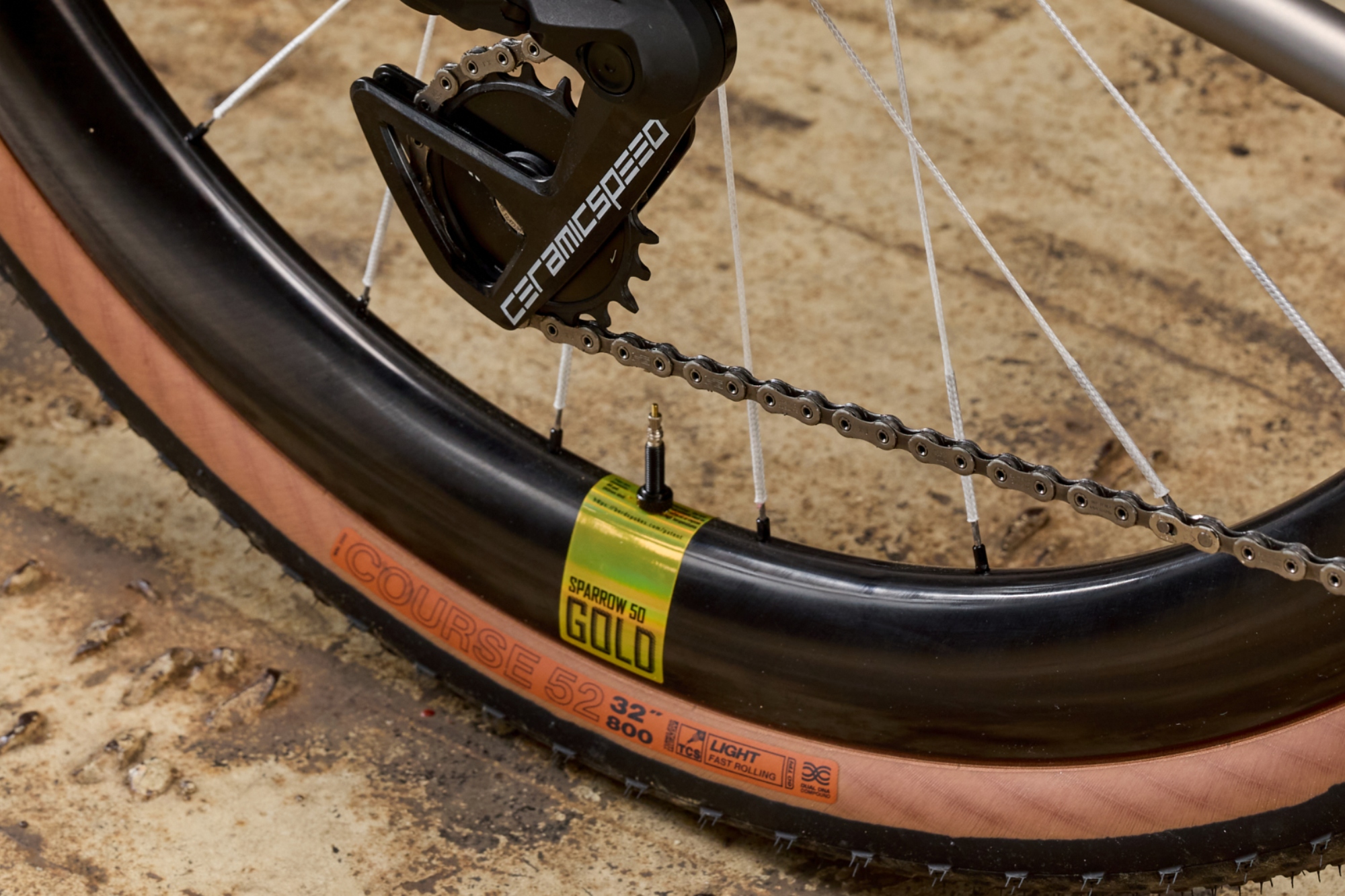
Walking around the MADE Bike Show in Portland last week, it was difficult to miss the 32-inch wheel. The emerging rim standard appeared on mountain bikes, bikepacking rigs and an increasingly convincing collection of gravel bikes.
There were purpose-built forks, carbon rims, various tyre options, production intentions and even a new TPU tube. What emerged as a collection of prototypes early in the season is beginning to resemble an actual ecosystem. But what I could not find was anything resembling a road bike built around the 32-inch platform.
The pitch for 32-inch wheels is usually that they roll over rough terrain with ease and cover lots of ground with significant momentum, at least in a straight line. This is because their larger radius meets obstacles at a shallower angle, reducing the disruption that can slow a bike down. Their greater rotational inertia helps resist changes in speed once the wheels are turning, but do take more effort to get up to speed.
Latest Videos FromCycling Weekly
The first benefit naturally belongs off-road. The second sounds tailor-made for riders who spend hours chasing aerodynamic and rolling-resistance gains. To me, that sounds a lot like triathletes.
And long-course triathlon has produced some of cycling’s wildest machines precisely because it sits outside the UCI’s tightly drawn equipment box. Think beam bikes, huge airfoil sections, unconventional hydration systems and adventurous cockpit arrangements.
When I pondered my thoughts out loud with a few builders at MADE who had already embraced 32-inch wheels, the first response was, admittedly, laughter. Then we went down the rabbit hole together, exploring the possibilities and limitations, lack of parts and potential use cases.
“This is a wonderful question,” said Aaron Barcheck of Mosaic Cycles. “We were talking about this last week.”
Road racing is a closed door, unless the UCI rewrites its rule
(Image credit: MADE)
The UCI does not need to ban a 32-inch road wheel by name because the rim size already sits outside the limits of its current code. Article 1.3.018 caps a bicycle wheel at 700mm in overall diameter, including the tyre. A 32-inch wheel uses a 686mm bead-seat diameter, leaving only 14mm for both tyre radii combined. In other words, any usable tyre would push the complete wheel well beyond the limit.
That makes UCI road racing a closed door unless the rule changes. Any eventual wheel design would also need to satisfy the UCI’s approval requirements for road, track and cyclocross wheels.
Road racing is not the end-all of bicycle design, of course, particularly for independent framebuilders whose freedom to experiment is part of the appeal. But when a new rim standard is seeking broad adoption across the industry, access to road racing and the development budgets, exposure and perceived legitimacy that come with it often matter.
A main concern with the larger-wheel standard is that it creates significant geometry problems (more on that below), and many shorter riders may struggle to fit one properly.
Interestingly, UCI rules and regulations do not require every product to fit riders of every height. However, the governing body seeks to preserve safety, sporting fairness and access to competition equipment.
The fit problem

The Salsa Fargo 32″ is meant to fit riders of all sizes
(Image credit: Lisa Charlebois/Future)
The UCI rules aside, for the industry to embrace 32-inch wheels as a genuine standard rather than a tall-rider niche, manufacturers would have to show that the platform works across a meaningful range of sizes.
Right now, the geometry compromises are difficult to ignore. Larger wheels tend to push the front end higher and the wheelbase longer while generating toe-overlap. The smaller the frame, the more significant those compromises become.
Barcheck was frank about the constraint: “It’s just going to be a long-wheelbase bike no matter what.”
In creating his 32-inch gravel bike, Mosaic’s new GT-1 i55 32, Barcheck couldn’t find a fork that suited the build, so he created his own. Sold under Mosaic’s new Zero Components name, the carbon fork has a deliberately short axle-to-crown measurement to suppress front-end height and an offset to preserve toe clearance.
However, this fork is built around a 2.2″ tyre clearance, and a road version with, say, a 30mm tyre would need another purpose-built fork with the appropriate length and offset.
Brian Hall of Rare Earth Cycles cautioned against declaring the fit problem insoluble, however. He declared that he has seen a five-foot rider happily using a prototype 32-inch bike, while recognising that it was, indeed, a mountain bike.
Hall also described his award-winning MADE creation as an “aero drop-bar-shaped mountain bike,” rather than a gravel bike, due to the fork offset and trail being closer to those of a rigid mountain bike than a traditional drop-bar bike.
The missing parts

Robin Gemperle’s Scott RC Gravel 32″ Bike Prototype as raced at Unbound Gravel
(Image credit: SCOTT Sports / Lukas Schumacher)
Before anyone can test the road concept properly, someone has to make the parts.
Aaron Stinner of Stinner Frameworks said the current ecosystem of 32-inch parts stays true to its off-road origins. There are no suitable forks, little-to-no narrow tyres and the available 32-inch carbon rims generally have internal widths intended for wide tyres. A road project would therefore need a suitable rim and tyre before a builder could learn much from it.
“If I had a road tyre, I’d build one and try it,” Stinner said plainly.
Barcheck arrived at the same conclusion. “You would need some road-specific rims,” he said, noting that the products appearing now tend toward 28 or 30mm internal widths. “That’s not going to work for road.”
Simply putting a narrow tyre into Mosaic’s existing fork and calling the result a road bike wouldn’t work either, he said, explaining that a smaller tyre would require “a really specific rake and offset of the fork.” Depending on the frame, it might also need a yoke or another chainstay solution to control rear-centre length.
“Maybe we try an all-road next,” Barcheck mused. It preserves some of the tyre volume and rough-surface benefit that justified the bigger wheel in the first place, while allowing builders to move incrementally toward road speed.
Would bigger actually be faster on asphalt?

Stinner’s MADE show bike built around 32-inch wheels
(Image credit: MADE)
The central unanswered question is whether there would be any real benefits of going bigger on pavement. On rough ground, the larger wheel’s shallower angle of attack is tangible: it meets rocks and holes less abruptly and can tackle broken terrain without losing as much momentum. Smooth asphalt removes much of that advantage. What remains is a hypothesis about rolling resistance and speed retention, but that’s met with extra material, aerodynamic exposure and rotational inertia.
Barcheck pointed out that a light 700c road wheel with a low moment of inertia will remain difficult to beat, especially when the road tilts upwards. The answer may be course-dependent, he said, just as a 32-inch gravel bike might suit the long, fast expanses of Unbound Gravel better than the steep climbing of Crusher in the Tushar.
Stinner’s experience was similarly specific. On an aggressive fire-road climb, the big wheel can roll over rocks that would trip up a smaller one. Take those obstacles away, however, and “you’re not going any faster uphill,” he said. The longer wheelbase also changes the way a rider approaches tight switchbacks and technical descents. Stinner admitted that when riding a bike with 32-inch wheels, he had to relearn finding the right lines.
That suggests that a 32-inch road bike, if it ever emerges, would be a highly specialised machine for flat or gently rolling courses, sustained speed and relatively few accelerations. Which brings the conversation back to triathlon.
The Kona case

Robin Gemperle’s Scott RC Gravel 32″ Bike Prototype as raced at Unbound
(Image credit: SCOTT Sports / Lukas Schumacher)
Triathlon had occurred to Barcheck, too. Its bikes are already “wild,” he said, and long-course racing often resembles gravel in one important respect: riders spend long stretches alone, travelling in a mostly straight line. Toe overlap matters little, and a long wheelbase can be a feature rather than a fault when stability is the priority.
IRONMAN’s rules provide substantially more design freedom than the UCI’s and do not specify a maximum wheel diameter. They even allow the front and rear wheels to have different diameters unless an event director decides otherwise for safety reasons.
That does not make a 686mm BSD wheel automatically race-legal. Under the current rules, “non-traditional or unusual” bicycles or equipment require approval from the event-specific head referee before the race. The bike also needs to meet the rules governing overall bicycle dimensions, axle placement, braking and safety. But unlike in UCI road racing, the wheel diameter itself is not expressly disqualifying.
The biggest concern would be wind. A larger, deeper front wheel catches more of a crosswind, which could make the bike harder to steer and control.
Stinner said that he’s currently waiting on a deeper 32-inch rim prototype, in part to reduce spoke length, which would increase a wheel’s stiffness. He expects it to be interesting at speed but wants to know what happens when faced with side winds. Deep-section and disc wheels already become “huge sails,” he said. Scale the front wheel up and the handling concerns increase.
Gravel first, road backwards

Brian Hall’s Rare Earth MADE show bike
(Image credit: Anne-Marije Rook)
Historically, bicycle technology has migrated in the other direction: road creates the performance idea, all-road adds volume and gravel pushes it farther. Like the adoption of disc brakes, the 32-inch wheel may travel backwards. Mountain biking supplied the first tyres and rims, gravel gives them another use case, and custom builders use their freedom to solve the geometry one rider at a time.
All-road may be the next step. Triathlon could be the first road experiment. The UCI peloton would come last, if it comes at all.
At MADE, nobody could say that a 32-inch wheel is, in fact, faster. What the builders could say, almost unanimously, was that it feels fast enough to make them curious.
Stinner compared his first ride to an e-bike moment: “You get on the 32, and you’re like, ‘’Whoa, this thing wants to go’.”
Barcheck sees all-road as a plausible next build. And Hall’s fully in love with the new wheel diameter. “I love it. I absolutely love it,” he said. “I pretty much quit riding 29ers at this point.”
So, is road next? Not any time soon. The industry needs to create more components. For that, it needs proof of the diameter’s benefits, geometries that aren’t limited to only the tallest of riders, and, above all, it needs demand.
Explore More
