The British Hill Climb scene is a unique cycling offshoot with its own ruleset, not governed by the UCI. The discipline has become a British staple, attracting riders of all abilities from across the United Kingdom, culminating each year in the British Hill Climb Championships. In simple terms, riders race up super-steep gradients ranging from one to 25 minutes, in a time-trial format, though recent editions have featured uncharacteristically shallower slopes. The fastest time wins.
Helmets and functioning front and rear lights have been compulsory for all hill climbs since 2021 – a move ushered in to improve visibility and rider safety. Previously, helmets were required only for riders under 18; adults could wear casquettes or forgo headgear entirely, something many riders fondly refer to as peak British Hill Climb culture. Because the discipline isn’t governed by the UCI 6.8kg weight limit, bikes under 5kg are commonplace – even in disc-brake configuration.
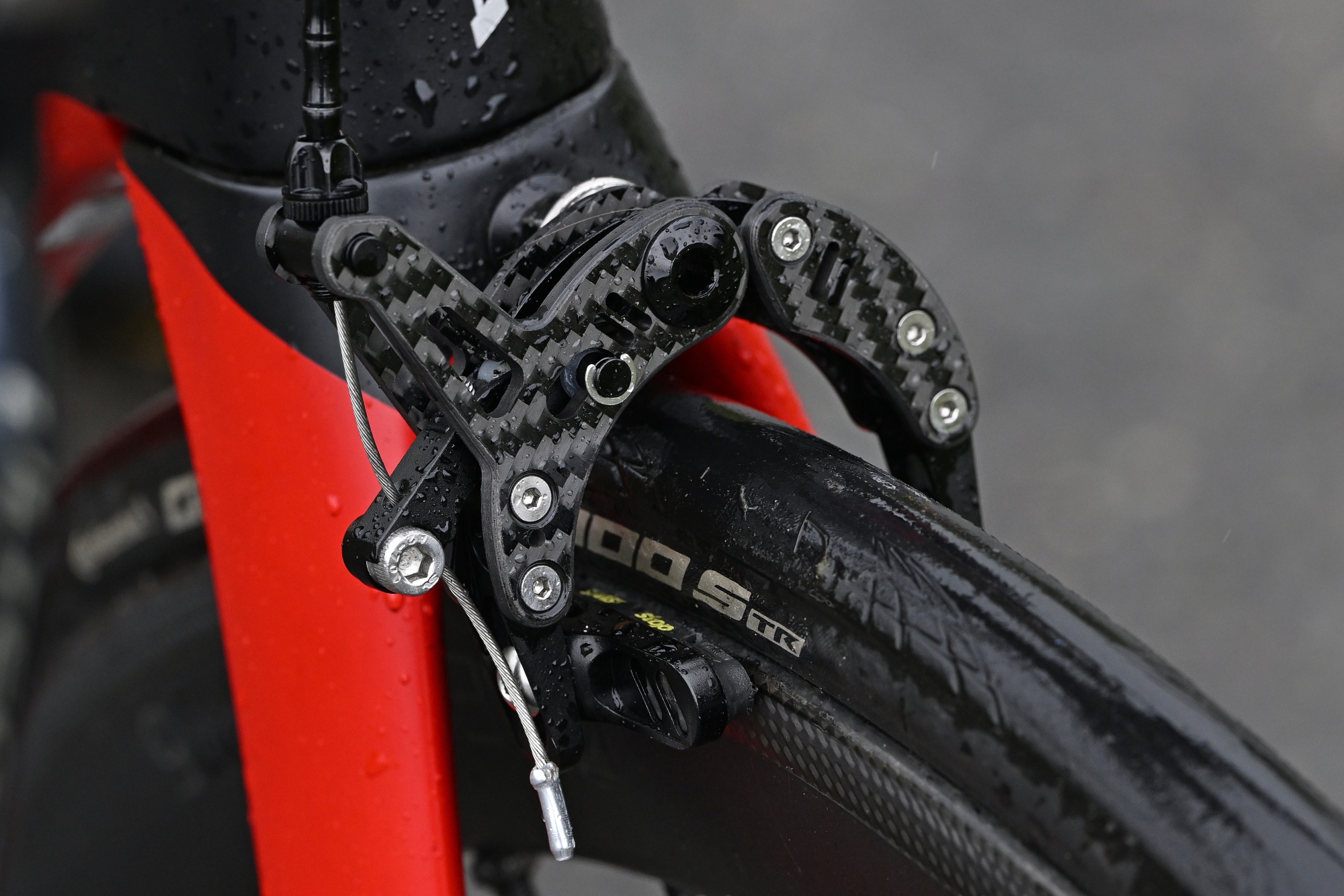
Before the rise of disc brakes, however, bikes adopted rather unique Frankenstein-like facades underscored by cut-off bars, wafer-thin carbon-shelled saddles, superlight brake calipers and lightweight rubber or even tubular tyres. While many of these bikes still show up every year, and with many historic traditions still being adopted by participants, disc-brake-actuated bikes are on the rise, especially as a new wave of younger riders enters the sport. Disc-brake-equipped bikes benefit from being stiffer and safer to pedal down descents once the hill climb is over.
(Image credit: Future / Andy Jones)
Before the rise of disc brakes, however, bikes adopted rather unique Frankenstein-like facades underscored by cut-off bars, wafer-thin carbon-shelled saddles, super-light brake calipers, lightweight rubber, and even tubular tyres.
Aaron Borrill

(Image credit: Dominic Gill)
While disc-brake bikes can often weigh as little as 5kg, depending on the configuration, many participants use off-the-shelf builds or team-issued bikes that can’t be tweaked because of sponsor commitments. These bikes will often weigh between 6.8-7.3kg but can still be competitive depending on the course profile. This year’s fastest rider, Ezra Bateman, rode a stock 6.9kg Van Rysel RCR-R Pro.
Over the past ten years, however, one specific bike has dominated the winners’ column: the Cannondale SuperSic Evo, which has racked up five wins between Dan Evans and Andrew Feather. Often built to under 5.5kg, the stiff, responsive high-modulus frame has also provided a solid base for a light, reliable hill-climbing machine.
|
Year |
Champion |
Climb |
Time |
Bike model |
|
2016 |
Adam Kenway |
Bank Road · Matlock |
2:18.2 |
Kuota Khan |
|
2017 |
Dan Evans |
Hedley Hill · Northumberland |
3:54.3 |
Cannondale SuperSix EVO Hi-Mod |
|
2018 |
Andrew Feather |
Pea Royd Lane · Stocksbridge |
2:18.8 |
Cannondale SuperSix EVO Hi-Mod |
|
2019 |
Ed Laverack |
Haytor Vale · Devon |
11:37.0 |
Tifosi Mons |
|
2020 |
Andrew Feather |
Streatley Hill · Berkshire |
2:04.8 |
Cannondale SuperSix EVO Hi-Mod |
|
2021 |
Tom Bell |
Winnats Pass · Derbyshire |
3:01.7 |
Rose X-Lite |
|
2022 |
Andrew Feather |
The Old Shoe · Horseshoe Pass |
5:29.5 |
Cannondale SuperSix EVO Hi-Mod |
|
2023 |
Andrew Feather |
The Struggle · Kirkstone Road |
11:48.0 |
Cannondale SuperSix EVO Lab71 |
|
2024 |
Harry MacFarlane |
Dipton Mill Road · Hexham |
3:09.4 |
Cervélo R3 SL |
|
2025 |
Harry MacFarlane |
Bank Road · Matlock |
2:14.7 |
Trek Émonda SLR (modified) |
|
2026 |
Ed Laverack |
Porlock Toll Road · Somerset |
14:32.1 |
Scott Addict RC Ultimate |
It’s a bottomless rabbit hole, and riders will often spend an entire year mulling over and experimenting with various bits and bobs as they search for the best combinations. Most bikes will be built around that year’s Hill Climb Championship course. Routes vary significantly in pitch and distance – one climb may suit a particular physique (or bike type) better than the next, adding an interesting dynamic and appealing to riders of all shapes and sizes.
While the past two editions – the 1.2km Dipton Hill Road in 2024 and the 835m Bank Road in 2025 – were short, punchy efforts, the 2026 venue tore up the script as far as bike strategy was concerned. Porlock Toll Road’s 6.6km was a much longer and steadier test for riders, and the average gradient of 5.5% forced riders to get creative with their setups – almost to the point where lightweight builds were ditched entirely for all-out aero setups.
Having covered the British Hill Climb Championships over the years, we’ve trawled through our archives to bring you some of the most spectacular machines to have (g)raced the pages of Cycling Weekly.

(Image credit: Unknown)
Kieran Wynne-Cattanach’s Giant TCR Advanced SL
In hill climb spec, Kieran Wynne-Cattanach’s Giant TCR Advanced SL tips the scales at 5.4kg, 6.8kg in everyday guise. What makes this rim-brake bike so unique is that it doubles up as his daily whip – a model he picked up brand-new in 2024 from WeCycle in North Wales.
Kieran’s TCR frameset measures in at a size small, which matches his height and weight of 5’8″ and 58kg, respectively. Every component has been carefully considered to balance lightweight performance with everyday usability.

(Image credit: Andy Jones)
Dan Evans’ Cannondale SuperSix Evo
Two-time British National Hill Climb Champion, Dan Evans, used a rim-brake-equipped Cannondale SuperSix Evo to win the 2014 Championships on the Pea Royd Lane climb in South Yorkshire.
Evans’ 2013 Cannondale SuperSix Evo Dura-Ace Di2 tipped the scales at just over 5kg, thanks to a lightweight full-carbon Selle Italia SLR Tekno saddle, Spada Breva 33 carbon wheels wrapped in 22mm Vittoria Crono Evo tubs, and a stripped-down 39T one-by Cannondale SiSL2 chainset.

(Image credit: Mark James)
Ed Laverack’s Scott Addict RC Ultimate
Ed Laverack won the 2026 British National Hill Climb Championship aboard a custom Scott Addict RC Ultimate. At a claimed 640g for a size medium frame and 270g for the fork, his rig is one of the lightest framesets ever made, thanks to the highest-end HMX-SL carbon. Thanks to his Brink Velix-Evo 2.0 wheels (approximately 865g for the pair), Gemini Rigel 1x chainring and 10-26T SRAM Red cassette, Laverack’s bike weighed in at 5.9kg with pedals.
To ensure he kept with tradition, the Welshman chose to strip his bars of handlebar tape – something that would have saved him around 30-50g.

(Image credit: Future (Andy Jones))
Harry MacFarlane’s Cervelo RS
Harry MacFarlane, himself a two-time British national Hill Climb Champion, won the 2024 competition on a 2008 Cervelo RS frameset, festooned with graffiti and built up with somewhat obsolete spare parts. Lightweight wheels, sanded-down paint, and custom-made bike lights are just a few of the modifications MacFarlane used on his machine.
He used a SRAM Red eTap rim brake groupset (one-by with 38T up front) and Shimano Dura-Ace C24 carbon tubular wheels shod with 25mm Vittoria Corsa tubular tyres to help keep the weight as low as possible.

(Image credit: Future (Andy Jones))
Andy Nichols’ Orbea Orca
Hill climb veteran Andy Nichols used the last-generation rim-brake Orbea Orca frameset at the 2024 British Hill Climb Championships. Mismatched in places, it reflects hours of meticulous calculations, all to achieve an overall bike weight of 5.70kg.
The build comprises a Bontrager XXX handlebar and stem, an AliExpress saddle, seatpost and carbon-fibre calipers, and an 80mm front wheel to his bike to improve aerodynamics. Nichols finished in fourth place. View his Orbea Orca in detail.

(Image credit: Andrew Feather)
Andrew Feather’s Swi Leve HC
Four-time British Hill Climb Champion Andrew Feather piloted a Swi Leve HC bike at the 2024 National Hill Climb Championships. It’s a superlight build, featuring a handmade monocoque weighing in at 680g. The bike features an array of Hill climb-specific parts, including a specially developed sub-1,000g disc-brake wheelset from Hunt, the Hill-Climb SL Disc Tubular.
Feather’s Swi Leve was built around a full 12-speed Shimano Dura-Ace Di2 groupset with a Rotor Aldhu 2x chainring, and also used a Schmolke touchpoint configuration and 3D-printed computer mount to further keep the lard off. Feather’s €11,000 (£9,200/$12,000) Swi Leve HC bike tipped the scales at 5.4-5.5kg.

(Image credit: Future / Andy Jones)
Celia Brown’s Liv Langma
Celia Brown’s hill-climbing machine started out as a standard Liv Langma, bought for around £2,000. After an Ultegra Di2 upgrade configured in a 1x setup, she swapped the standard cockpit for a Prime carbon handlebar, which she chopped down to save weight.
She also fitted a 100g carbon saddle, which sits at an aggressive angle given the discipline’s uphill nature. Her build came in at just under 6kg.

(Image credit: Andy Jones)
Rebecca Richardson’s Specialized S-Works Aethos I
Rebecca Richardson’s featherweight machine is built around a Specialized S-Works Aethos frameset, with hand-painted, Welsh-inspired graphics that make the bike stand out.
The tubular wheelset comes from German brand AX-Lightness complete with Berd Polymer String spokes. At the heart of the bike is a 1x drivetrain using SRAM’s Red eTap groupset, with an XX1 Eagle mountain bike crankset as yet another adaptation. The 28T chainring acknowledges the harsh reality of hill-climbing racing in the UK.
The total build weighed in at 5kg dead.

(Image credit: Andy Jones)
Birtha Jones’ Tifiso Mons
Birtha Jones’ Tifosi Mons blends a broad mix of road bike groupset components. It pairs Campagnolo levers and a Record short-cage rear derailleur with an Ultegra FC6750 crankset. The weight savings extend to the brake calipers and cables – with individual aluminium links used for the outer housing instead of a standard wound coil in a rubber sheath.
Used during her 2021 British National Championship win on Winnats Pass in the Peak District, she opted to ditch a set of carbon Fulcrum Racing wheels for Fulcrum Racing Zero hoops shod with Continental GP5000 tires, because of the biblical weather. A closer look reveals the chopped-off handlebars to shave off more weight.

(Image credit: Future / Andy Jones)
Chris Potts’ Specialized S-Works Aethos
Starting at just 585 grams for a size 56, Chris Potts went through every possible component to build the lightest machine possible for the 2023 National Hill Climb Championships.
Coming in at just 5.30kg without pedals, his Aethos ran a 1x Dura-Ace 12-speed groupset, complete with CeramicSpeed oversized pulley wheels for maximum efficiency.
The Zed wheels were the star of the build. Weighing just 878 grams for the pair, this custom-built set is the lightest wheelset the brand has ever built. The bike was topped off with a Darimo carbon finishing kit and a feathery 63g AX lightness saddle.
