Giant Bicycles has submitted a U.S. patent for a self-charging power meter. The details of the patent show a power meter pedal containing a “self-powered apparatus” that includes a generator and an “energy storage element”.
(Image credit: Giant Manufacturing)
Currently, the best power meters require a traditional battery to power the strain gauge sensor. This is typically done with either a small CR2032-like cell or a rechargeable lithium-ion battery. The former requires changing, which opens the system up to the threat of water ingress; the latter means the bike needs to be near a power source, or the power meter removed for charging.
In the patent, Giant claims that “frequently changing or removing the battery of the conventional power pedal to charge is inconvenient to the rider” and “thus, there is a requirement or an incentive for improving the charging convenience of the battery of the conventional power pedal.”
Latest Videos FromCycling Weekly

(Image credit: Giant Manufacturing)
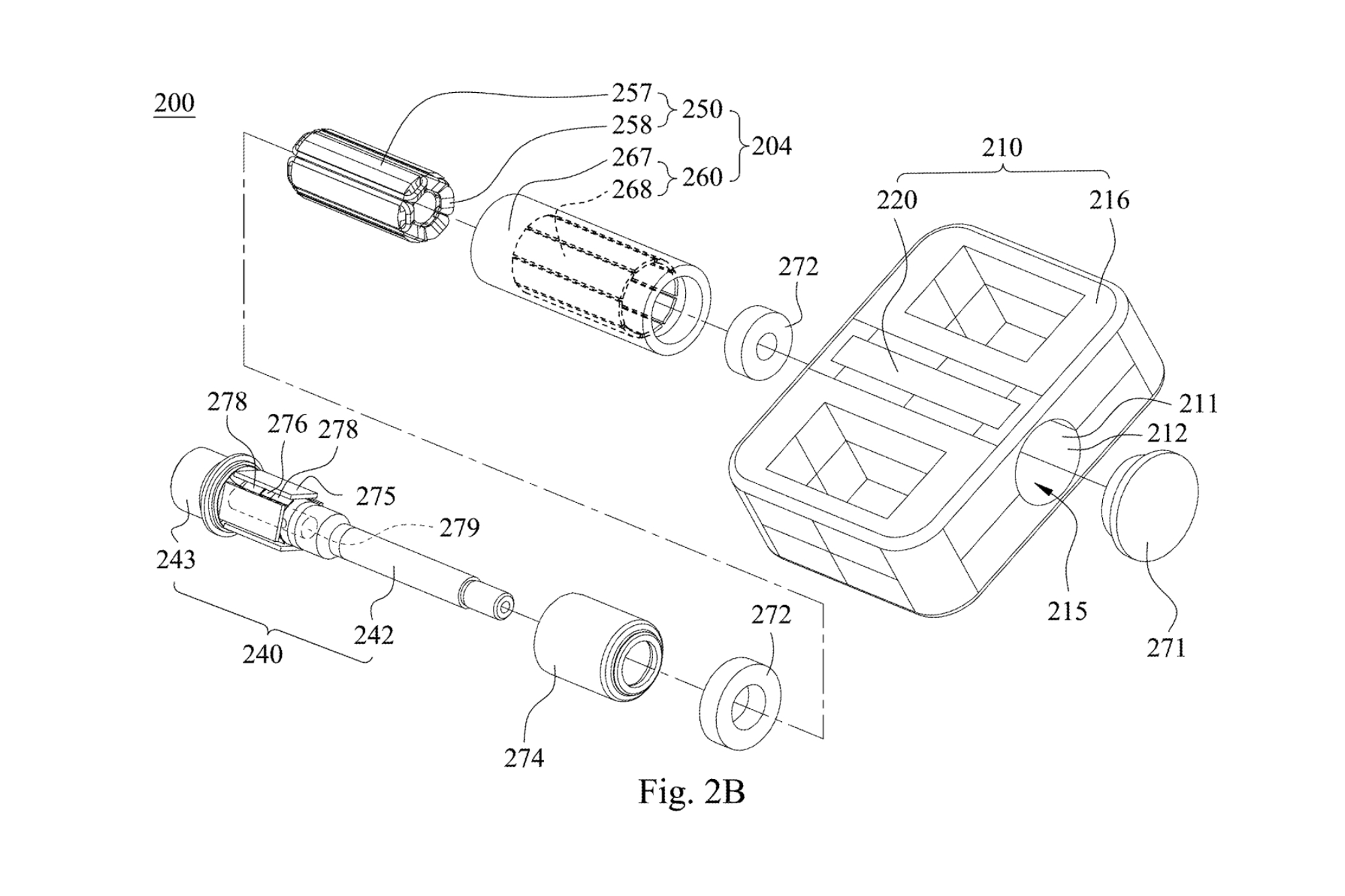
The diagrams featured in the patent show a traditional-looking pedal unit, complete with a pedal body and a spindle. The patent also includes a generator with a stator and a rotor, as in electric motors and generators; the stator is the stationary, or fixed, element of the system, while the rotor is the rotating component.
The stator contains steel and copper teeth and coils that create and receive a magnetic field, while the rotor spins in response to these magnetic forces, creating torque.

(Image credit: Giant Manufacturing)
In a generator, the spinning rotor and the magnetic field it generates apply an electrical current to the metal coils in the stator. In this patent, the stator is mounted on the spindle, while the rotor sits on the inner surface of the pedal unit, surrounding the stator but not touching it.
By turning the pedals, the cyclist spins the rotor relative to the fixed stator and, voilà!, the generator produces DC power, which charges the “energy storage element” and powers the sensor.

(Image credit: Giant Manufacturing)
Given that a cyclist naturally acts as the ‘power source’ through the act of pedaling, it’s perhaps a surprise that a self-charging power meter isn’t already in existence.
However, while several self-charging best exercise bikes use pedal power and an internal generator to run without being plugged into an electrical source, they don’t require a generator small enough to fit inside the pedal body. This is clearly a challenge, and we’re guessing the hurdle that may have tripped others up in the past?
As with all patents, there’s no way of knowing if or when the product will see the light of day. After reaching out to Giant for comment on the patent, they had this to say: “As a manufacturer with multiple brands- Giant, Liv, Cadex & Stages- we are constantly designing, developing and investigating new products and new tech. Some of these projects are taken forward; some aren’t.”
What we do know is that, given that Giant/Liv sponsors the WorldTour outfits Team Jayco-AlUla and Liv AlUla Jayco, they have an ideal testing platform for the pedals, if they ever come to fruition.
Could this be the death of the Dynamo Hub?

(Image credit: Shimano)
From what we can gather from the patent, this won’t revolutionise how we power other electronics on our bikes. This looks like a neat way to provide a more convenient solution, designed to power very low-voltage products like power meters.
This does look like an interesting step in the right direction for, at the very least, making road bikes less reliant on the plug socket.
Many brands have tried solutions like Cannondale’s Smart Sense system, found on the brand’s Synapse range only a couple of years back. While that battery only powered the radar lights, it had the right idea: a single battery powering multiple devices.
Let us not forget the very current Shimano Q’Auto system, which eliminates the need for any batteries to power the Japanese brand’s electronic Di2 groupset. While we haven’t seen widespread adoption of this system, it’s likely a stepping stone to something in the future.
