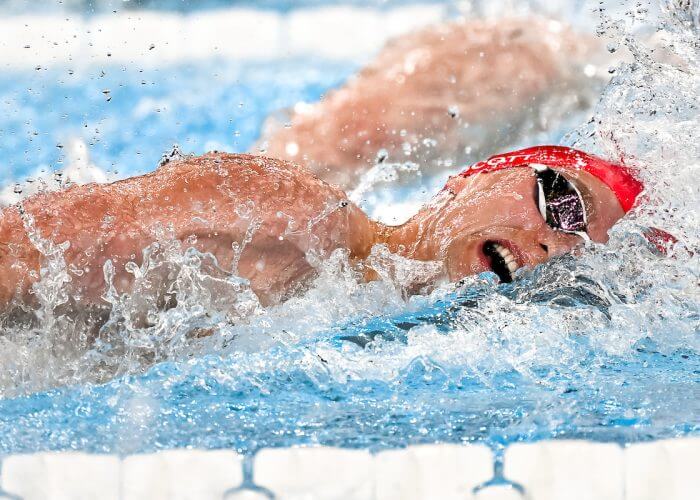
Duncan Scott on the Challenge that Lies Ahead for 4×200 Squad Come LA 2028
When the British men added the European 4×200 free title to their Olympic and world crowns, victory was met with quiet satisfaction as well as a recognition the winning time fell short of what’ll be needed to retain their global crowns over the next couple of years.
The quartet of Matt Richards, Jack McMillan, James Guy and Duncan Scott came home in a championship record of 7:01.52.
Duncan Scott: Photo Courtesy: Deepbluemedia
They had to fend off an onslaught from France and Germany with the former featuring a 1:43.76 lead-off from Leon Marchand before touching with 0.71secs to spare over their nearest challengers.
It was the third time a Great Britain team topped the European podium and the first since Glasgow 2018 where Scott and Guy joined Calum Jarvis and Tom Dean on the top step. Dean swam the prelims in Paris along with Tyler Melbourne-Smith, Gabriel Shepherd and McMillan.
It was another gold for Great Britain but almost three seconds shy of their European record of 6:58.58 en-route to Olympic gold in 2021, just 0.03 off the 6:58.55 world record held by the USA since the 2009 worlds at the height of the supersuit era.
Since Tokyo, the British have broken 7mins on three occasions going 6:59.08 at Fukuoka 2023, 6:59.43 at Paris 2024 and 6:59.84 at the 2025 worlds in Singapore amid armfuls of gold medals.
However, the USA fired a warning shot at last month’s Pan-Pacific Championships when they surged to 6:59.37. China set an Asian record of 7:00.17 at the Asian Games, featuring a 1:42.92 anchor by Zhang Zhanshuo but to date, only three teams have broken the seven-minute mark.
The threat posed by the USA will be at its peak at a home Games in LA in 2028 and while Scott points to the consistency of the British serial winners, he has no illusions as to what it will take to remain atop the rostrum.
“You take a bit of a step back and (look at) the number of times (GB has won) and how consistent we’ve been as well,” he said. “But I think, you know, 7:01, if we’re being a little bit harsh and reflective on ourselves, we know we have to be better than that next year and the year after.
“I think that’s why we’re probably not doing the happiest interviews, because we know that time, 7:01, countries around the world will go we can challenge that. I think looking at it, we’re a bit like, it’s good, but we know we need to be better.”
Guy Puts The Spotlight On Teamwork
Key to victory in Paris was Guy’s split of 1:44.07 which saw him steer the team from fifth to first after just one length of his penultimate leg, handing over to Scott on anchor with a 0.31 lead over Germany.
Guy would go on to become the oldest man to break the 1:45 barrier in the solo 200 free where he won bronze. He continues to blaze a trail as a leader and role model on the British team but despite his split being central to the outcome, the 30-year-old wanted the spotlight firmly on the team rather than him.
“It’s about just doing your job to the best of your ability,” he said. “There’s no ‘I’ in ‘team’. And the one thing we said before walking out is ‘just do your part and try and get the best outcome possible’.”
It was a first European relay gold for McMillan, who said: “It’s awesome. It’s what we train for, it’s what we want to do,” while Richards described his leadoff as “perfectly solid.”
Tigg Envisions Different Dynamic Come LA 2028
Since Tokyo, the British men have retained their Olympic title at Paris 2024 and won world titles at Fukuoka 2023 and Singapore on top of their European gold last month.
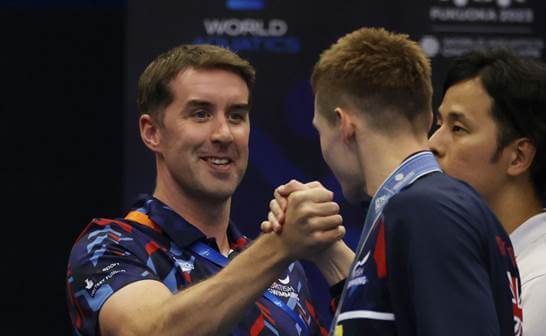
Steven Tigg: Photo Courtesy: Ian MacNicol, Scottish Swimming
GB head coach Steve Tigg recognised things may be different come 2028 where he expects the race to go down to the wire.
“We know that in LA it’s going to be closer than it has been in the past,” he said. “There won’t be us two body lengths ahead, it’s going to be a line. The boys want to get used to being under a little bit more pressure, and the line might be ahead of them.”
McMillan and Richards swam the first two legs of the mixed 4×2 relay followed by Freya Colbert and Freya Anderson as the British quartet won gold ahead of Germany and the Neutral Athletes B team.
It was, says Tigg, a chance to hone their race craft.
“The reason we took the 4×2 mixed so seriously was to give Jack and Matt the opportunity to race two very strong Germans and then to give Freya and Freya the opportunity to race two very strong other Germans as well.
“We thought, look, this is a chance to practice, half your relays together and again, learn the craft. We saw 1:55.9, I think, from Freya Anderson, fastest she’s been since 2018, which is great. And that’s what you want to use it for. You’ve got to take the opportunity and everything that’s presented. And if people are swimming fast, there’s going to be an opportunity to learn.”
