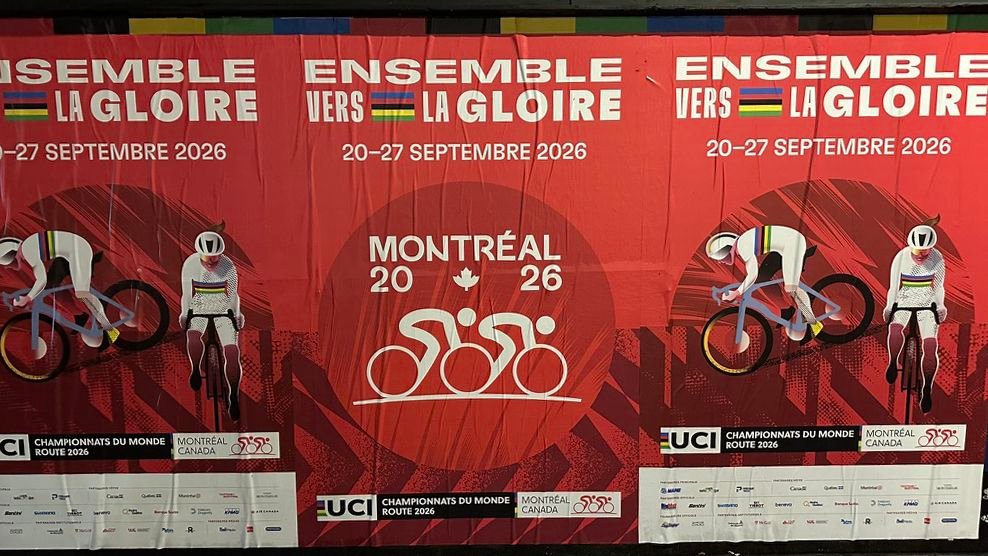
For the next week, 20–27 September, the Canadian city of Montréal will be hosting the 2026 UCI Road World Championships. I’ve just been to visit, scoping out Québec’s biggest city before the best cyclists on the planet (well, those that aren’t injured) arrive in town and turn everything on its head.
So, whether you’re visiting to watch the worlds, or spectating from afar, here are a dozen things you should know about Montréal.
1. This isn’t the first time the UCI Road World Championships has been staged in Montréal – the city also hosted the Worlds back in 1974, which was an extra significant event because it was the first time the prestigious championships had been held outside of Europe. That year Eddy Merckx took the rainbow jersey, completing a Triple Crown (having already won the Giro d’Italia and Tour de France that year.
Latest Videos FromCycling Weekly
2. The name of the city derives from the volcanic hill that towers over it, Mount Royal, around the flanks of which the 2026 World Championships course wends. When the worlds isn’t happening here, these same roads and various gravel tracks that spin off them are popular with local riders. The first European to climb to the summit, led by local First Nation people, was Jacques Cartier du Couvreur on 2 October 1535, and it was he who called the peak Mont-Royal, from which the city of Montréal took its name.
3. Montréal was officially founded on 17 May 1642, making the city considerably older than the country of Canada, which only came into being on 1 July 1867.
4. The streetscape of Montréal is covered in spectacular graffiti and giant murals, including – until very recently – one depicting Hugo Houle, the second Canadian and first Quebecer to win a stage of the Tour de France, dedicating his 2022 victory to his brother, Pierrik, who was killed in 2012 by a hit-and-run driver. But, on the very eve of the Worlds coming to Quebec, the painting of Houle has controversially been replaced by one of fellow Canadian cyclist Michael Woods (who is from Ontario) celebrating his 2024 Vuelta a España stage win. The mural is on the side of a building owned by Sylvan Adams, the Israeli-Canadian owner of the Israel-Premier Tech team both men rode for.
5. The best bar food in Montréal is a dish called poutine, which is basically chips in gravy with spring onions and cheese curds – it’s not the prettiest meal in the world, but it’s delicious, goes well with the equally wonderful local IPAs and is brilliant for carb-loading if you’re going cycling (although we doubt Wout van Aert or Demi Vollering will be scoffing too much of it the night before their big rides).
6. Also, bagels. Montréal is famous for its world-class bagels, especially Fairmount Bagels, baked in wood-fired ovens in the funky suburb of Le Plateau, beneath Mont-Royal. These are the best post-ride feast imaginable.
7. Protected bike lanes spider all around the streets of Montréal, including some Copenhagen-style ones, there are dedicated bike streets and the city has an excellent shared-bike system called BIXI. I also found drivers to be disarmingly polite compared to those in most other cities – perhaps because of this campaign about road-crossing awareness that ran a few years ago.
8. Like Manhattan, Montréal is an island. The city is surrounded on all sides by the waters of the magnificent St Lawrence River which, further downstream, opens up into the immense Gulf of St Lawrence.
9. You can spot black squirrels in Montréal and the city is also home to bin-raiding racoons and cheeky chipmunks, which can be seen around Mount Royal, in Parc Jean-Drapeau and various other green spaces.
10. Over 30km of subterranean tunnels burrow beneath the surface of Montréal, so you can navigate the city in comfort even in mid-winter, when temperatures can plummet to -20°C. Sadly, cycling is not allowed in these underground passageways.
11. One of the most popular places for visiting cyclists to explore is Île Notre-Dame, a small island in the St Lawrence River reached via a bridge from Montréal, where you can ride around the track of the Formula 1 Grand Prix circuit, which is named after Gilles Villeneuve, a Canadian racing legend who was killed during the 1982 Belgian Grand Prix.
12. Montréal is sometimes known as the City of Saints, because of its many Catholic churches and cathedrals. But it’s also known as the City of Sin, because people flocked here for boozy weekends during the Prohibition era in the United States.
