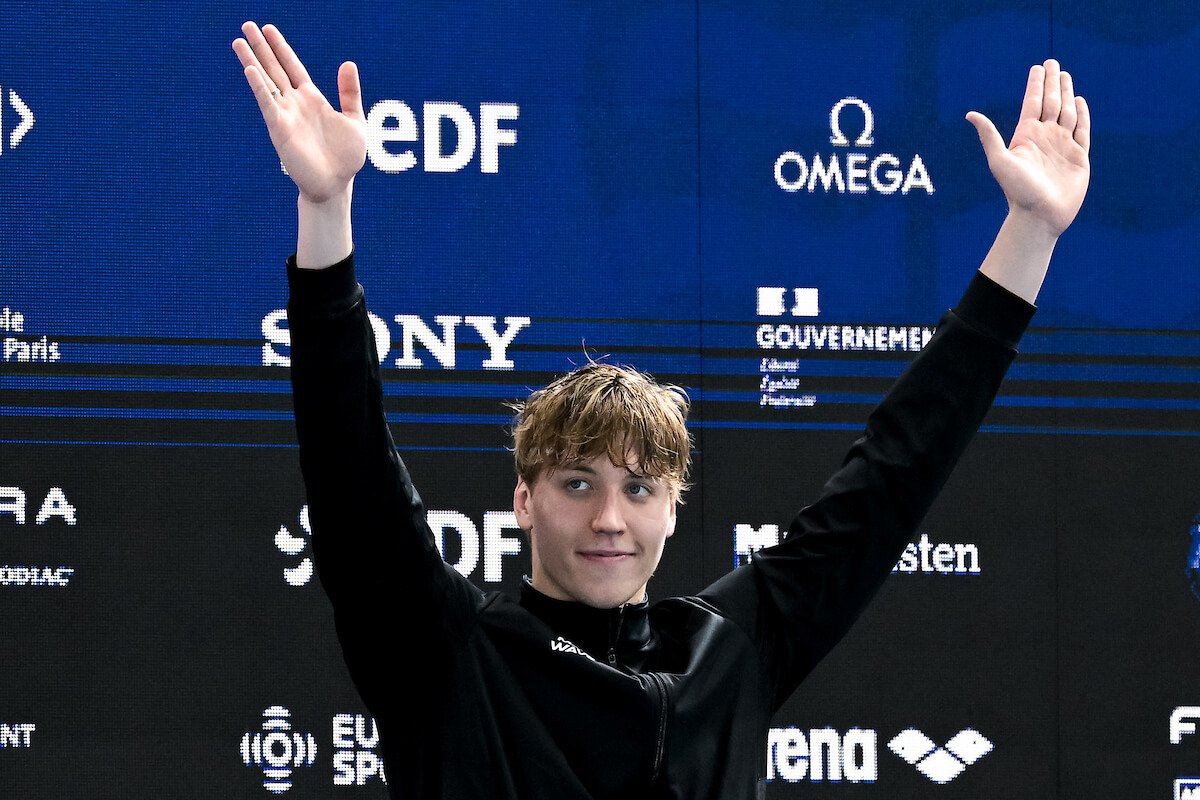
Egor Kornev vs. Kyle Chalmers: World Record Comparison (100 Freestyle)
During the first stop of the World Cup Silk Road Tour, 22-year-old Egor Kornev of Russia tied the 100 freestyle world record set by Kyle Chalmers of Australia. Like Kornev, Chalmers broke the 100 free world record at a World Cup stop back in 2021. Even though they both swam a time of 44.84, their races looked very different. Here’s a comparison.
Egor Kornev
Kornev swam the first 50 in this race with a very different approach than most do in the 100 free. He sacrificed a little bit of speed for higher efficiency. Even in his 50 frees, Kornev is known to have a much longer stroke than the typical 50 freestyler. This 100 freestyle was no different.
He flipped at the 25 in 10.1 while taking eight strokes. Eight strokes is a very low number for the first 25. This theme continued on the second 25, where he took nine strokes, flipping in a time of 21.6, two tenths off of Chalmers’ record pace. At this point in the race, Kornev looked like he was swimming a 200 free, not a 100. This gave him an incredible boost for the last 50.
Kornev’s stroke count rose with every 25. He saved his energy for the final 25, where he took 14 strokes, which is more than even Chalmers managed in his swim. Kornev came back in 23.2 and had incredible consistency throughout his 25-meter splits. His second, third, and fourth 25 were all in between 11.5 and 11.6. Because his stroke was longer on the first 50, he possessed more energy on the last 50 to increase his tempo, allowing him to have the same splits on the last three 25s.
Kyle Chalmers
Chalmers took his race out fast in a time of 21.4. Unlike Kornev, his stroke count was high from the start, and he maintained that tempo throughout the race. His last three 25s had stroke counts of 12, 12 and 13, respectively, but his splits slowly dropped off throughout the race.
The last 25 for Chalmers was his slowest. He came back in a time of 11.8, two tenths slower than Kornev. His last 25 was a half-second slower than his second 25, which was 11.3. Chalmers sacrificed efficiency for speed, and because he does not have as much natural speed as Kornev does, he is forced into using a strategy like this, especially in the short-course pool.
Compared to Kornev, Chalmers found a rhythm and stuck with it. Rather than shifting gears every 25, Chalmers was consistent in terms of his stroke count. Being able to practice at a certain stroke count makes it easier to repeat in a race.
Similarities
When two swimmers swim the exact same time, there have to be things that are similar. In this race, there are two main similarities: the stroke technique and underwaters. Both swimmers have a gallop-like stroke. Kornev has more of a gallop than Chalmers, specifically on the first 50. By the last 25, their strokes look very similar in terms of how high they are in the water.
Both swimmers stay underwater for about 10 meters. Other than the first 25, both focus on getting up and swimming once they hit that 10-meter mark. They are underwater until their speed begins to slow, and they focus on long and powerful kicks rather than short and fast kicks.
Kornev will have a chance to hold the record outright this weekend at the second stop of the Swimming World Cup Silk Road Tour in Tashkent, Uzbekistan. If he can dial up his speed a little bit on the first 50, he will have a great chance to break the record. At such a young age, he should have many more chances to break the 44.84 mark, but this next stop could be where he gets it done.
