College sports are in a state of chaos — at least that’s what certain corners of Capitol Hill will tell you.
The industry has been thrust into a shift toward professionalism following decades of resistance to changing economics. That rub has created an environment lacking central governance and authority in a world where rules have merely become suggestions in a way that’s never been more apparent.
Those fears from administrators, commissioners and other stakeholders led, at least in part, to the introduction of the Protect College Sports Act in June.
The PCSA is currently weaving its way through Congress and presents the best chance the industry has had for federal legislation — albeit the journey remains arduous and complicated.
Here’s a brief explainer on what it entails and what comes next:
What Is The Protect College Sports Act?
The PCSA is a bipartisan bill spearheaded by Sens. Maria Cantwell (D-Wash.) and Ted Cruz (R-Texas) that aims to bring governance to college sports.
It’s essentially a spiritual sequel to the House settlement — a sweeping antitrust suit resolved last summer that combined the House, Hubbard and Carter cases and opened the door for schools to pay athletes directly.
The primary objectives of the PCSA include:
- Implementing a “hard” revenue-share cap and closing loopholes to avoid schools utilizing multimedia rights partners (MMRs) and other partners to circumvent the cap
- Establishing a $22.5 million retention fund, with up to $5 million in additional retention spending earmarked for women’s and Olympic sports ($27.5 million total)
- Adding certification requirements for MMRs, sponsors, apparel companies and vendors to ensure legitimate NIL deals
The bill also stipulates varying regulations around transfer rules, conference realignment, coaching movement and other topics du jour percolating around college sports in the current climate.
The NCAA — which has long supported federal legislation through millions of dollars spent in lobbying efforts — sent its membership a memo on Friday that outlined key points of the bill, such as requiring the NCAA to oversee school compliance, preserving existing broadcast contracts and defining the reach of national eligibility rules.
The conference realignment clause has been a crucial piece of the puzzle in recent weeks as earlier drafts of the bill capped maximum conference membership at 19 schools, while those institutions attempting to depart would be required to spend five years as an independent. Recent reporting, however, indicates that language has been adjusted to force just three years of independence, while that specific provision would sunset after six years.
Not coincidentally, that six-year window that would open the door for schools to again jump ship more freely coincides with the expiration of a number of television contracts across the college sports ecosystem that are slated to come due over the next five-plus years.
Who Are The Major Names That Are Backing The Act?
Cruz and Cantwell have been the key names in the Senate pushing legislation, but there are plenty of other key voices with vested interests in its passage.
The Big Ten and SEC were among the last conferences to offer their support of the bill as they worked through varying language changes with lawmakers over the summer (Again, keep an eye on expansion language). The ACC, Big 12 and others across the FBS have also lent their support to the bill.

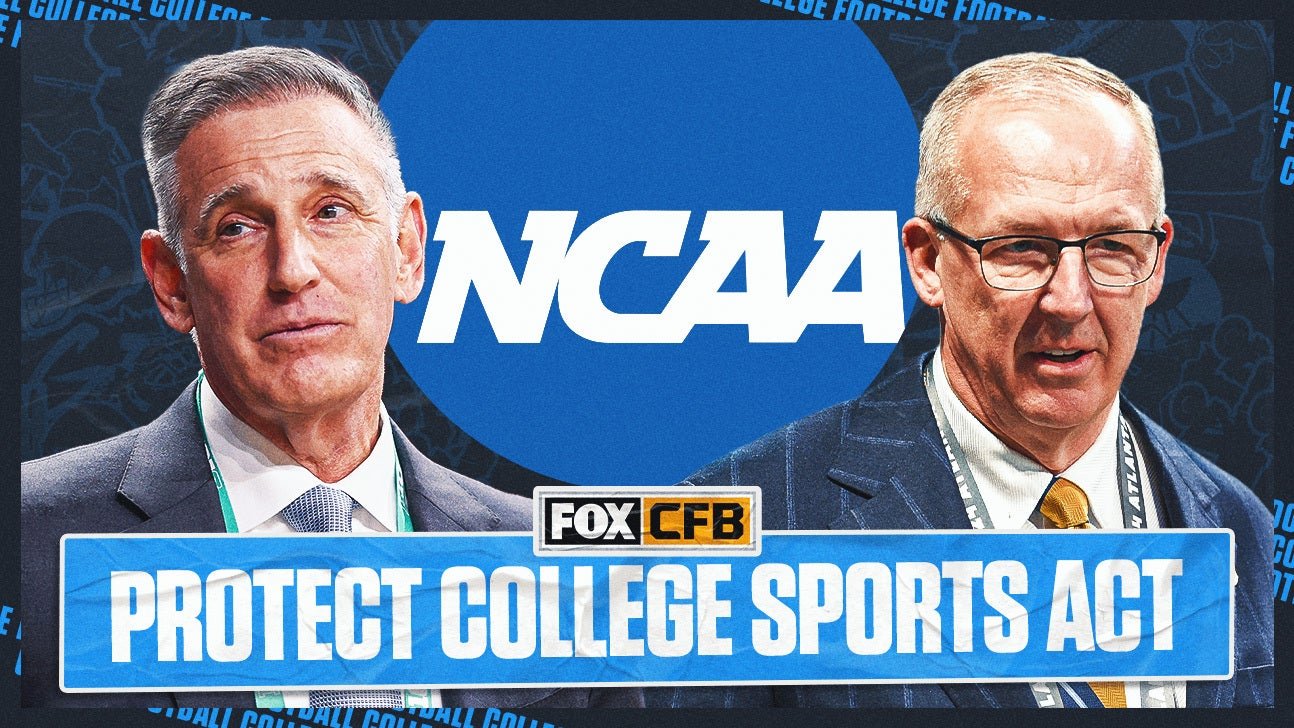
SEC Commissioner Greg Sankey and Big Ten Commissioner Tony Petitti were among the last conference commissioners to offer their support of the Protect College Sports Act. (Photo by Jamie Schwaberow/NCAA Photos via Getty Images)
The other key name that has been instrumental in the bill’s progression to this point is Texas Tech booster Cody Campbell. The former Red Raiders football player-turned-oil baron and his 501(c)4 Saving College Sports has been a staunch advocate for the bill, running commercials pushing for its approval for months.
Those opposed to the bill include a handful of Senators on both sides of the aisle and a number of organizations designed to represent athletes’ interests in ongoing conversations about labor and college sports.
Sens. Chris Murphy (D-Conn.) and Cory Booker (D-NJ), who himself played football at Stanford, have been among the notable vocal critics of the bill.
When Could The Protect College Sports Act Pass?
The PCSA is still very much in flux.
The bill took an important step last week, receiving 74 of 100 possible votes in its favor to halt debate and invoke cloture in the Senate — technical terminology that effectively means move it to be voted on.
The shift does not guarantee passage in the Senate, but it marked a crucial move amid a handful of procedural votes required to proceed the bill, eventually, into the House. Now comes two more votes in the Senate before it might be passed — efforts that could happen as soon as Tuesday.
That said, the timeline remains tight and a fight in Congress’ other wing looms.
The Senate is slated to go on its pre-election recess on Oct. 3, giving lawmakers just two weeks to guide the bill onto the House, where it’s expected to receive significant pushback.

The Protect College Sports Act could pass the Senate this week. (Tom Williams/CQ-Roll Call, Inc via Getty Images)
There is also a matter of the coming midterm elections, which figure to reshape the composition of the House and Senate. Given the widespread bipartisan support the PCSA has enjoyed thus far, that may not be a killer.
However, those involved in the proceedings have cautioned that the House presents a stiffer challenge for passage than the Senate and there figures to be a notable shake-up in who is actually in office by the time this might come to a vote.
College sports might just get its bill through the Senate this week. What happens beyond that?
That’s anyone’s guess.
