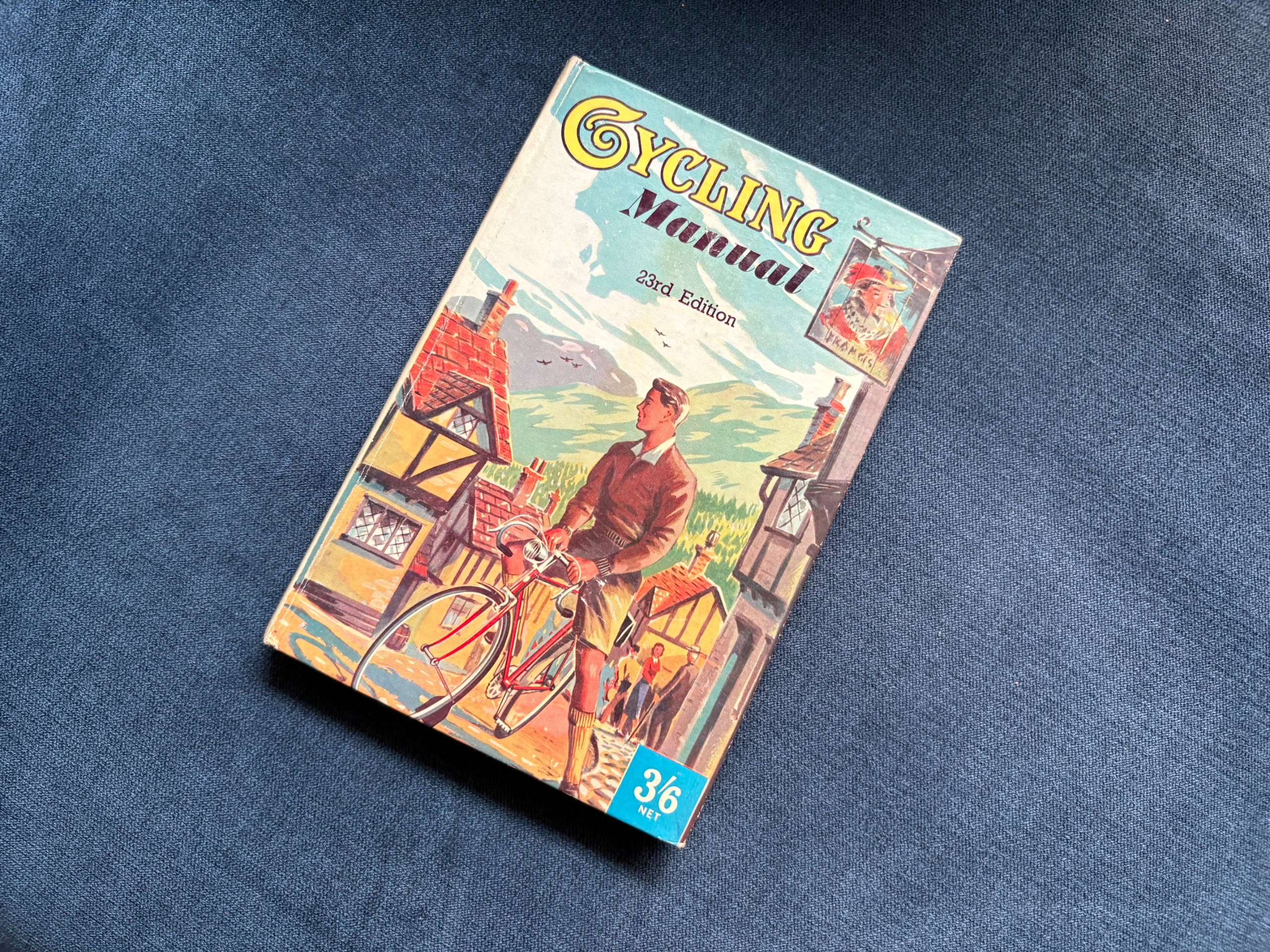
You can’t beat a bit of nostalgia, and cycling offers so much food for reminiscence. In fact, the sport is pretty much built on it. The long-standing Monuments afforded special status because of their history, held on cobbled roads that are entirely impractical but preserve a sense of history; the bikes that must look like they always have done.
Don’t get me wrong – I personally love it, as many do. It’s that appreciation for history, perhaps, that found me browsing through the wares of an antique bookshop on a recent day off. That was where I turned up an especially cute-looking book, 72 years old, called ‘Cycling Manual’. The font on the cover was familiar, as was the author, H.H. England. He was the then-editor of Cycling Weekly (then simply called Cycling), and the book was published by the magazine.
As a journalist in the cycling space there’s rarely a day off. Or, as this book – written in the characteristically patriarchal language of the era – would likely put it: ‘the keen journalistic man is always on the lookout for new material’. A snip at £10 and in very good condition indeed, I’d have bought it anyway. But it quickly occurred to me that the ‘Cycling Manual’ offered an intriguing glimpse into a past world, and I thought I’d share it. Here’s a selection of insights into a bygone era – some are outdated, but more surprisingly others still hold true today, and we can even learn from them.
Latest Videos FromCycling Weekly
I’ve set aside the manufacturing and social limits of the time – there’s nothing to be gained from suggesting that the 1950s rider would have been better off with a carbon-fibre gravel bike over a lightweight roadster, for example – and concentrated on the general approach.
(Image credit: Future / James Shrubsall)
We know better now (at least we think we do…)
Take it easy, kids
“Don’t go all-out unless youth is on your side”, and “the growing boy and girl can take part in club time trials, but they must be advised not to race all-out, not even to beat a near rival”
H.H. offers a lot of well meaning health-related advice throughout the book, presumably based on the accepted wisdom of the day. A surprising amount of it has stood the test of time, but plenty hasn’t. In this case, an increasing number of riders signing on the line for WorldTour teams while still on junior gears would probably attest that unless they’d tried pretty hard in the preceding years, they would unlikely be where they are. That said, there are still those – CPA president Adam Hansen, for example – who would prefer a more cautious approach here.
At the other end of the scale, the popularity of masters championships and riders like 67-year-old ultra-distance record breaker Joe Barr disprove the idea that going hard in your later years can’t work out.
It’s all in the ankles
“Select a hill up which you normally ride halfway and then dismount. Pedal the first half of the hill in your normal style and then start ankling. You will be amazed at the ease with which you can accomplish the rest of the climb.”
Of all the advice within the ‘Cycling Manual’ – and much of it really does hold true today – this is perhaps the most fantastical. The idea that ankle movement alone could bridge the difference between finding a hill so hard you have to get off and walk and completing it with relative ease just doesn’t ring true.
I’m old enough to remember ‘ankling’ being standard advice for developing cyclists back when I began. Of course I tried it, but quickly gave up. The exaggerated heel-drop at the top of the stroke and backward scrape at the bottom was just tiring, to be honest. No doubt there are those that persevered and have found it useful, but while maintaining a supple ankle is probably something we all do when pedalling, the scientific jury is out on the exaggerated ankling movement, and it has fallen by the wayside.

(Image credit: Getty Images)
Get the hot water ready…
“Get up and dress in shorts and shirt; drink a glass of cold water; do a series of breathing exercises; skip two to five hundred times”
And so begins H.H.’s daily workout recommendations. Prescriptive, one-size-fits-all training advice is hardly a thing of the past, and it’s not useless either. That said, modern off-the-peg training plans will be based on a personal FTP and geared towards a particular goal. H.H. England’s daily recommendations on the other hand are altogether from a different era. They begin with a glass of cold water and some breathing exercises. So far, so good. But then it’s time for a skipping session followed by a workout for the stomach muscles and a bath or a rub-down – all before breakfast.
At lunchtime there is an active recovery ride to get you ready for the evening, where, every other day, the proper work is done. This involves a 25-30-mile ‘out and back’ ride at a “romping pace”, which from the description sounds rather like today’s ‘tempo’. Two days later the running shoes come out (or perhaps plimsolls for the Fifties lady or gent), for a two or three mile jog-trot session. Then repeat on days five and seven to complete the week. Followed by a bath or a rub-down of course.
It’s easy to make light of such quaint directions, but in reality it’s hardly terrible advice for all-round fitness. I’m half-tempted to give it a go, in fact, and see what happens – but I won’t commit to that here. I’m not sure I could deal with all those baths. H.H. even points out that everybody is different, and suggests tailoring it if it doesn’t suit you. Sound advice. Which leads us on to…
Things we’d do well to remember
Health, not fitness
“The fitness that cycling gives is not necessarily of the athletic type… We are all entitled to ‘abounding health’, which involves feeling good as well as having an athletic body.”
This might seem like a rather quaint notion, the idea of health as being separate to athleticism, but it’s advice that feels ahead of its time. Modern tech has given us so many numbers to measure and parameters to track in search of excellence that it’s easy to forget that simple good health is worth placing on a pedestal.
While tech wearables can be useful in this respect too, helping us keep tabs on sleep and heart rate variability, the building blocks of sustained health are generally quite unsexy – a whole food diet, a well-rounded exercise regime that includes resistance training, and a goodly amount of kip. It’s a recurring theme throughout this book.

(Image credit: Getty Images)
Food for thought
“There is no special diet for cyclists. Any man or woman, cyclist or otherwise, eats more naturally than is the modern habit which accepts the commercially-prepared, easy to serve, palate tickling foods we take as a matter of course today.”
This little gem was found, for reasons unknown, in a chapter titled ‘Business riding and dress’, but that doesn’t make it any less applicable – either in 1954 or today. The core message is eat a healthy whole food diet.
Quite what the commercially-prepared, palate tickling foods of 1954 were, who knows. Ketchup, perhaps? But it’s safe to say the mind of the average Fifties grocery shopper would be comprehensively blown inside a few minutes of a visit to a modern food shop. The dominance of lab-grown ultra-processed foods means that eating well today is harder, and requires more focus, than ever.
Sometimes those processed foods can even be beneficial for our cycling – sports fuel when on a hard training ride, for example. But in most cases, the ‘Cycling Manual”s simple advice on this subject rings as true today as it ever did.
