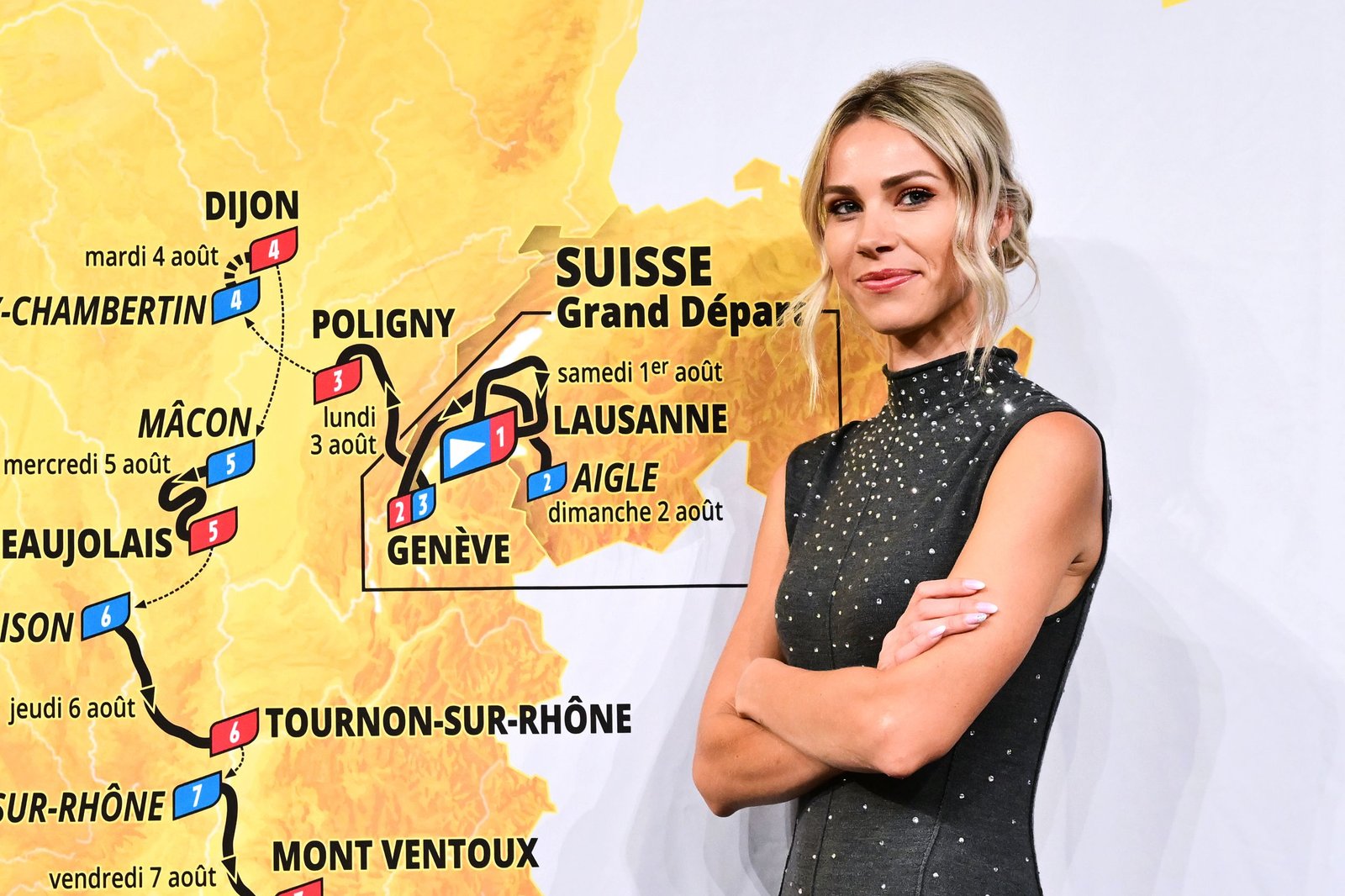
Marion Rousse has worn almost every hat in the cycling world. Born in northern France, she learnt to ride at the Roubaix Velodrome and went on to become national road champion in 2012. Three years later, however, at age 24 and earning no income from the sport – she was working part-time at a town hall to make ends meet – she retired from racing to pursue a career in media.
Today, Rousse is one of the most recognisable and influential figures in the sport. She’s the voice of cycling on France’s national broadcaster, France Télévisions, and directs the Tour de France Femmes avec Zwift, having spearheaded the race’s highly anticipated revival since taking the reins in 2021.
“I was always sure of one thing with this race,” she said after the first edition in 2022. “Creating a women’s Tour de France wasn’t a gift that we were giving to women’s cycling. They simply deserve it and you see the proof each day.”
Latest Videos FromCycling Weekly
Ahead of this year’s race, we sat down with Rousse for a Q&A.
How did you get into cycling?
I started when I was six years old. I come from a cycling family: my dad was a high-level amateur cyclist and my cousins, Laurent and David Lefèvre, were pros. As a little girl, I had a lot of energy, and I was bored of cheering on my dad from the side of the road. So I told my parents I wanted to ride myself. Initially, they weren’t on board because they said it was really hard for boys and would be even harder for a girl. They also said I was too young. My mum ended up taking me secretly to sign up.
You went on to turn pro. What has been the proudest moment of your career?
I had some amazing moments in my career, even if it was in a different era of women’s cycling, when we weren’t paid. Winning the French national road title [in 2012] in my home region in front of my family was nice. For me, sport is the best school for life: it teaches you about discipline and pushing your limits. My time as a pro helped me get where I am today in my career.
Why did you decide to retire from racing at 24?
Because I wasn’t paid. After I became French champion, Eurosport asked me if I wanted to try commentating on bike races. I did that for two years, but I got the feeling I wasn’t giving 100% in either of the two roles. At that time, I didn’t see the future of women’s cycling evolving so quickly, and since I wasn’t paid, I figured commentary gave me a good opportunity to stay in the industry I loved while also receiving a salary.
(Image credit: Getty Images)
In 2021, you became the director of the Tour de France Femmes. How did that come about?
I’d heard on the grapevine that they were bringing back a women’s Tour de France. Then, one day, [men’s race director] Christian Prudhomme called me and said, “We’re going to start the Tour de France Femmes avec Zwift. We need someone to organise it, and we want it to be you. We don’t have any other names. Take some time to think about it.”
Of course, when someone gives you an opportunity like that, you don’t have any other choice than to accept. I knew that the evolution of women’s cycling would come through the Tour de France; it was the only race that could get us recognised by the masses, bring in big audiences, and attract sponsors. I told Christian, “OK, let’s do it.”
Did you have any doubts about taking on the role?
Not really. Obviously it’s a huge role, but I knew that with ASO behind it, it would be run by experts. I also already had experience that I knew would help me in the role: as a former high-level sportsperson who knew and had lived through the past struggle of women’s cycling, I was probably more able to make the right decisions at the right moments than a man who had never been part of women’s cycling. I also had my media hat, and in the first few years, the race needed someone who was known to the public. It was all quite natural.
You also have your family life with Julian Alaphilippe, son Nino – and of course your dog Eliott. How do you find juggling everything?
It’s a unique lifestyle, and Nino’s arrival shook up a lot of things – the arrival of a baby for anyone is a big thing. We had to find a balance. Being able to count on my parents helps me a lot with fitting in all my work trips. I’m very lucky to have a little boy, five years old now, who is happy and understands the situation. And Eliott’s great – he’s so sociable, I don’t even know if he knows I’m his owner. He just adores everyone.

(Image credit: Getty Images)
Has the rapid growth of the Tour de France Femmes surprised you?
The fact it’s been this fast, yes. I was confident, because I trusted ASO and I knew that if they put the resources in to make it work, it would be a success. Last year, Christian Prudhomme was with me at the race – we did a few stages in the car together – and he said, “Marion, I no longer see the difference [between the men’s and women’s Tours] in the number of people at the side of the roads.” Our big hope was that people would no longer see a men’s Tour and a women’s Tour, but rather the Tour de France.
Do you feel pressure to grow the race every year?
No, but we put pressure on ourselves to come up with an exciting route and meet the high standards of the Tour de France. It needs to be prestigious. The hardest gamble for us was making women’s cycling a household topic for people, even though they didn’t really get to see women’s racing on TV.
In the first edition, I went to speak to the wider public, and they struggled to name a single rider. Now I’m really happy because everyone knows the riders; you see signs at the side of the road, and journalists talk about end-of-season transfers. We’ve really overcome an obstacle and now people don’t watch because it’s men’s or women’s cycling, they watch for the performances.

(Image credit: Charlie Forgham-Bailey/SWpix.com)
How do you respond to people who say the race should be three weeks long?
You’ve really got to put the race in its context: barely five years before [the race began], there were hardly any riders in the peloton who were paid. That’s very recent. The Tour de France Femmes is there to accompany the evolution of women’s cycling, and we can’t evolve quicker than women’s cycling itself. If we do, it’ll implode.
There was a Tour de France Femmes before us, the Grand Boucle Féminine, and it disappeared. It would be a catastrophe if, in eight years, we have to say, “It doesn’t work, we grew too quickly, and it’s all imploded.” Yes, it’s evolving quickly, but we’re not at the same stature as the men’s peloton yet. We also shouldn’t put any barriers in our way, and one day there might be more stages, but we won’t go from nine days to 21 overnight. It will need to be done little by little.
The rider union The Cyclists’ Alliance stated in May that women’s cycling is in danger and “built on fragile foundations”. What’s your sense of the health of the sport?
Bad. We talk a lot about women’s cycling, but it’s the same outlook on the men’s side, too. At the top of the pyramid, you have the men’s and women’s Tours, which are very solid and attract the best riders because we have the resources to organise at this level. But it’s becoming difficult to organise bike races. At many levels, races are made possible by volunteers, and everything is expensive. The bottom of the pyramid is really fragile.
What have been the defining moments of the first four editions of the Tour de France Femmes for you?
There have been many. We’ve been very lucky. We’ve had four different winners and that’s great. One of my favourite Tour de France Femmes memories was giving the start on the Champs-Élysées [in 2022]. I popped out the roof of the car, turned around, saw the peloton with the road behind them, and knew it was a big moment for women’s cycling.
Then there were the four seconds that separated Kasia Niewiadoma and Demi Vollering at the summit of Alpe d’Huez [in 2024]. That was a crazy scenario. And Pauline [Ferrand-Prévot]’s victory last year, the first Frenchwoman to win the yellow jersey. The number of people who came out to cheer her on at the roadside, the TV audiences we had on France Télévisions – we peaked at eight million viewers, the second highest that year, including the men’s race [the first was the Paris stage in Montmartre] – it’s incredible. Pauline and I started around the same time and I know her well, so it was a nice quirk of fate.

(Image credit: A.S.O./Pauline Ballet)
What does it mean to have a French winner? Have you noticed more home interest in the race?
Oh yes. We’ve waited so long to see a French man or woman take the yellow jersey again, and now it’s been done. It brought together an enormous amount of people. Pauline already had a big fan base, with lots of people behind her, especially after [winning mountain bike gold at] the Paris Olympics. For the development of women’s cycling, it was a steal to have her return to the road.
Do you think Ferrand-Prévot will be the first person to win the race twice?
I hope so for her. People have been questioning Pauline’s form a lot this year, saying she’s not as strong as last year, but I think she’s on the same trajectory – I’m not too worried for her. She has this ability to fix an objective in the year, and arrive 100% ready. She’ll be very strong. That said, it’s true that Vollering has taken a step up. I think the level has improved since last year. You’ve also got riders like [Vuelta Femenina winner] Paula Blasi, who will be interesting to follow, and Marlen Reusser, with the time trial. I think it will be a bit closer than last year, but I still believe in Pauline.
Quickfire round
What was your first bike? It was a black Alan road bike with downtube shifters.
Who was your childhood cycling hero? When I was really young, I loved Erik Zabel. Then when I grew up a bit I was a Tom Boonen fan.
What’s your favourite place to ride? Now, with my lower level, I like going to Calpe [in Spain]. It’s a bit hilly, but you don’t have to climb mountains. The south of France and the Alps are also great.
Your favourite Monument? Paris-Roubaix.
Your favourite type of stage: mountains, sprint or breakaway? Not sprints, especially when I commentate on them for seven hours and nothing happens! High-mountain stages are always great. But as a commentator, you’re always less disappointed with the Classics-y stages, where there’s a fight from the beginning, compared to the high mountains. With those, you know you’re going to have a good afternoon in front of the TV.
Your favourite mountain in France? I love Mont Ventoux. I’ve climbed it five times.
Your favourite sport after cycling? I really like following biathlon and athletics. But especially biathlon, because it’s in the winter and there’s no cycling to watch.
Who’s the next star of women’s cycling? Célia Gery.
What do you do to relax? I go through real on-off periods, so when I’m at home, I’m a real mother hen. I love going for walks or to restaurants with my son.
This feature originally appeared in Cycling Weekly magazine on 30 July 2026. Subscribe now and never miss an issue.
Explore More
