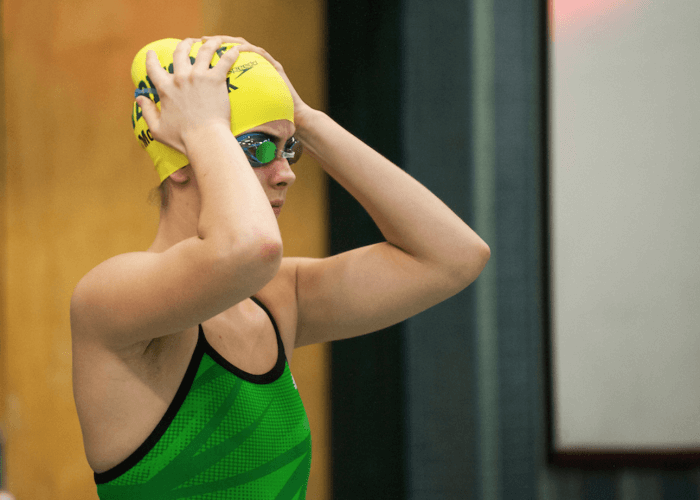
The Power of the Mind Through Visualization
By Taylor Byers, Swimming World College Intern.
You are behind the blocks, staring down the end of your lane. The warm, chlorine air is strong. Coaches, teammates and parents are cheering and whistling for the swimmers currently racing in the water who are fighting to get their hand on the wall first. Your cap is pressed tightly against your head and your goggles are secured. You are ready to blast off the blocks.
Photo Courtesy: Brian Jenkins/UVM Athletics
Imagining your swims before meet day can be done through an advanced technique called visualization. Visualization refers to the self-created images and experiences in the mind. The significance and complexity behind visualization can be so powerful and beneficial to swimmers, if done correctly. There are multiple steps and key tricks to visualization that can be done to help overcome fear, build self-confidence and develop new skills faster, which programs the inner GPS and overrides limiting beliefs.
Dr. Michael Gervais, a sports psychologist, believes the objective of visualization is, “to create such a lifelike experience that your body believes that it could be real.” Studies show that the brain is not able to differentiate between a real memory and an imagined (visualized) memory. Whenever extreme vivid images are in the mind, the brain has a hard time distinguishing between something that is imagined versus something that is real. This is why Gervais believes that visualization should be a full sensory experience.

Photo Courtesy: Twitter, @michaelgervais
Gervais also mentions: “There’s a switching on or an animation that happens within you when you create an image that is crisp and has color, and sound, and smell and taste.” The better you can imagine all of those senses, the more realistic it feels to your brain.
As heard before, swimming is not only a physical sport – it is also a mental sport. Our bodies are trained physically every day at practice. However, our minds also need to be trained but in a different way. Visualization is a way to train your mind. Imagining your races will train your brain to get used to swimming your events, just as you race six one-hundreds off the block at practice to train your muscles to get used to swimming your events.
Visualizing programs the subconscious brain. When you are relaxing and imagining your races, you are programming your subconscious mind to store and remember everything you are picturing. The subconscious brain is a huge memory bank in which it can permanently store everything that ever happened to you. Your conscious mind commands, while your subconscious mind obeys. This means that whenever you are behind the blocks, your conscious mind is commanding your body to race, and your subconscious mind obeys and tells your body how to perform. So if you train your subconscious mind to race how you want to race, then whenever it is being commanded to do so, it executes.

Photo Courtesy: Annie Grevers
Michael Phelps and Bob Bowman once broke down how they feel visualization should be done. They started Phelps’ visualization process by getting the body in a completely relaxed state. Bowman stressed how the visualization had to be vivid and rehearsed many times. Phelps would rehearse his races hundreds of times before the day of the race so that when he would step up on the blocks, his body goes on autopilot. His body knew what to do from rehearsing so many times, and his races became second nature in a way that his brain already knew how to swim the race.

Photo Courtesy: Robert Stanton/USA Today Sports Images
One important part of Phelps’ visualization was imagining anything that could go wrong and being prepared for it. If he had a suit rip or goggles fill up with water, he would be ready to fix the issue or overcome the adversity of swimming with water in his goggles. That way, once race day came and for some reason one of those things happened, his mind did not go into panic mode. Phelps was able to stay calm and work out the problem.
Visualization is a committed practice. It is ideal to do it at the same time every day. The best time to visualize is in the morning as close to waking up as possible. In the morning, the mind is still slightly lucid so that makes it easier to summon crystal clear images like you would encounter in your dreams.
What kind of visualization practices are helpful for you?
-All commentaries are the opinion of the author and do not necessarily reflect the views of Swimming World Magazine nor its staff. All research was conducted by the author.
