
Max Ashton could not believe what he’d just witnessed.
The Washington Commanders had managed to squander their attempt to beat the New York Giants in overtime because, to put it as kindly as I can, they failed to execute a professional two-minute drill. The game ended in a rather deflating 27-27 tie.
Ashton, 20, left that game unconvinced that Commanders coach Dan Quinn or quarterback Jayden Daniels were incapable, but rather wondering if running a two-minute drill in the NFL or at the highest levels of college football might be one of the more difficult tasks in team sports.
At class on Monday at the University of Tennessee, seeing classmates pass time playing mobile games, Ashton had an idea: What if he just made a game, an app, that allowed for people to simulate a two-minute offense and defense?
So he built one. It’s called Two-Minute Drill, and it’s as addictive as it is fun to play. I had already upgraded my account to Pro before Ashton and I began discussing his web browser game.

Max Ashton with his parents, Brent and Robin Ashton, at a Tennessee football game. (Photo courtesy of Brent Ashton)
A Clear Vision
“There were two aspects to the game,” Ashton told me by phone. “I wanted to make the game fun, and I did not want to overwhelm users with a bunch of numbers and data. I knew I wanted them to see player ratings, the percentages for how successful a play might be involving a run or a pass and a specific player. But I didn’t want to give people a math lesson.”
Ashton wanted to give football fans a chance to test themselves against play-callers or head coaches of their favorite teams. For me, the thrill of seeing I’d defeated Nick Saban or graded out with a 91 as a play-caller was enough for me to spend hours playing through the game over and over again. Ashton, who majors in business analytics, also made the game as an application he hopes NFL franchises might take advantage of. And why not? It’s good, and it’s free.
“Two-minute [drills are] where games get decided a lot,” Ashton said. “I mean, you’ve got seconds to make a call that swings the outcome and I think this app could potentially help some NFL front offices just decide those last two minutes if they don’t have that data.”

Alabama-Tennessee. Tie game. What do you do?
At its core, football is a game of strategy. It’s not played against a computer or analytics, but people. And people are fallible, make mistakes and blunder all the time.
Those blunders and brilliant moves are also what makes playing against each other so much fun. That’s the reason Ashton has plans to roll out a multiplayer game with a running play clock. He had resisted adding those components to the first iteration of Two-Minute Drill.
“I wanted the game to be fun and casual, and two-minute drills are not fun or casual,” Ashton said. “So it’s hard to balance the game by adding the actual pressure of the moment, and I hope multiplayer will bring a good balance to making the moment feel a little more intense, but still fun.”
‘Prove It With My New App’
Ashton built and launched Two-Minute Drill in two days. It’s a remarkable feat, and one his father, Brent Ashton, marveled at.
“I’ll be honest. It’s very crazy,” Brent told me over the phone. “Back when I was his age, you couldn’t do this. To build a video game would have taken years. I’m sure he put in some sleepless nights. He’s a very persistent kid. For him to be able to pull this off is really cool, and it’s been a little surreal ever since then.”
Brent was referring to last week, when Ashton launched the app and promoted it with a post on X, formerly known as Twitter.
As of Wednesday afternoon, that post has been viewed more than 16 million times, reposted nearly 5,000 times and liked more than 33,000 times. The game is a hit.
“I think about 700,000 people played it on the first day,” Max said. “When there’s that many people playing the game, there’s going to be quite a few bugs and things to fix. And so I did not really get much sleep last week or weekend.
“I want to make the best product for the people who enjoy it, and I will say the overwhelming amount of positivity from everyone I’ve gotten about this game has been the best part of it.”
No one in Max’s life told him he couldn’t do it. Not his older brothers Bennet or Blake. And certainly not his parents.

Tennessee student Max Ashton built his game, Two-Minute Drill, in just a couple days before it took off.
“I give him credit,” Brent said. “I think he deliberately chooses to do a little bit more on his own than maybe most kids do. I don’t think he wants to prove to me, but to the world that he can do this, and I don’t necessarily need my dad stepping in to help.”
In a matter of days, Max turned a miserable NFL game ending into a video game enjoyed by thousands — all while attending college full-time in Knoxville. It’s an impressive display of drive, and somehow, not even his most impressive accomplishment.
‘It Has Made Him Appreciate Life’
Max beat cancer.
The youngest of Brent and Robin Ashton’s three boys, Max was diagnosed with leukemia at age nine.
“Seeing your kid go through that is really, really tough,” Brent told me, “It was a big shock when he got diagnosed, and, honestly, I don’t remember a whole lot about that day.”
Max received treatment at Children’s Minnesota-Minneapolis Hospital for three years. He was diagnosed with leukemia at 9 and entered remission at 14.
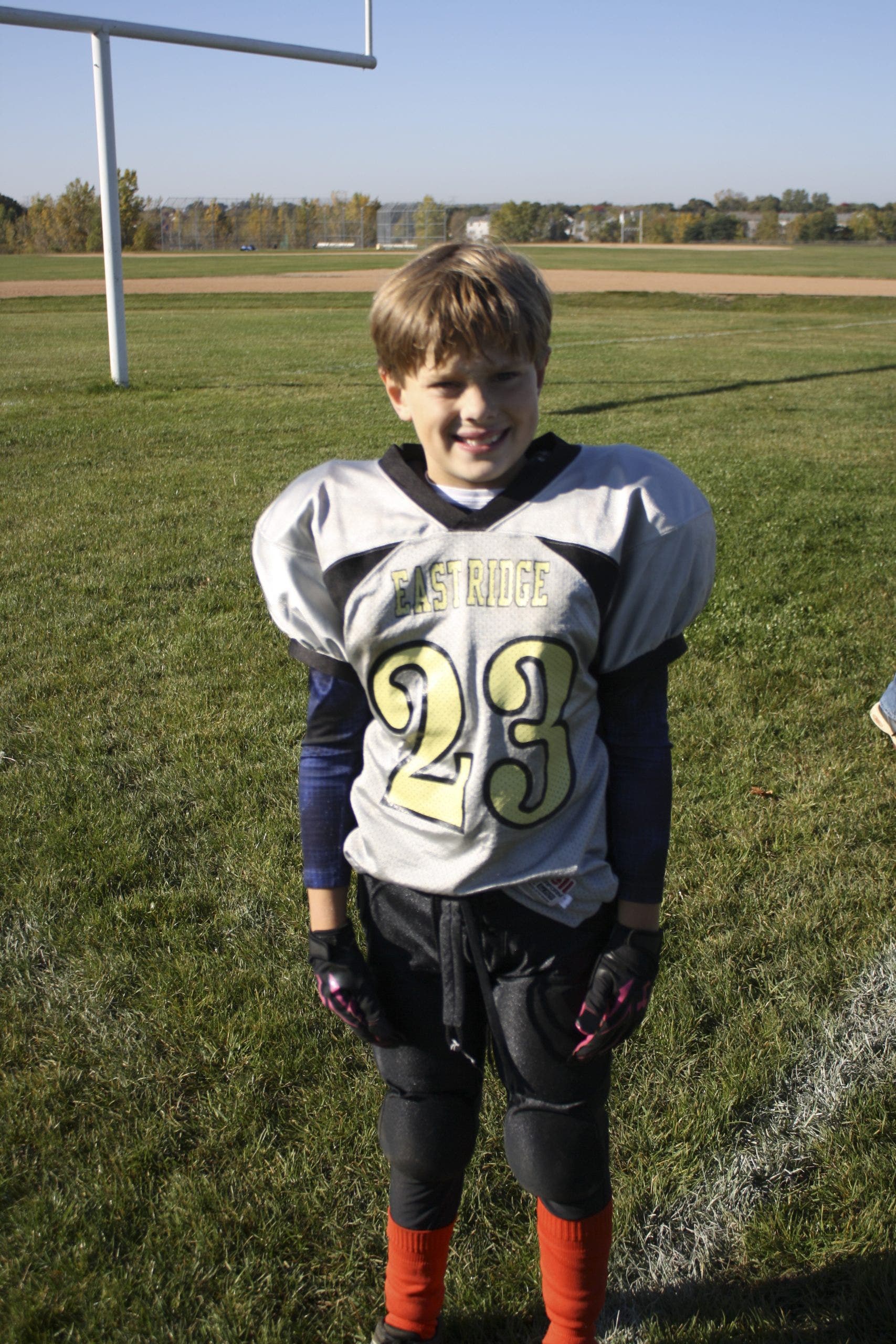
Max Ashton in 3rd grade, the fall before he was diagnosed with Leukemia. (Photo courtesy of Brent Ashton)
“He battled through it,” Brent said. “Had some ups, had some downs. I think I learned a lot about him from it. I think it has made him appreciate life.”
Max’s obsession with sports went beyond the playing field. Watching games with him as a boy, Brent told me Max could get out a player’s rating or analytical metric of note before most broadcasters. When he was diagnosed with cancer, none of that changed, even when doctors told him he could not play tackle football because he had a port implanted in his chest to deliver medication.
But there was always baseball — until there wasn’t.
At 11 years old, Max was put on blood thinners, meaning a blow to the head from a baseball could cause a potentially fatal bleed. Brent knew Max needed baseball in his life.
“I knew if he had to stop playing baseball he was going to get into a bad mental state,” he said.

Max as a child playing first base. As his dad, Brent, told me, it’s one of his favorite photos because you can see the look in his eyes staring at the ball and stretched out as far as he can. (Photo courtesy of Brent Ashton)
Wearing a batting helmet at every position was unusual in Little League, and not everyone understood why Max did it. During one game, an opposing first-base coach noticed Max wearing his helmet at first base and told him he’d forgotten to take it off.
“Max totally ignored him,” Brent said. “Didn’t even give the guy the time of day. Would not acknowledge it.”
Eventually, one of Max’s coaches politely asked the opposing first base coach to knock it off, but that story sticks in Brent’s mind as formative for his son.
“That was just him,” Brent said.
“Fast-forward to today,” Brent said, “and I think he’s a little more open about his [cancer diagnosis]. He’s made some money from [Two-Minute Drill] and the first thing he did was give back to Children’s Minnesota, which was actually really cool to see.”
For me, too, Brent.
For all of us.
