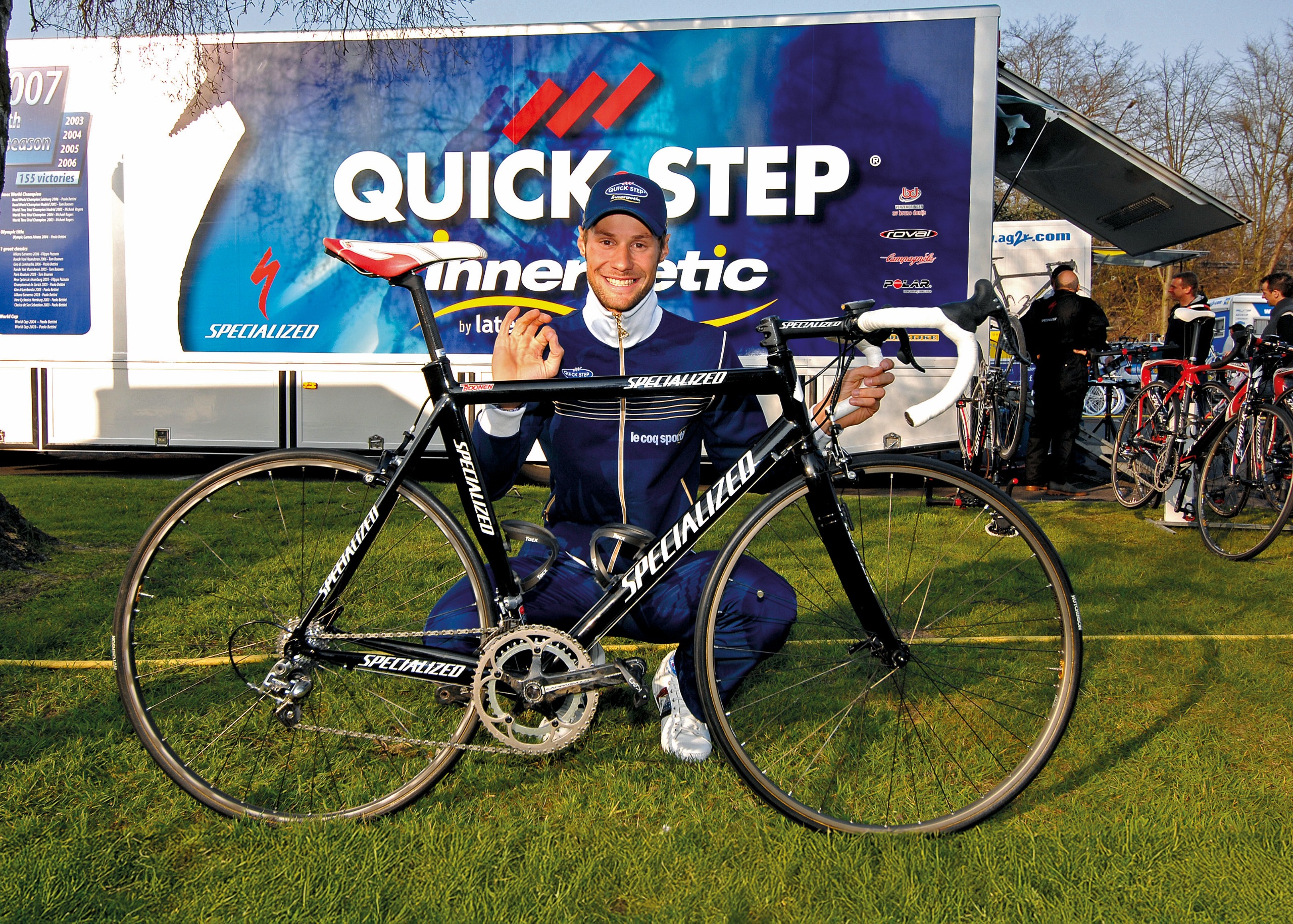
Tom Boonen, Classics demi-god and all-round Belgian superstar, is at Specialized’s California HQ, and he’s not a happy man. It’s 2006 and the Paris-Roubaix/Tour of Flanders double defending champ is at the height of his powers. He needs a stiffer bike, though. The Specialized Tarmac SL isn’t cutting it.
“It was quite an uncomfortable situation,” recounts Specialized’s leader of brand voice Ben Capron. “We had done every test we knew of stiffness and weight, and we’d tested the Time bike they had [been riding before]. [When Boonen saw] the stiffness data with his own eyes, he waved it away and said, ‘I don’t care about that’. He was standing there [on the bike], and said, ‘When I’m in the saddle and I’m winding up for a sprint,’ – and he wiggled his butt – ‘the bike flexes like this. It’s too flexible. I can’t wind up for my sprint’.”
It was a salient lesson for the team at Specialized, who managed to develop a brand new test and a brand new rear end – to satisfy Boonen’s rear end. They called it the SL2, and it changed Boonen’s mind comprehensively. “This is the best bike I’ve ever ridden,” he told Capron, who remembers: “That season, he won everything. It was a great testimony.”
(Image credit: Getty Images)
The Tarmac is now on its 10th iteration – nine SL models, plus the original 2003 offering, fashioned from the brand’s E5 aluminium. That original bike was, by all accounts, a harsh machine to ride. While Specialized’s own history books call the first carbon SL “a blank canvas that we could begin to channel our… design ideas into,” they hail the SL2 as “the first Tarmac that was both comfortable to ride and formidable to race.”
‘We literally sat in a room and said, “should we just get out of the road business altogether?”‘
It was a watershed moment for the Tarmac. A coming of age. But it hadn’t been so long before that it was just a twinkle in a Specialized designer’s eye. In fact it nearly didn’t happen at all.
“At a certain point in the mid to late-Nineties, the road business was single-digit for us,” Capron says. “We literally sat in a room, and said, ‘Should we just get out of the road business altogether?’ We contemplated that question, and then a teammate who’s not with us anymore slammed his fist on the table and said, ‘No, we’re going to go all-in, and one day we’re going to win the Tour de France’. And it was so ridiculous that we all laughed out loud. And then the room got really quiet, and you could just feel the commitment in the room.”
The pro peloton beckons
Specialized’s first road goal, even before the Tarmac was officially launched, was to enter the pro peloton. The brand’s mountain bike image could have held it back, but in 2000 it was taken on by the Festina team, who weren’t exactly flavour of the month following a major dope scandal 18 months previously. “We sponsored Festina because other teams, frankly, didn’t want to touch a mountain bike brand,” Capron says. “But Festina had a bit of a black eye, as you know. So we were able to get into the peloton that way.”

(Image credit: Getty Images)
The team’s German sprinter Marcel Wüst got things up and running with a Tour de France stage victory that July. Initially its riders used M4 aluminium bikes, though, and it wasn’t until 2003 that the first Tarmacs appeared. Specialized began sponsoring Quick-Step–Innergetic at the end of 2005, which was when things really took off for the Tarmac – helped by Boonen’s theatrics. It was, says Capron, “an exponential leap.”
Incredibly, for a company that was barely scratching the surface with road bikes a decade before, Specialized appeared to have fulfilled its boardroom dream in 2010, when Alberto Contador won the Tour on the SL3, the successor to Tom Boonen’s stiffened-up special (he was subsequently stripped of the title). The real thing came in 2014, when Vincenzo Nibali won on the Tarmac, and then it became the first bike to win three consecutive World Championships under Peter Sagan in 2015-2017, plus Anna van der Breggen the following year.
‘You’ve got that flow’
Over the years the bike has become not just a favourite with WorldTour pros, but with riders of all levels. Multiple UK hill-climb champion Andrew Feather is one rider who has chosen the bike for his campaign this year. He calls it “the bee’s knees”. It’s fast and light, he says, but that’s almost a given; what really makes it stand out over previous rides is the comfort factor.
“It’s really comfortable to ride, and a big aspect [of its success] is that comfort,” Feather says. “You’re not bouncing along, instead you’ve just got that flow.” The way the Tarmac is built has also allowed Feather to size down, which has helped him “to feel closer and more connected to the road.” “It just feels really nice,” he adds. “That’s what this bike had over different brands.”

(Image credit: Getty Images)
The Tarmac’s most recent iteration is the SL9, which has already earned its wings at the highest level – ridden to World Championship victory in Montreal by Demi Vollering. All the more appropriate given she was the rider that inspired its design, after she lost the Tour de France Femmes avec Zwift in 2024 by just four seconds.
We realised we were developing our bikes in the wind tunnel with two bottles on,” says global programme manager Koes De Boer. “Whereas in these breakaway moments, these riders actually race with one bottle. So we looked into what we need to change in the shape of the frame to actually make her faster.”
Always innovating
The resulting bike was the S-Works Tarmac SL9, released this summer to great fanfare. It is, says Specialized, “the fastest road bike ever made”, with a tweaked, more aerodynamic front end which, presumably, is fastest with a single bottle. Not that the Tarmac story is likely to end there. As De Boer says, “We are always thinking about the next new product. So if people ask, are you busy with the SL10? I say, if we weren’t, it would be a shame, because it would mean we were not innovating anymore.” The question is, who will be the next pro rider whose performance demands the bike take its next big step?
Evolution: from E5 to SL9
2003: The first Tarmac, the E5, launches with an aluminium main triangle, carbon seatstays and a carbon fork. It’s fast, but harsh.
2006: The Tarmac SL arrives as Specialized’s first full-carbon frame.
2008: Spurred on by Tom Boonen’s complaints about flex, Specialized develops a new stiffness test and creates the SL2, the first Tarmac that is both comfortable and race-ready.
2010: The SL3 wins the Tour on its debut with Alberto Contador, who is later stripped of the title.
2011: The SL4 follows just a year after the SL3.

(Image credit: Future)
2014: A new Tarmac, later known as the SL5, introduces Rider-First Engineered, with each frame size engineered independently. It also brings the first disc-brake Tarmac. Vincenzo Nibali wins the Tour on it.
2017: The SL6 brings a dedicated disc-brake frame.
2020: With the SL7, the aero Venge is dropped and the Tarmac becomes Specialized’s one race bike.
2023: The SL8 refines the aero shaping further.
2026: Specialized launches the SL9, calling it “the fastest road bike ever made.” Demi Vollering wins the Worlds on it in Montreal.
The owner’s view: Mike Hughes

(Image credit: Mike Hughes)
Londoner Mike Hughes, 40, has been a dedicated Specialized Tarmac owner for almost his entire five-year road riding journey.
As a mountain-biking youngster, Specialized was the brand Mike Hughes always lusted after, but it wasn’t until he switched to skinny tyres that he actually owned one. He traded in a cheaper bike after just three months on the road. “I ended up with a Tarmac, though it was far too expensive to justify. But the idea was that it would be the last bike I needed.”
That bike was an SL7, and his Strava feed tells the story of that bike switch, says Hughes, with his time on the bike quickly ramping up, “because I enjoyed it more and more”. “The Tarmac just feels incredible. It just gives you loads of confidence. It’s nice and nimble, but also there’s the aesthetic side of it as well. It’s a pride-and-joy piece, and you enjoy riding it because it looks nice,” he adds.
Hughes graduated to an SL8 after his SL7 was damaged, and says he felt the newer bike had a stiffer front end and BB, with more comfort at the rear. He has done numerous big rides abroad on his Tarmacs, including the Mallorca 312 – not without risk, as he recently discovered when his SL8 was damaged on a flight. Guess what he’s replacing it with? “I’ve been looking at the SL9, and [considering] paying a little bit more,” he says. “I just can’t think of another bike that fits the bill so well. With the Tarmac you don’t worry that you’ve bought the wrong bike or made the wrong compromises because it does everything well.”
‘Specialized did well across the board with this one’: the mechanic’s view
We spoke to mechanic Kyle Imisson at Guildford’s Bike Bros store, who has worked on a range of Tarmacs, from base model bikes to building up SL8 framesets.
What’s the Tarmac like to work on?
They’re pretty simple, to be honest. Obviously a lot of them are running [Shimano] Di2 or [SRAM] AXS, so the gear cabling is not even there. But the brake cables are really nicely run through the frame. They’re really nice to work on.
Are there any fast-wearing parts, or those that are difficult to find?
There’s nothing that really wears faster or that’s difficult to source. Specialized did well across the board with this one – to some extent, it does depend on the rider, though.
Would you buy one yourself?
I’d love to say yes, but I’m not actually a roadie. If I was, I’d definitely eye them up, they’re a really nice bike.
What’s the best-value Tarmac?
That’s a tough one. I think you do pay a bit more for the Specialized name in general, but I think all the Tarmacs are pretty good for the money. In terms of groupsets alone, the Shimano 105 Di2 is great value – you’ve got pretty much everything that Ultegra and Dura-Ace offers.
If you were buying used, which version would you go for?
If money was no object, it’d have to be the SL8. It’s such a nice-looking bike.
Explore More
