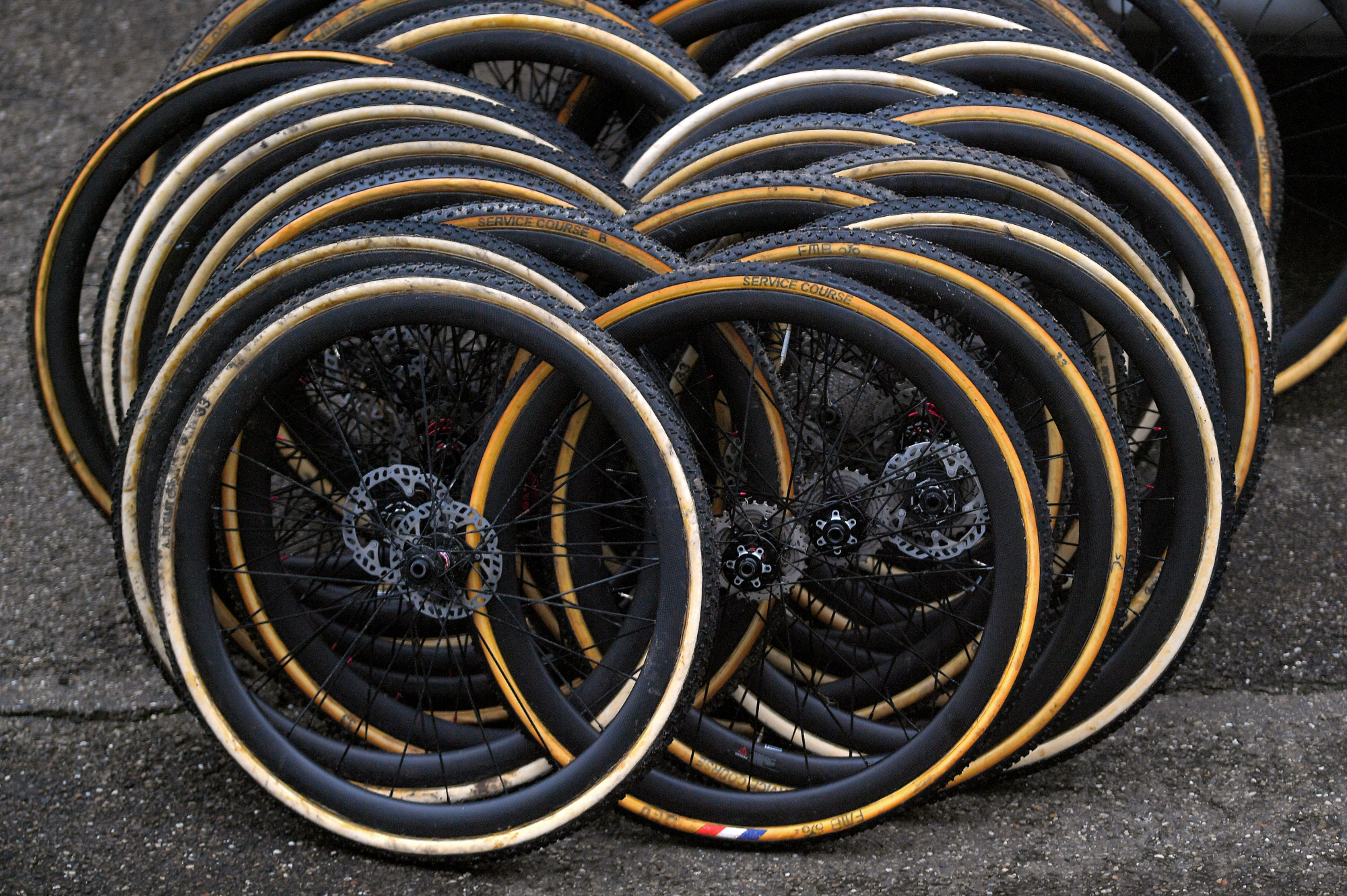
Since its inception, cyclocross has been defined by the fact that, no matter how you look at it, a ‘cross bike is rarely the perfect option for whatever course a promoter has dreamt up. And part of that is the restriction on tyre width.
Since 2010, restrictions for cyclocross have capped tyres at 33mm wide, in part as a response to disc brake technology coming into the sport. Today, by gravel and even road standards, 33mm is laughably narrow, and that has arguably turned cyclocross from a ‘run what you brung’ participant sport into one that requires a much more specialised setup.
So, why is CX still limited to 33mm tyres? After all, disciplines such as gravel are pushing the tyre-width envelope to unprecedented standards. Tradition plays a part, but even a few millimeters could have major repercussions for the industry. We spoke to tyre makers, bike builders, promoters, and athletes, and looked at the current rules in place to figure out who would want the change, who wants to stick with the old standards, and, if you’re someone who wants to race, where you’re allowed to run wider tyres.
Latest Videos FromCycling Weekly
(Image credit: Luc Claessen/Getty Images)
A brief history of the 33mm rule
“The initial tyre size rule started back in the nineties when top pros would show up to races with a ‘truckload’ of tubular wheels, with tyres ranging from 25mm to 34mm glued up and ready to race,” recalls framebuilder and former pro rider Chris McGovern. The UCI eventually limited the tyre width in order to make the sport more egalitarian – after all, this was a sport that began in the farmfields of Belgium as a fun off-season event, and there have been width rules ever since.

(Image credit: Billy Ceusters/Getty Images))
In 2010, when disc brakes were introduced to the sport, the UCI decided to cap tyre width at 33mm, down from 35mm, to reduce the amount of equipment that racers needed to own in order to be competitive – because disc brake bikes could allow for a huge range of tyre widths, going narrower allowed those who still wanted to race on cantilever brakes (those of us who said ‘disc brakes were just a passing fad’) to stay competitive.
The irony is that 16 years later, that rule designed to make the sport more accessible and inexpensive may be holding it hostage. The idea may have worked back in CX’s heyday when cantilever brakes were the norm and disc brakes were a rarity, but today, with almost every bike running a disc brake setup, a normal set of gravel wheels is too wide to accommodate the thinner tyre for cyclocross. So, is it time for the UCI to loosen the restrictions, or would that lead ‘cross down the slippery slope of turning into gravel or MTB racing and disappearing altogether?
It’s worth noting that the restriction does not apply in all races; in the UK and US, the rules are often (but, not always) loosened for amateur fields. Some events will allow any bike – including mountain bikes – check with the organiser before you head to compete.
The case for tradition
The pro racers who’ve been in cyclocross for a long time are torn: “To be honest, I’m not 100 percent sure how I feel about it!” admits retired American racer Ellen Noble, who took silver in the U23 World Championships in 2017.
“I think my initial instinct is that cyclocross is, at its core, about riding the wrong tool for the job… If we start widening tyres, we may next discover that a little suspension in the front helps people go faster, and so on. Fortunately, there is so much pedaling in CX that I don’t ever see us just riding straight-up mountain bikes, but I think the parameters are nice because they keep the sport relatively simple and true to its roots. Part of what makes CX, CX, is that you’re rarely riding the ideal setup for any given section.”

(Image credit: Getty Images – DAVID PINTENS)
In fact, hunting down the gear and the search for the perfect tyre tread in 33mm is arguably part of what cyclocross is all about: The sometimes excessive obsession with gear. (Just head to any start line and ask “what tyre pressure are you running?”)
“Having a max tyre size at 33mm is actually a defining part of the sport,” says McGovern. Getting that size tyre with whatever tread to do what you need it to do is a skill. A skill that is a big part of the sport’s definition. Pro baseball players can’t use aluminum bats; that would change baseball.”
Longtime pro cyclocrosser/gravel/road racer Tobin Ortenblad was a top U23 cyclocross racer during CX’s American peak, and he still loves the sport. “It’s hard to beat a 33mm tubular on a good course,” he says. “I also think there is a bit of magic to riding 33s fast. They’re twitchy and quite sketchy, but that’s kind of the glory of cyclocross.”

(Image credit: TOM GOYVAERTS/BELGA MAG/AFP via Getty Images)
Similarly, pro cyclocrosser and creator of CX Fever Maghalie Rochette loves cyclocross more than anything – and because of that, she’s a bit of a gear traditionalist. “I don’t necessarily think that wider tyres would make our sport better,” she says. “Depending on the condition, you don’t have more grip necessarily with a wider tyre. If your tyre is narrower, you cut through the mud better, and you have a better grip in that way. You can rip corners really fast on the grass. So I actually like the 33s.”
“I think that at the top end of the sport, the tyre size is one of those limiting factors that forces riders to go slower or to take turns differently,” says Connor Gregory, promoter for Christie Cross in Toronto. “Big tyres are a bit of a cheat code. You can buy speed in every other type of racing, whereas in cross, having that tyre limitation means that your 10-year-old cross bike is still quite relevant and still pretty much the same as the current technology.”
In that way, “Cyclocross has become kind of immune to the technology progression and the upgrade culture that cycling is so set on,” Gregory adds.
But is that a good thing?

Maghalie Rochette at the UCI Cyclo-cross Worldcup in Tabor,
(Image credit: Billy Ceusters/Getty Images)
The case for going wider
“I think we are more than due for an update to the tyre width regulations for UCI events,” says Bill Schieken, founder of CX Hairs and promoter for DCCX and Pan-American Cyclocross Championships. He sees the participant numbers drop hugely during the races that have the tyre width requirements, and believes that the rules are keeping the elite fields in particular smaller than they would be otherwise.
Despite loving the 33s personally, Ortenblad agrees. “I can’t say for sure if I think tyre width keeps people from racing CX, but I definitely think that a 33mm tyre feels a bit archaic seeing as I ride 32mm tyre on my road bike now,” he says. “I do constantly think a 35 or 38mm tyre option would be good for cross. I think bumping the max size number a bit would be good for the sport. Obviously, we don’t need people out there on massive gravel tyres, but I think the racing would be a bit faster and maybe more fun on a slightly bigger tyre.”
In North America in particular, cyclocross has long been a participant sport – and that’s why USA Cycling and various Canadian provincial governing bodies have loosened tyre-width rules for amateur categories to increase participation. If you currently own a gravel bike, you may be able to fit 33mm tyres on the wide rims that are standard with modern gravel bikes – but because tyre width is measured by how the tyre stretches onto the rim, not what’s written on the sidewall, these wheels still may not pass the UCI’s tyre width test. So, USA Cycling allows for up to 38mm tyres for most non-pro categories, and Ontario Cycling takes it a step further by allowing wider widths even in elite categories of the provincial race series, though for National Championships, they warn that tyres will be measured to the UCI standard.
In the UK, British Cycling applies the 33mm rule to Elite, Under 23 and Junior races at both the National Trophy and Championship level but, as in the US and Canada, some local leagues allow for the running of wider tyres – checking the rules before you head to a race remains prudent.
At the pro level, the 33mm width wasn’t a problem ten years ago. Today, it challenges the very racers the rule was meant to protect: privateers and elites on a tight budget. If an elite racer has a gravel bike, they still will likely need a new wheelset in order to race cyclocross, despite the bikes and tyres being nearly identical. Widen the tyre restrictions, and you potentially widen the pool of athletes showing up to races because gravel teams and gravel privateers could more easily hop into a nearby UCI race with the equipment they already own.

(Image credit: DAVID PINTENS / BELGA MAG / Belga / AFP via Getty Images)
“Cyclocross is just waiting for everyone to realize that their gravel bike is capable of doing cyclocross,” says Gregory. But while the gravel bike may work well in a local race, the tyre is unlikely to conform to UCI standards. “We shouldn’t have a tyre width rule for amateur categories, and really, I don’t think the pros would go much wider anyway. I can’t imagine Mathieu van der Poel racing a 45mm tyre – maybe a 38mm though.”
Rochette agrees. “The way I see it is that everyone has a gravel bike now, and that means everyone can do a cyclocross race – if they’re allowed to. I would love to see people using their gravel bikes to do cyclocross, so at least amateurs should be able to use wider tyres. That way it breaks one barrier for people trying the sport.”
“I don’t see anything wrong with going as wide as 40mm or whatever that limit may be,” Schieken adds. “Is this any different than the UCI being so reluctant to allow disc brakes, an innovation that has done nothing but make racing more exciting at the top level? Bring in the wide tyre. The racers will quickly figure out if wider is better or where the sweet spot lies.”

(Image credit: Getty Images)
Would a wider tyre change the sport?
In a word, maybe. But there’s a reason that top riders still sometimes opt for even narrower tyres, says Challenge Tires founder Alex Brauns. They may be less supple or grippy, but they’re faster. (Asked who would win: Van der Poel on a 33mm tyre versus Wout Van Aert on a 40mm tyre, Brauns says Van der Poel would annihilate Van Aert because the “40mm tyre would create too much drag and be slower.”)
There is an important tech distinction to make when it comes to understanding tyre width and tyre choice, and that’s the tubular versus tubeless or clincher difference. “Tubulars at 33mm are not affected by rim width, so volume remains consistent,” says Brauns. “Clinchers and tubeless tyres, however, are impacted: As rims get wider, tyre volume decreases, reducing traction and rolling efficiency – clear disadvantages in off-road riding. With rims now reaching 25mm internal width and beyond, the system is compromised.”
Because of this, Brauns says, tubular tyres are still the best bet for cyclocross riders at the higher levels of competition. He says that as far as rules and regulations go, disqualifications at the start line have occurred due to a clincher tyre measuring too wide because of the rim, and he’d like to see clarifications to the current rules, given the rising popularity of tubeless-ready tyres. No one wants racers who’ve paid and registered to race to be turned away at the start line because of an avoidable measurement error.
McGovern believes wider width allowance would be the death knell for tubular tyres as we know them. “Even now, tubulars are almost dead and getting a low-pressure, low-volume tubeless tyre to work like a tubular is very difficult,” he says. “Increasing the max width would make it much easier to set up, I think. But that would change the essence of the sport. ‘Cross doesn’t need to go gravel.”
While it may be a changeup for tyre manufacturers if the rules changed, it wouldn’t necessarily be a bad thing, Schieken says. “Maybe it will make it more palatable for more tyremakers to offer a varied line of cyclocross treads again,” he says.
And Ortenblad makes the most valid point about industry standards: “It seems like gravel only took off because the industry wanted to sell something they didn’t already own… so maybe if we bump tyre sizes up, the tyre industry will at least make some profit on cross again as everyone buys new tyres.”
Explore More
