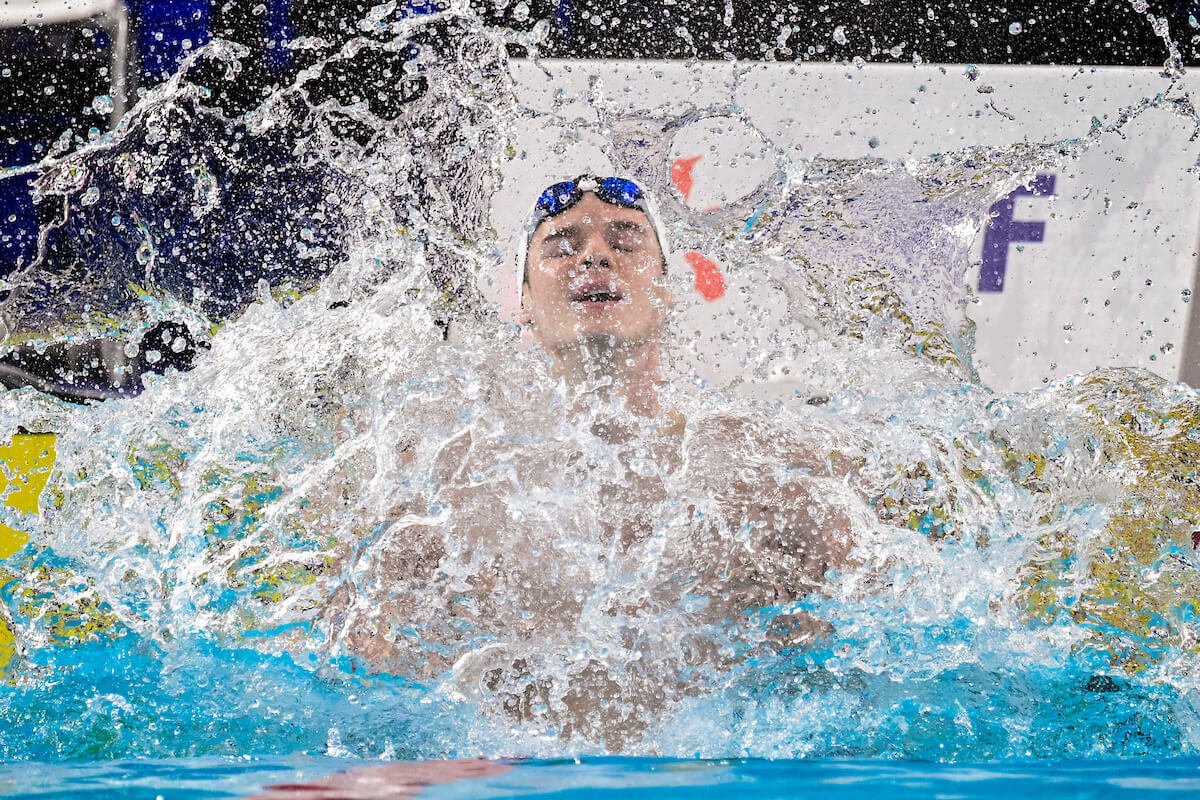
Hungarian Hubert Kos Tracks Down One Hall of Famer; Has Another Cornered
In a way, Hubert Kos played a game of tag with a pair of Hall of Famers as he raced at the just concluded European Championships in Paris. On the final day of competition, Kos tapped countryman Laszlo Cseh, eliminating the 74-time international medalist as the Hungarian record-holder in the 200-meter individual medley. Four days earlier, Kos backed Aaron Peirsol into a corner, the American narrowly escaping as the world-record holder in the 200 backstroke.
It was a sensational return to Paris for Kos, who claimed the Olympic title in the 200 backstroke when visiting the French Capital for the 2024 Olympic Games. At Euros, Kos’ solo crowns in the 200 back and 200 IM were complemented by a victory in the 400 freestyle relay and career-best times in the 100 butterfly (50.25) and 200 fly (1:54.89). With the 2028 Olympics in Los Angeles two years away, Kos is perfectly positioned to star at a Games in his adopted homeland.
There is no argument that the best swimmer in the world remains Leon Marchand, he of four Olympic titles in Paris. Despite nursing an injured adductor muscle during the European Champs, an ailment that forced his withdrawal from the medley events, Marchand marched to gold medals in the 200 butterfly and 400 freestyle, and led off the French 800 freestyle relay with a scintillating split of 1:43.76. If that wasn’t enough, he closed the meet with a sub-50 butterfly leg in the 400 medley relay.
The body of work compiled by Marchand is Phelpsian, his freestyle performances the latest indicators of his incredible range. They brought back memories of the 2007 United States Nationals, when Michael Phelps branched into the backstroke events and scared Peirsol’s world record in the 100-meter distance. Call it legends being legends.
But an argument can be made that Kos occupies the No. 2 men’s position in the sport, he and Marchand benefiting from training together – and pushing one another – under coach Bob Bowman with the University of Texas pro group. The scary thing is that both men continue to improve, an ominous prospect for the opposition they will face at SoFi Stadium just two summers from now.
Five months ago, Kos provided an indicator of what was to come at the European Championships. As the University of Texas captured its second straight NCAA title, the Hungarian was nothing short of brilliant, setting all-time records in the 100- and 200-yard backstrokes. More, he gave Canadian Josh Liendo all he could handle in the 100 butterfly, Kos notching the second-fastest time in history during a runnerup finish. But American-college times are often lost on the rest of the world, so the Hungarian had to wait for Euros to show his enhanced repertoire.
For 17 years, since it was delivered in Rome in 2009, Peirsol’s world record in the 200 backstroke had gone unchallenged. Forget pushing the standard of 1:51.92. No man since 2011 had broken 1:53. And then Kos, on Night Three of Euros, let rip with a continental record of 1:52.30 in the semifinals. The chase was clearly designed. Because he had a double on Night Four, Kos chose to use the semifinals for pursuit of the Peirsol mark. There was no restraint from the start, as Kos was under world-record pace at the first turn, more than a second ahead at the midway point of the race and still .98 to the good at the 150-meter mark. Down the stretch, Peirsol’s closing lap of 28.62 was the difference, Kos falling short, but with the No. 2 time in history.
In less than two minutes, Kos put reality to the dream of Peirsol’s record eventually tumbling. He also further cemented his status as one of the great 200 backstrokers of all-time, an identity earned through an Olympic title and multiple world championships. Yet, Kos had one more Hall of Famer to stalk in Paris, this one from his own backyard.
During his illustrious career, which was honored with Hall of Fame induction earlier this year, Cseh was one of the world’s premier all-around swimmers. Often overshadowed by Phelps and Ryan Lochte, Cseh often didn’t receive his rightful credit. During a decade-plus run at the top of the sport, Cseh was a six-time Olympic medalist and 13-time medalist at the World Championships. In international competition, he made 74 podium appearances, solo hardware earned across an astounding eight events.
Twice, Cseh medaled in the 200 individual medley at the Olympics, and on four occasions, he medaled in the event at the World Champs. In 2009, he set the European record in the 200 IM, going 1:54.18 at Worlds, and that standard endured as the Hungarian mark until Sunday, when Kos popped a 1:54.24 performance to move to No. 4 all-time, behind only Marchand (1:52.69), Lochte (1:54.00) and Phelps (1:54.16). Kos now owns four Hungarian records, and to have supplanted Cseh in the 200 medley is a passing of the torch of sorts, versatility long a defining trait of greatness.
The journey from Paris to Los Angeles is now halfway complete and next year, Kos will have the World Championships in his native land, Budapest scheduled to host what will be a dress rehearsal for LA28. What type of schedule will the 23-year-old embrace? That answer will be determined by athlete and coach. If nothing else, the options are plentiful, Kos on the short list of the sport’s current greats.
At Euros, one Hall of Famer was caught. Another is on the run. Kos is IT.
