American Men’s Backstroke Shows Signs of Life at Short Course Trials, But Questions Remain
The United States men have struggled mightily in backstroke for the past two years, at least since Ryan Murphy won bronze in the 100-meter race in Paris for his third consecutive Olympic medal in the event. Six different swimmer contested the stroke at last year’s World Championships, and they combined for just one finals appearance and no medals. The long course results this year were only marginally better.
American men did win four backstroke medals at the Pan Pacific Championships, but none of those swimmers finished in the top-10 in the world rankings. Even Quintin McCarty, the Pan Pacs champion in the 50 back, finished the summer tied for 14th in the global standings. A returning Murphy was the only American under 53 this year in the 100 back, his top time of 52.80 ranking 10th in the world, and the 200 leader was David King, his time of 1:55.01 finishing ninth among racers.
But in a relatively unexpected turn of events, the men’s backstroke contingent fired off some strong times at the U.S. Short Course World Championship Trials, putting themselves in medal-contending positions for next month’s Short Course World Championships in Beijing. The top performances came in the 200 back from Cal teammates Gabriel Jett and Destin Lasco, who have jumped themselves to the top of the world rankings.
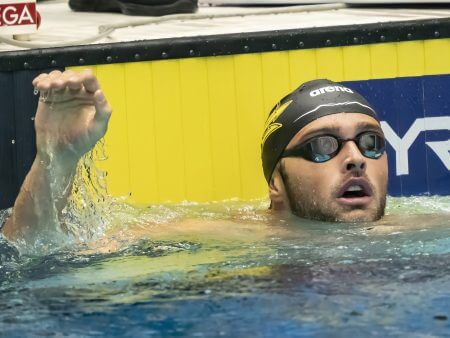
In the event’s final Thursday evening in Westmont, Ill., Lasco had the lead for the entire race, only for Jett to come through with a 27.17 closing split to take the title in 1:47.75, with Lasco second in 1:47.94. Those swimmers jumped past South Africa’s Pieter Coetze, a triple crown winner in all three backstroke races during the World Cup circuit, to the helm of the 2026 world rankings. Moreover, Jett moved to 12th all-time in the event and Lasco 14th, and both swam much faster than the silver-medal-winning time from the 2024 Short Course Worlds.
Those results put Jett and Lasco into medal contention for the upcoming global meet, although the competition could get much quicker depending on who opts to attend the meet between short course world-record holder and Olympic champion Hubert Kos, his fellow European Championships medalists Apostolos Siskos and Thomas Ceccon and the five other swimmers who clocked 1:54s in long course this year.
Adam Chaney — Photo Courtesy: Peter H. Bick
As for the 50 back, Adam Chaney won the event from an outside lane in 22.71, making him the sixth-fastest swimmer in the world this year behind world-record breakers Xu Jiayu and Coetze, Russians Egor Kornev and Pavel Samusenko and Australia’s Isaac Cooper. Chaney doubled up with a win in the 100 back, his time of 49.50 ranking third in the world behind Coetze and Samusenko.
Not too shabby, especially from swimmers not even considered to be among the main contenders in American men’s backstroke entering the meet. But whether these performances translates to improved results in the long course pool is a completely different question, especially considering these swimmers had a history of strong short course yards results in backstroke without ever showing that off in long course.
Lasco was a multi-time NCAA champion in the 200-yard backstroke, and although he swam the 200-meter back at the 2023 World Championships, he has primarily focused on the 100 freestyle for international racing in the years since. Jett dabbled in the 200 back during his last season at Cal but has established himself as a freestyler in long course; his silver-medal-winning swim in the 200-meter free at Pan Pacs made him the third-fastest swimmer in the world this year. At that same meet, Jett placed ninth and Lasco 13th in the 200 back prelims, with three other Americans ahead of them.
Chaney, meanwhile, showed plenty of speed in short course during his college career at Florida and Arizona State, but his long course results have never matched up. At this summer’s U.S. Nationals, he placed fourth in the 100 back and eighth in the 50 back. All of these swimmers rely on their underwater kickouts in their short course backstroke success, but that skill is deemphasized in a format with half as many turns.
The results at the short course trials marked progress for American men’s backstroke, and medal-winning performances next month in Beijing would be another strong step. Still, long course backstroke remains an enormous question mark for the U.S. men with less than two years to go until the Los Angeles Olympics.
