It’s a well-proven fact that music can enhance physical performance, elevating long training sessions from mammoth slogs to efforts that entertain. However, conventional headphones aren’t really cut out for cycling. In-ear designs compromise awareness of approaching traffic to the point of being dangerous, while sweat, rain and wayward helmet straps present real challenges. Over-ear cans present similar drawbacks, adding unwelcome warmth to the mix.
In common with similar products from brands such as Shokz, who feature in our guide to the best headphones for cycling, H2O Audio’s TRI 2 Pro headphones take a different approach. Bone-conduction transducers deliver sound through vibrations against the cheekbones, leaving the ear canals unobstructed. They’re waterproof too, making them particularly attractive to triathletes. The model reviewed here is the Lucy Charles-Barclay special edition, featuring a distinctive colour scheme and a preloaded, 40-second welcome message from the incredibly talented British Ironman world champion. If you prefer your headphones to be a little more discreet, they are also available in black.
Design details
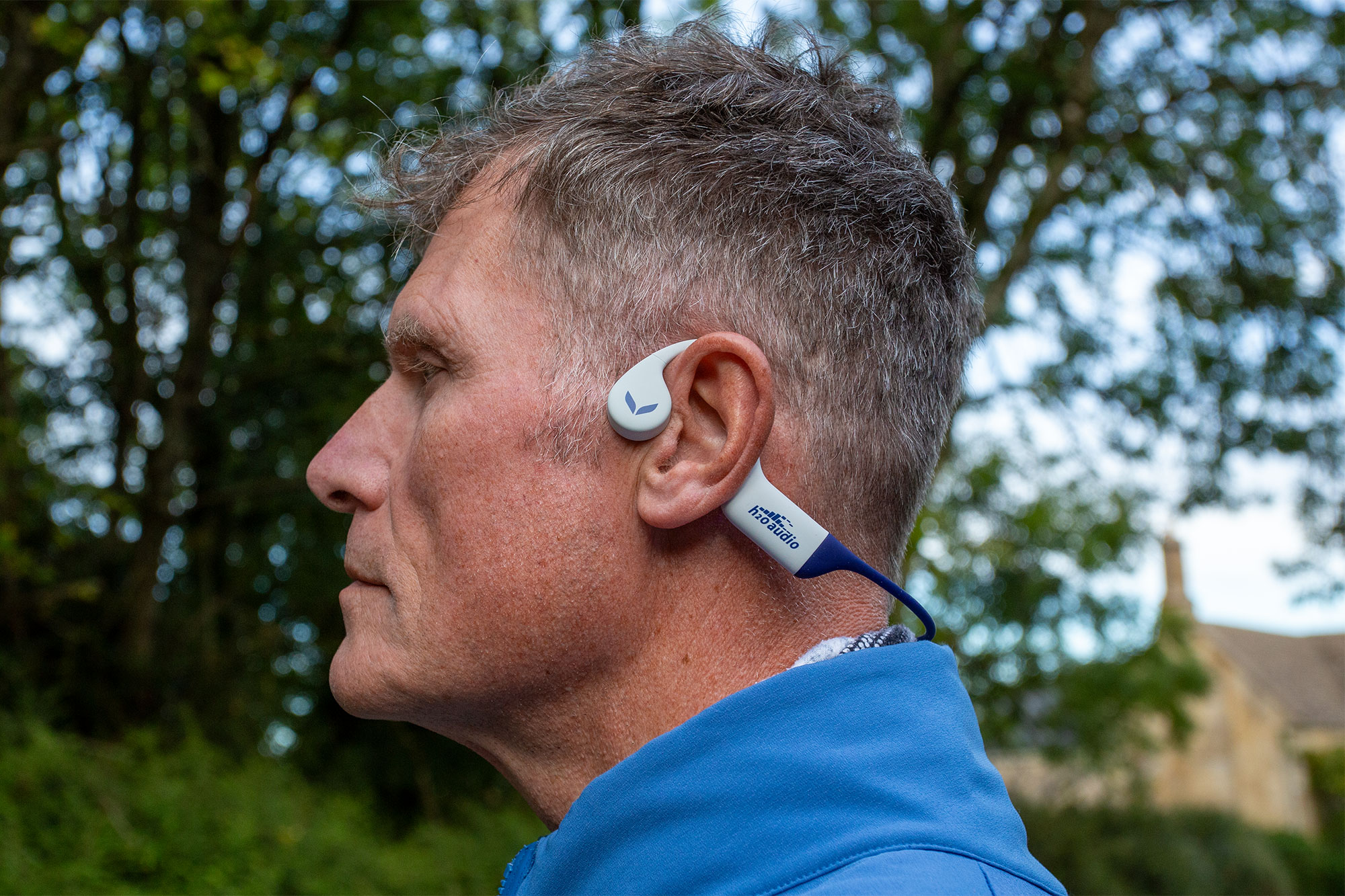
I found the TRI 2 Pro headphones to be super secure, much more so than earbuds.
(Image credit: Simon Fellows)
The TRI 2 Pro features a flexible neckband, over-ear hooks and a soft, uniform silicone finish. H2O’s custom-developed bone-conduction transducers are relatively slim at 10mm thick, and at 19mm in diameter they’re not going to dominate faces with smaller, finer features. They use proprietary digital equalisation designed to enhance bass response, a universal weakness of bone conduction sound reproduction.
Latest Videos FromCycling Weekly
Bluetooth 5.3 provides wireless playback, while 8GB of internal storage allows music to be played independently of a phone. The player supports conventional audio files, including MP3 and compatible AAC files. More intriguing is Playlist+, which records audio streamed from services such as Spotify and Apple Music for subsequent offline listening. It’s an attractive alternative to purchasing individual tracks – H2O argues that Playlist+ complies with US copyright law but acknowledges it cannot confirm compliance with legislation in other territories.

The full package includes a good-quality hard case, a lanyard, earplugs for swimming and a charging cable. The case is quite large, but that means you could probably include a small power pack for travel.
(Image credit: Simon Fellows)
There’s also a microphone that features software noise cancellation, enabling the TRI 2 Pros to function as a Bluetooth headset for telephone calls. Three physical buttons, which can be easily felt beneath the TRI 2 Pro’s waterproof silicone skin, control playback, mode selection and call answering.
The TRI 2 Pros are rated to IPX8, which means they tolerate depths of up to 3.6 metres. Clearly desirable for swimmers, this level of waterproofing is also useful for cyclists wanting a set of headphones that will endure heavy rain, road spray, sweat and the inevitable electrolyte spillage when necking a bidon in too much of a hurry. We’ve all done it.
Claimed battery life is nine hours over Bluetooth or six hours using the onboard MP3 player. The package includes a protective case, charging cable and swimming earplugs. The charging cable is currently proprietary at the business end, and Type-A at the power outlet, which is a little disappointing. However, I suspect that H2O Audio will update from Type-A to USB-C sometime soon.
Performance

At just 35g and with nothing to block my ear canals, I found the TRI 2 Pro headphones light and unobtrusive.
(Image credit: Simon Fellows)
Let’s talk comfort and security before we get into the nitty-gritty of how these headphones sound. Frankly, I found them ridiculously comfortable, so much so that for extended periods of exercising, I’d much rather wear a pair of these than earbuds or full-blown over-ear headphones. At 35g, they’re about three times heavier than a pair of Apple AirPods Pro 3, but with the weight distributed across the ears and nape of the neck, they feel remarkably light. Not ‘light as a feather’, but almost.
Despite having a large 59cm circumference head married to laughably small ears, I found the fit pretty much perfect. The clamping tension of the band is light, but secure enough thanks to the additional assurance provided by the ear hooks.
I’ve never found a pair of earbuds that I’ve trusted implicitly not to dislodge 15 minutes into an indoor training session at my local gym, only to scoot purposefully and irretrievably under the nearest running machine. In comparison, these headphones are impeccably behaved.

The three buttons are relatively intuitive, but they are fiddly to operate when wearing gloves.
(Image credit: Simon Fellows)
Out on the road, it’s a similar story. After a bit of initial fumbling with helmet straps and a territorial standoff with the arms of my Oakleys (the top of the ears, the superior auricular sulcus, is now a shared space) I forget they are there. If I have a misgiving, it’s that the buttons are extremely fiddly to use when wearing winter gloves.
Music reproduction is inevitably a compromise with bone-conduction headphones because they lack an enclosed air chamber to amplify low frequencies. The massive mechanical vibration against your skull required to move enough heavy low-end energy to compensate would be, well, uncomfortable to say the least. Instead, brands such as H2O Audio employ EQ to emphasise higher harmonics, which give the illusion that there’s more low-end, but the technique is never totally effective.
For a real-world, unscientific but nevertheless useful comparison, I pitted the TRI 2 Pros against a good pair of studio-grade headphones. The similarly priced Beyerdynamic DT 700 PRO X cans are closed-back, over-ear headphones widely praised for their neutral, accurate sound reproduction and high sensitivity.

The transducers are large but surprisingly comfortable against the skin.
(Image credit: Simon Fellows)
I chose four audio tracks to put both pairs of headphones through their paces. Eusexua by FKA twigs to judge bass, rhythm and contemporary electronic production. Dreams by Fleetwood Mac for vocal clarity, midrange balance and natural instrumentation. Bubbles by Yosi Horikawa for transient response, fine detail and spatial separation. Lastly, Movement 6 from Promises by Floating Points, Pharoah Sanders & LSO for dynamics, subtlety and complex musical textures.
Unsurprisingly, there was no contest, with the DT 700 PRO X excelling in every area, while the TRI 2 Pros fell short, particularly in bass reproduction. However, the TRI 2 Pros were far from bad. Detail, transient response and clarity were far better than I expected from a pair of bone-conduction headphones, areas where the lack of bass – which in poor quality headphones often results in a muddy mix – probably helped.
Detail, transient response and clarity were far better than I expected from a pair of bone-conduction headphones…
In fact, the TRI 2 Pros make for remarkably pleasant listening. Would I buy them for enjoying the highest fidelity? Of course not. But for listening to music and podcasts in challenging sporting environments, such as on the bike or in the pool, they’re great. These are headphones to complement, rather than replace, a conventional pair. They won’t satisfy every listening requirement, just as my Beyerdynamics would be thoroughly unsuitable for cycling and swimming.
Back to the ride, ambient noise, such as wind, can be intrusive, just as sound leaking from the TRI 2 Pros can be a little intrusive for other people in indoor environments like gyms. Fortunately, leakage is relatively modest at sensible volumes. The microphone is also susceptible to ambient noise when riding outdoors in traffic or wind. None of these issues are specific to the TRI 2 Pros – all bone-conduction headphones suffer from similar problems.

The charging port is proprietary – I’d rather see USB-C.
(Image credit: Simon Fellows)
I’m a very keen swimmer, so I also wore my TRI 2 Pros in the pool. Provided the straps of my goggles were carefully layered over the ear hooks, the headphones remained snugly in place regardless of whether I was swimming breaststroke, backstroke, freestyle or making a turn. H2O Audio provides earplugs for pool use, which help suppress water noise, although sound quality remains better than expected rather than outstanding. Long sessions in the pool can get very dull, so I’m looking for a much-needed distraction, not concert hall authenticity. The TRI 2 Pros don’t disappoint.
Of course, Bluetooth doesn’t work reliably under water, which is why the TRI 2 Pros feature an MP3 player. Most of the time Bluetooth mode makes more sense for cycling but it’s handy to have the MP3 player in the wings should you suffer frequent Bluetooth dropouts or just fancy leaving your phone at home in order to enjoy a ride free from interruptions.

The Playlist+ feature enables you to record content from Apple Music, Spotify and other similar services for subsequent offline playback. Ideal for swimming, I found this feature useful for cycling too.
(Image credit: Simon Fellows)
Bluetooth mode also opens up the possibility of receiving spoken navigation instructions and compatible radar alerts, either through a smartphone connected to a bike computer or directly from certain smartwatches. This could be useful in windy conditions, and for some people who suffer hearing loss, although compatibility and audibility are worth checking before relying on it.
H2O Audio provides a smartphone app, as well as a desktop app for macOS and Windows, to manage the TRI 2 Pro. Both are very easy to use. Bear in mind that recording content for Playlist+ happens in real time, so an hour’s worth of songs will take an hour to record.
Value

The TRI 2 Pros compare favourably with the competition but suffer from being similarly priced to H2O Audio’s slightly superior Ultra Pro model.
(Image credit: Simon Fellows)
At £167/$219.99, the TRI 2 Pro is a relatively expensive pair of sports headphones, but it compares favourably with the similarly specced Shokz OpenSwim Pro at £199/$229.95 , though the latter does feature 32GB of storage against the H2O’s 8GB. In both cases, much of your money pays for waterproofing, versatility and connectivity rather than outright audio fidelity. The TRI 2 Pro is comfortable, secure, easy to use and sounds more than acceptable. Triathletes should love it.
Ironically, the main competitive threat may come from H2O’s own Ultra Pro, which offers substantially longer battery life for just £23/$30 more, although that model is slightly heavier and offers no improvement in sound quality, fit or comfort.
If you don’t intend using headphones in the water, then another option is the Shokz OpenRun Pro 2, but at £169/$199.95 there’s no price advantage. Remember, the TRI 2 Pro’s superior IPX8 rating should make it more resilient against rain, sweat and other liquids too – it’s not a product just for swimmers and triathletes.
Tech specs
- Price: £167/$219.99
- Dimensions: Transducers – 10mm x 19mm
- Colours: Black, White (LCB edition)
- App: Yes
- Weight: 35g
- Battery: approx. 6 to 9hrs (mode dependent
- Waterproof rating: IPX8, tested to 3.6m/12ft
- Connectivity: Bluetooth Version 5.4
