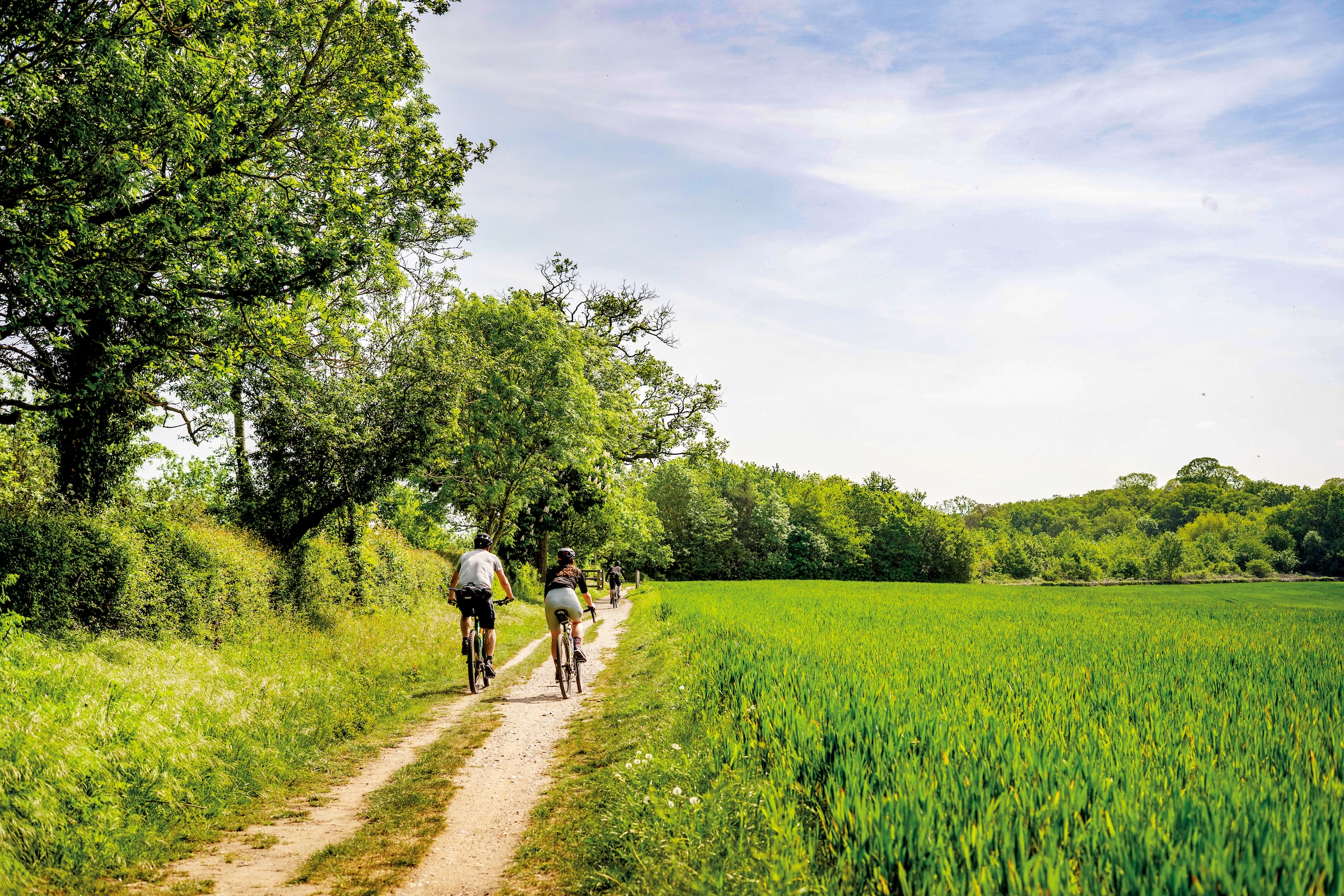
Midday had rolled around by the time the view finally opened up beyond my handlebars. The sun bathed the surrounding fields, casting everything in a golden-green hue. With the soft crunch of gravel under my wheels mingling with the birdsong, it was hard to believe I’d left inner-city London that morning. Thatched cottages were the only buildings I was passing now, each a smudge of grey-brown against a cloudless sky. We were just beyond the halfway point in North London Dirt (NLD), a 70-mile out-and-back charity ride from Stoke Newington, connecting the city’s secret off-road routes with the Hertfordshire countryside that lies beyond. A 100-mile option was available for those wanting an even harder endurance test.
Brothers Andrew and Phil Diprose founded North London Dirt in 2017. Initially a fundraiser for their local church and community centre, the event grew rapidly. Combining Andrew’s design skills with Phil’s talent for sniffing out the most rogue off-road segments, NLD became as stylish as it was exciting. It served as a launch pad for riders seeking to explore their city in new ways – finding secret gravel routes that unfurl from the inner city, before sharing a beer and pizza in the sunshine.
I found NLD at a moment when I was itching to get out into the countryside. Spring had arrived and the city’s trees were full of blossom, but I had noticed myself longing for the open fields – and their cycling trails – which had been the playgrounds of my younger life. Having moved to the city in my 20s, I’d assumed off-road was no longer available, but I was about to find out that within easy reach was a network of connecting alleyways, parks and riverside singletrack – edgelands waiting to be discovered by bike.
Latest Videos FromCycling Weekly
(Image credit: Archie Bromfield)
The term “edgelands” was coined by the British environmentalist Marian Shoard in her 2002 essay of the same name. She describes these peripheral places as a “mysterious no-man’s land” that we encounter on our way out and beyond. Rarely are they deliberately explored. Shift your view and these edgelands become something different: outsider spaces; sanctuaries for wildlife pushed to the boundaries; routes that tie the city together; a special “urban-rural interface”. For cyclists on gravel bikes, edgelands provide a lesser-known yet vast playground.
Heading out of the city limits
How to find your own edgelands
While we might not have the expanse of gravel routes available to American riders, the UK has some great hidden gems – if you know where to look. But how can we go about finding our own extra-urban, off-road routes?
According to Phil Diprose, your greatest assets are the ones already at your fingertips: begin by looking at Google Maps around the area you’d like to route-plan, and then drop down into it on Street View. Where are the shortcuts that could take you from a cul-de-sac into an open field? Could you pull off a canal towpath into some woodland singletrack? If you’re willing to put in the hours to perfect the route, nothing is better than scoping out your proposed trail in person.
While Phil chooses “happy accidents” as his navigation tool of choice, for those of us seeking to find off-road routes in cities we’re not yet familiar with, it can be a challenge. When I lived in Manchester for a while, online forums helped me find rides. These are routes built from local knowledge, many of which don’t even come with a GPX file. One such route took a tour along the river Irwell past the velodrome along the canals and onto Clayton Vale via offshoots of man-made, off-road trails. From there, the trail joins another reused railway that leads on to the Sett Valley Trail. The options, it seems, are endless: you just have to go looking for them.
We’d left the ride HQ at 9am, rolling north and cresting hills that teased us with views of distant woodlands. As we made our way out of the urban sprawl, we weaved along narrow bike paths before reaching the first off-road section. From there, the ride knitted together a sequence of wooded sections, muddy descents and short, sharp ascents.
We were a motley crew. I was aboard a pistachio-green Kona Dr Dew, adorned with a slow-growing collection of stickers, including my favourite ‘allez, allez, allez’ hot-pink Ribble Outliers logo. Navigating with our group’s only Garmin, Archie led the way on a blue Cannondale Topstone. Chris followed on what he called a “parts bin special,” built around a Ragley Big Wig frame, an Öhlins fork, and mismatched wheels and brakes.
Riding with me at the back was Mike, a former editor of Dirt magazine, who was fittingly riding a full-suspension Whyte T129. Faster groups tore past us, skimming effortlessly over the loose surface, but we met slower groups too, made up of road riders adventuring beyond their usual city rides.
For the first time in NLD history, the 2026 edition came with perfect weather. The early May conditions struck the perfect balance: cool in the morning, but steadily climbing to 20°C, warm enough to ride in a short-sleeved jersey for the rest of the day, raincoats undisturbed in our pockets. Bad weather had come to haunt the event.
Phil recounted the “biblical rain” of edition three, and “the deluge” of number six, which saw groups of riders sheltering as they strove to evade raindrops so big they were visible in his photos. At least it ensured those editions were memorable, he added with a characteristic optimism – describing NLD as “type-two fun”. “It’s like love songs,” he grinned. “No one sings about being happy.”

(Image credit: Archie Bromfield)
As the route curved around an orchard, we gathered speed, twisting and turning on a now flowing gravel track before cutting back briefly onto the road. A beep from Archie’s Garmin alerted us to the fact we’d veered off-track. After a quick about-turn, we were back on course, with no one any less cheerful for the short detour.
“I like to think of it as an urban fox sneaking through the urban and suburban bits without anyone else knowing he’s there.”
Phil Diprose
For the Diprose brothers, the biggest challenge of organising the annual off-road event around North London is maintaining variety. The first edition of NLD was simply about escaping London as quickly as possible, but as the years rolled on, their ambitions shifted. NLD became more about seeking out the hinterlands where urban and natural landscapes meet, hunting for “slightly weird places,” Phil explained.
Each year, the task is to make locals see their back lanes and gravel segments anew, surprising even the riders who think they already know this corner of the world. “I like to think of it as an urban fox sneaking through the urban and suburban bits without anyone else knowing he’s there,” Phil mused. “Most of the people on the roads don’t know that we’re sending a group of gravel cyclists down this path that’s right next to them – they don’t realise we’re there.”

(Image credit: Archie Bromfield)
The route out of London certainly felt secret. We were largely alone, save for the occasional group of gravel riders speeding past in a cloud of dust. In a part of the country where it can feel hard to get away from traffic and crowds, North London Dirt is a reminder that it’s possible to find the path less travelled and cobble together a full day of riding barely touching tarmac. “We realised that where we were riding were actually edgelands,” Andrew continued. “For people who aren’t blessed with the South Downs or the beauty of the Forest of Dean, we have to find the rubbish version, the grittiest version of gravel; behind a factory, or down the side of a canal.”
Linking the green spaces
The routes Phil devises are sprinkled with “happy accidents”; post-apocalyptic industrial land or a hole in a fence used to link two pieces of off-road. But he uses more orthodox methods of navigation, too. GPS is, he told me, his “weapon of choice”, used in unison with Google Maps and Google Street View to catch a glimpse of what the trails might look like before he checks them out himself. “There’s so much around where you live,” he continued. “Give yourself the time to go and explore, look online to see if there are any green spaces that could be linked together – what mini paths can you jump between? Some of them are not worth going to, but it’s always interesting, and you can always find something you weren’t expecting.”

(Image credit: Archie Bromfield)
Five hours in the saddle and an agonising 10km bumping along cobbled towpaths later, we rolled back to the church to find 300 riders eating pizza in the sunshine. Phil and Andrew stood at the entrance, looking out proudly over the community they had built. “London riders have so much rich culture,” Andrew told me, “but what we don’t have are rolling hills. London’s more like a bubblegum-footed pigeon – it shows its resilience in gravel.”
Resting in the sun beside our dusty bikes, the genius of the route finally clicked. I had spent years yearning for the open countryside, completely unaware that a sprawling off-road escape was waiting right here on my doorstep.
North London Dirt
North London Dirt (NLD) is a self-supported, mixed-terrain charity cycling event that celebrates the thrill of finding adventure on the edges of the city. Typically covering a 70-mile (110km) mystery route, the ride transitions seamlessly from urban alleys and B-roads to sweeping suburban gravel and woodland singletrack. Entry costs £45. The event always starts and finishes at the St Mary’s Community Centre in Stoke Newington (London, N16) – and for good reason.
All proceeds from NLD directly support the centre, which provides vital local resources including a food bank, a migrant centre, and a homeless shelter. Riders are traditionally rewarded at the finish line with well-earned pizza, craft beer, and a buzzing community atmosphere. For more information, follow NLD updates on their Instagram page: @northlondondirt.
