Asian Games, Day Three Finals: World Junior Record from Yumeki Kojima in 400 IM; Peng Xuwei Sets Asian Mark in 200 Backstroke
The Asian Games reached their midway point on Tuesday at the Tokyo Aquatics Centre, with six events highlighting the Night Three schedule. Through two days, China has been the dominant nation, paced by double victories from 13-year-old Yu Zidi (200 butterfly/200 individual medley) and Xu Jiayu (50 backstroke/100 backstroke). Yu’s victory in the 200 IM arrived in 2:06.10, the second-fastest time in history.
The women’s 100 freestyle opened Tuesday’s night session, Hong Kong’s Siobhan Haughey chasing a repeat of her title from three years earlier. Haughey already claimed the gold medal in the 200 freestyle and helped Hong Kong to the silver medal in the 400 freestyle relay. The 100 freestyle was followed by the men’s 400 individual medley, women’s 200 backstroke, men’s 1500 freestyle and women’s 400 freestyle. The final night of the evening was the men’s 400 medley relay.
The men’s 400 IM featured the Japanese tandem of Tomoyuki Matsushita and Yumeki Kojima, who were the gold and silver medalists in the 200 medley earlier in the week. Matsushita won the 400 IM last month at the Pan Pacific Championships and also dipped under the 4:06 barrier earlier this month. As for Kojima, he is the world junior record holder in the 400 IM and set a WJR at the Asian Games in the 200 IM.
Here is an event-by-event recap of the Night Three competition:
Women’s 100 Freestyle
For the second consecutive day, Hong Kong’s Siobhan Haughey captured an Asian title, this time in the 100 freestyle. Following her gold medal in the 200 freestyle, Haughey dominated at half the distance, building a half-second lap over the first lap and finishing in 52.45. That mark was the only time under the 53-second barrier and comfortably ahead of China’s Yu Yiting, who took silver in 53.21. China also garnered bronze, behind a 53.45 from Cheng Yujie.
Haughey has now defended her 100 freestyle and 200 freestyle crowns from three years ago in Hangzhou and will look to add the 50 freestyle title to her collection. She was the silver medalist in that event in 2023.
Men’s 400 Individual Medley
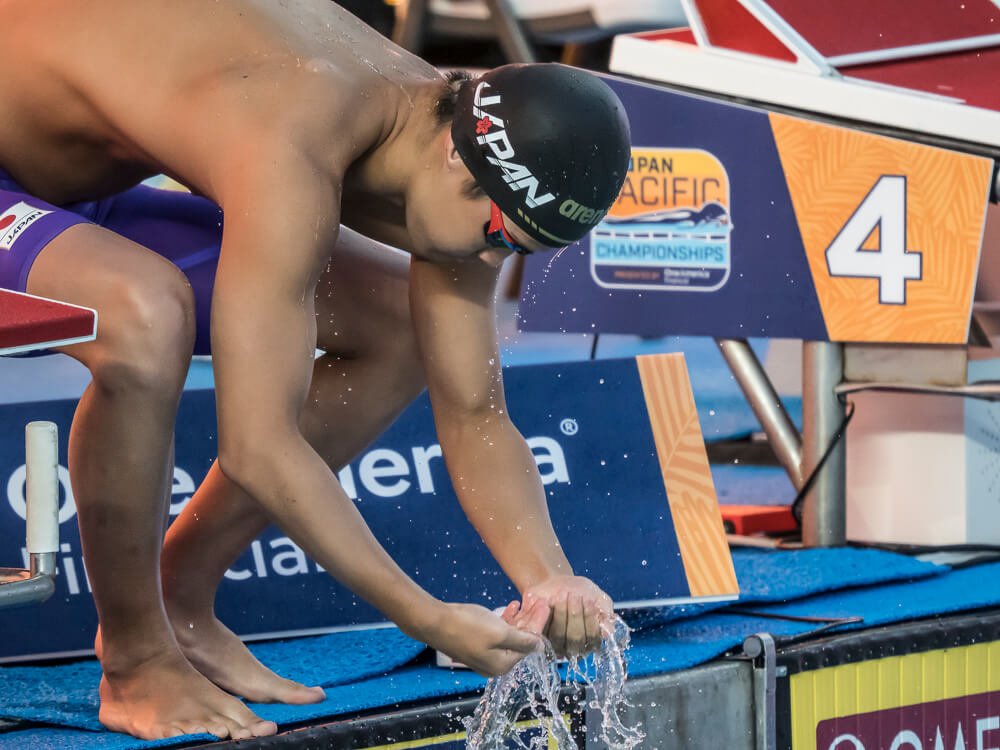
Coming off a sub-4:06 performance earlier this month, Japan’s Tomoyuki Matsushita was the favorite in the 400 individual medley, but a world junior record from Yumeki Kojima disrupted expectations. The silver medalist in the 200 IM behind Matsushita, Kojima roared down the freestyle leg and touched the wall in 4:07.02 to easily break his previous world junior record of 4:08.69, posted at last month’s Pan Pacific Championships.
Matsushita built a sizable lead through the opening two legs of the event, as he split 54.95 for the butterfly and came through the halfway point in 1:58.49. At those turns, Kojima was at 56.56.16 and 2:00.41, but the 17-year-old pulled to within .03 at the end of the breaststroke leg, thanks to a split of 1:09.72, compared to the 1:11.61 of Matsushita. On the closing freestyle, Kojima wasted no time pulling ahead, then away from his countryman, as he finished in a sensational 56.89, including 26.85 for the final lap.
China’s Wang Shun was the bronze medalist in 4:14.59.
Women’s 200 Backstroke
It was a runaway title for China’s Peng Xuwei in the 200 backstroke, as she established an Asian record with a mark of 2:05.77. That performance took down the 2010 continental record, which stood to Zhao Jing at 2:06.46. Peng dominated the field, as she built a lead of 1.62 seconds by the halfway point and added to that margin over the final two lengths. The silver medal went to China’s Sun Mingxia, who touched in 2:08.65, just ahead of Japan’s Rio Shirai (2:08.70).
Men’s 1500 Freestyle
Although best known for his ability in the 200 freestyle and 400 freestyle, China’s Zhang Zhanshuo is also a force in the longer events, as demonstrated in the final of the 1500 freestyle. Zhang earned his first solo title of the meet with a swim of 14:42.42, which was three seconds clear of the 14:45.99 of Japanese silver medalist Kaito Tabuchi. Also reaching the podium was Japan’s Kasushi Imafuku, who went 14:54.37.
Zhang was coming off a gold medal from the previous night in the 800 freestyle relay, where he clocked a sub-1:43 split on the anchor leg to power China to an Asian record. Given his form, Zhang appears positioned to put together career-best performances in the upcoming 200 freestyle and 400 freestyle.
Women’s 400 Freestyle
China’s Li Bingjie secured her third career medal at the Asian Games in the 400 freestyle and defended her title from three years ago when she posted a time of 4:02.71. Li was the silver medalist in the event at the 2018 Asian Games and has now followed with back-to-back golds, this latest victory by more than four seconds over Singapore’s Gan Ching Hwee (4:06.81). The bronze medal was claimed by Japan’s Ichika Kajimoto, who stopped the clock in 4:07.45.
The 400 freestyle handed Li her second victory of the meet, as she won the 1500 freestyle earlier in the competition. She has the 800 freestyle to come.
Men’s 400 Medley Relay
China closed out the session with a gold-medal effort in the 400 medley relay, as the quartet of Xu Jiayu, Dong Zhihao, Xu Fang and Pan Zhanle surged to a time of 3:27.89, nearly a second ahead of Japan, which took silver in a national record of 3:28.70. While Xu opened in 52.13 for the backstroke leg, Dong delivered a breaststroke split of 57.94. He was followed by Xu’s 50.52 for the butterfly leg and Pan’s freestyle anchor of 47.30.
Japan was impressive in cutting more than a second off its previous national record of 3:29.91, set at the 2020 Olympic Games in Tokyo. After Hidekazu Takehara led off in 53.53.71, Shin Ohashi blazed a breaststroke split of 57.64. The biggest leg came from Shoon Mitsunaga on the butterfly, where he went 49.74 to set the stage for Tatsuya Murasa and his freestyle of 47.61.
Bronze was earned by Korea in 3:31.97.
