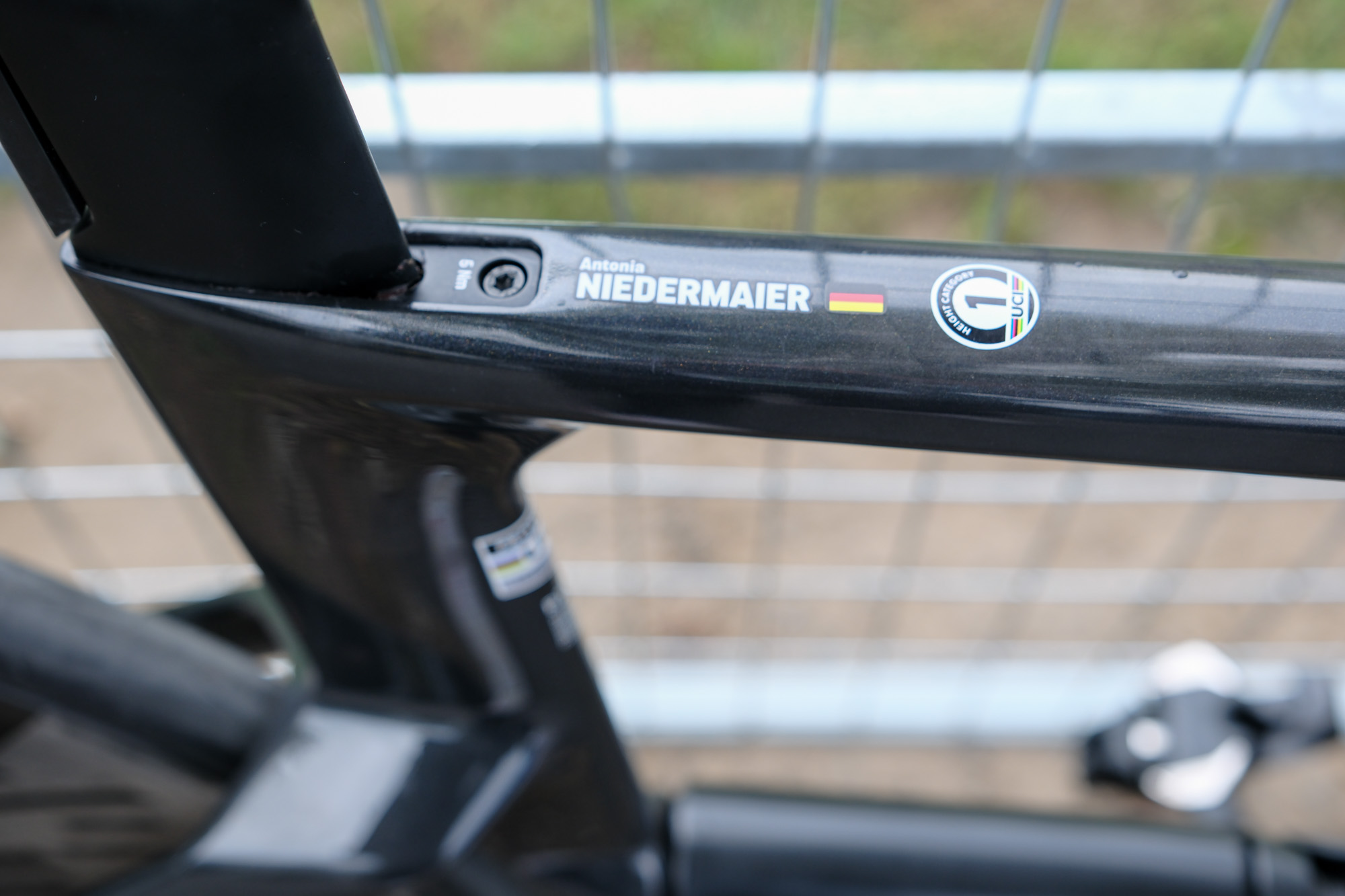
This is the as-yet-unreleased Canyon time trial bike that Marlen Reusser and Zoe Bäckstedt rode to the gold and silver medals in the World Championship individual time trial, with Antonia Niedermaier giving the new model another top-10 place when she finished seventh.
(Image credit: Anne-Marije Rook)
Cycling Weekly’s Anne-Marije Rook is on location in Montreal and shot Niedermaier’s bike at the finish. She also had a quick chat with the German rider.
Usually team mechanics will whip unreleased bikes out of sight and do everything they can – without quite resorting to violence – to stop any overly keen cycling journalist from trying to find out about a new bike prior to it’s launch. But this was not the case with the new Canyon. The German brand didn’t try to hide the bike – in fact it has already written the story on its own website.
Latest Videos FromCycling Weekly
“Drawing from the same DNA as Canyon’s Speedmax triathlon bike, which was released earlier this year, the bike that looks set to be the new TT version of the Speedmax powered Reusser around the 39.2 km course in 50m 24s to earn the bike rainbow bands on its first race outing.
“Engineered at Canyon’s headquarters in Koblenz, Germany, the unreleased Speedmax CFR TT looks like it has been designed to push the boundaries of aerodynamic efficiency, structural stiffness, and ergonomic customisation under full UCI compliance.
“The 1-2 podium placing in Montreal surely marks the culmination of an intensive development cycle as Canyon prepares the next-generation Speedmax CFR TT for a future commercial release. Further details around the technical specifications, global availability and launch dates will be announced by Canyon in the coming months.”
Canyon’s holding story is designed to tease rather than to actually tell us anything, so what can we discern from the photos? The front end is the biggest change compared with the old Speedmax, which was launched in 2021. The new bike has a wider fork, likely to push up to the UCI’s maximum limit of 115mm for the internal width. This is a design we’ve seen most recently with Factor’s ONE road bike, its Hanzo track bike, and the Hope HB.T track bike that was designed for Great Britain to use at the Tokyo Olympics.

(Image credit: Anne-Marije Rook)
The base bar sits on top of the extended fork blades that rise either side of the crown, with the stackers for the tri-bars continuing the vertical line. The airflow is channeled past a very narrow head tube through the ducts created by the layout.
Widening the fork and seatstays in line with the rider’s legs aims to allow cleaner air to pass through the much wider blades and then capture turbulence off the legs and smooth it as it leaves the bike, but it’s interesting that Canyon has only gone with the concept for the front of the new bike. The rear has relatively traditional dropped seatstays like the older version rather than the high, arcing shape of the Hope or the swept-back Factor Hanzo. The chainstays are a similar shape as before – horizontal with the ground to present a smaller frontal profile and then bending upwards to meet the rear axle.

(Image credit: Anne-Marije Rook)
The other new feature for the Speedmax TT is the integrated water bottle that fills in the gap at the bottom of the main triangle and smooths the air off the front wheel. Colnago did something similar with the TT1. On initial inspection, it seems to contravene UCI technical regulation 1.3.024 that states; ‘Bottles shall not be integrated to the frame and may only be located on the down and seat tubes on the inside of the frames.” And, “there must be a physical and/or visual space between the bottle and the tube to which it is attached.”
They go on to say, “bottle cages that are integrated must be submitted by a manufacturer to the UCI during the approval procedure for framesets,”. Canyon would not have developed a mould for this frame without prior approval and none of the riders were DQ’d for riding this system.
In this case the top of the water bottle aligned with the top of the radically dropped seatstays, whereas the new Canyon has a small lip on the seat tube to act as a fairing for the bottle while the seatstays emerge above it.
The Cervélo P4 in the 2000s used a similar integrated bottle – that was popular in triathlon – and at the time was very fast in the wind tunnel, so there’s clearly aerodynamic value in it.

(Image credit: Anne-Marije Rook)
Niedermaier said she liked the new bike and noted that despite the large fork, the handling at the front is sharp and responsive. She rides the 2XS size. Whereas Reusser has tested it in the wind tunnel at Friedrichshafen, Niedermaier said she had yet to optimise her position on the new model in a wind tunnel.
How easy to use is the new integrated water bottle? Niedermaier said the Worlds TT at just under an hour of riding was relatively long, but despite this she hadn’t reached for it.
Niedermaier’s bike (and Reusser’s and Bäckstedt’s) is built with the SRAM Red AXS TT groupset as before, using a 1x chainset and wheels from Zipp, the wheel brand also owned by her Canyon-SRAM team’s groupset sponsor.
We expect Canyon’s engineers will have found watt savings and possibly weight savings – that’s the way progress works of course – and we’ll have to wait to find out exactly what they claim to be. Canyon have told us the bike will be commercially available in 2027. But what can’t be disputed is the dream debut for this bike – a 1-2 podium at the World Championships.
