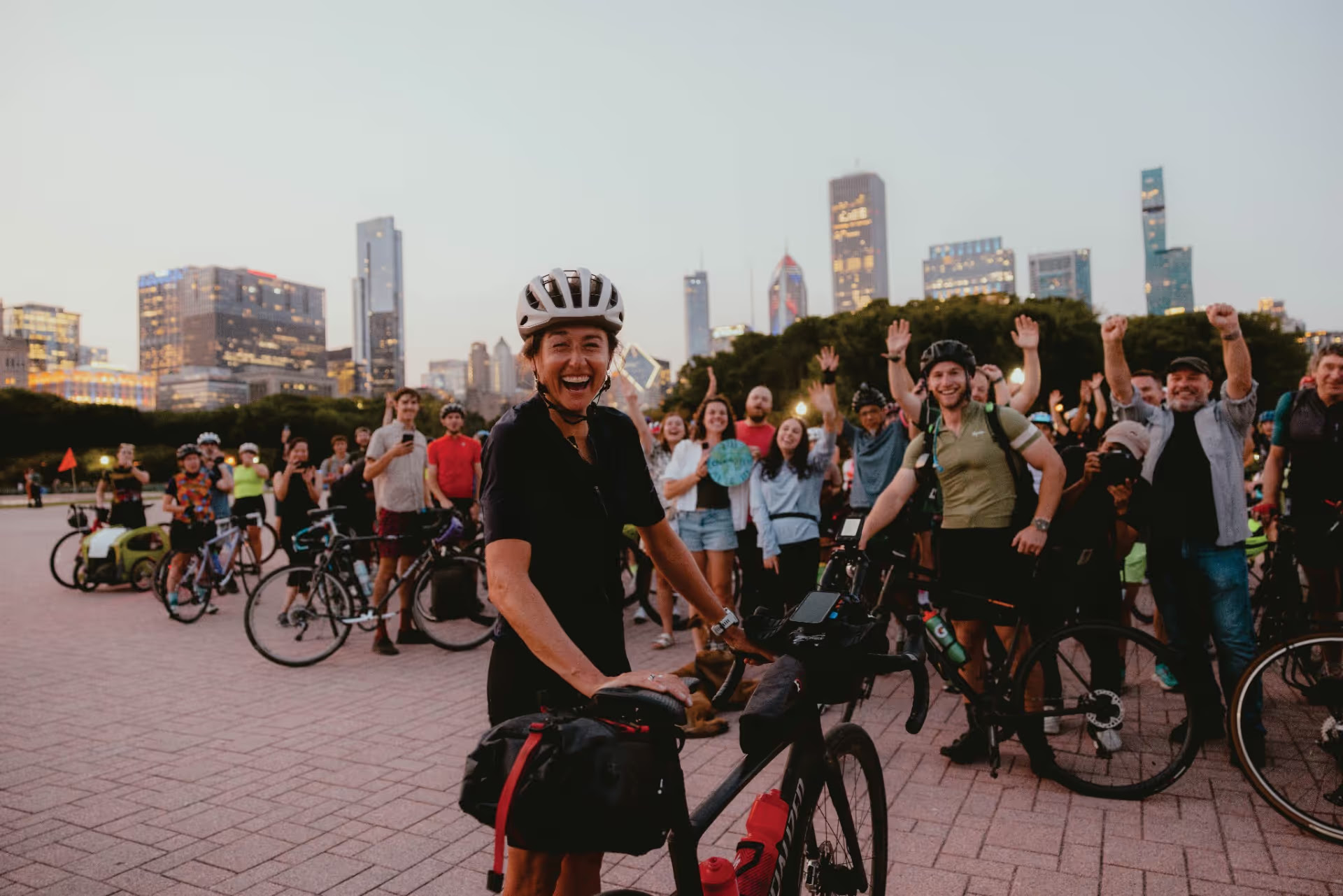
After her failed around-the-world attempt this summer, ultra-endurance cyclist Lael Wilcox has shifted her attention to a new challenge: tackling the Pan-American Highway from her home in Alaska to Argentina in 2027.
Wilcox said she is aiming to begin the north-to-south ride in August or September of next year with a Fastest Known Time in mind.
The exact route and start date have not yet been announced, but the established record course runs from Prudhoe Bay, Alaska, to Ushuaia, Argentina, and covers roughly 22,400km (13,900 miles).
Latest Videos FromCycling Weekly
“I’ve been looking at this ride for basically my whole time cycling because it makes sense,” Wilcox said. “It’s a straight line and because it goes to all these new places, and it rides through the Andes.
“And I want to do it fast.”
The announcement comes after an early end to Wilcox’s attempt to break Mark Beaumont’s outright around-the-world record. She left Chicago on June 7 but stopped just 14 days and approximately 3,000 miles into the ride, having suffered nausea, vomiting and heat exhaustion during a severe European heatwave.
“Sometimes things just don’t work out the way you had expected,” Wilcox said. “I trained harder than ever. I had a huge plan. I had more support, bigger budget, and by day 14 I had to quit the ride.”
Wilcox said the outcome had been disappointing both for her and for her wife, filmmaker Rugile “Rue” Kaladyte, who had backed and documented the project. But the pair remained in Europe, spending time hiking in the Swiss Alps before Wilcox rode the Pan Celtic Race around Ireland and Wales. They then watched the Tour de France Femmes avec Zwift, and capped their travels with a solar eclipse. This time, Wilcox said, gave them space to ride, hike and consider what should come next.
Their answer was the Pan-American Highway.
From Alaska to Tierra del Fuego
“We want to do it in the spirit of how I rode around the world in 2024, so people can come join for any stretch, and I’ll go taking care of myself,” Wilcox said.
(Image credit: SRAM)
The Pan-American system consists of interconnected roads extending from the far north of North America (Alaska) with the southern tip of South America.
The network of roads total approximately 30,000km (19,000 miles), while record attempts typically follow a more direct route of approximately 22,000km (around 14,000 miles) between Prudhoe Bay and Ushuaia.
The route crosses dramatically varied terrain and climates, from Alaska’s Dalton Highway through Canada, the United States, Mexico and Central America, and on through the Andes and Patagonia.
The road is interrupted by the Darién Gap, which is stretch of dense, undeveloped, rainforest between Panama and Colombia. Under the Guinness guidelines used for Michael Strasser’s 2018 record, the missing section had to be bypassed by flying from Panama City to Cartagena, but the clock continued to run during the transfer.
The fastest reported north-to-south ride is Bond Almand’s solo, unsupported journey in 2024. The American covered the route in 75 days, 17 hours and 55 minutes, improving on Michael Strasser’s 2018 time of 84 days, 11 hours and 50 minutes.
The women’s unsupported benchmark belongs to Canadian Ashleigh Myles, who rode 22,412km (13,926 miles) from Prudhoe Bay to Ushuaia in 118 days, 2 hours and 30 minutes. Myles was the first woman known to complete the full route by bicycle.
“Those are fast, really good times,” Wilcox acknowledges.
Wilcox did not explicitly say which category or record she will target, only that she wants to ride the route quickly.
As with her 2024 around-the-world ride – when she set a new women’s record at 108 days, 12 hours and 12 minutes over 18,125 miles – her Pan-American Highway ride will be self-supported with an open-door invite to the cycling community.
“We want to do it in the spirit of how I rode around the world in 2024, so people can come join for any stretch, and I’ll go taking care of myself,” she said.
Kaladyte plans to film the journey, and the couple will meet in the evenings to record Wilcox’s podcast and have dinner together. Wilcox acknowledged that unstable weather will again be an unavoidable variable.
“It’s hard now with climate change,” she said. “Weather is very unstable, unpredictable, but I want to give it a shot, and Rue wants to shoot it.”
For Wilcox, though, the appeal extends beyond the clock. She’s inspired by those who came before her, including Greg and June Siple, whose Hemistour to Argentina in the 1970s led to the creation of the organisation now known as Adventure Cycling Association.
“I just want to join the mix,” Wilcox said. “And I want to see this land.”
