A couple of years ago, Archie Atkinson sent an email to one of his old school teachers. He wanted her to know she had inspired him – but not in the way she might have hoped. “This teacher told me that cycling would never get me anywhere in life and that I should focus on my education,” he recalls. Atkinson, 17 at the time, took it as an ultimatum: it was either cycling or school. He made his decision straight away. “I told her, ‘I appreciate your feedback’, and I never went back to school again,” he says. It was the last the teacher heard from him – until the email.
Atkinson sent the update just as he was about to travel to Paris for the 2024 Paralympics. It read: “Just to let you know, I’m going to the Paralympics. Cycling will get me somewhere in life, and if you ever say that to a kid again, I’ll be having words.” He received no reply. “Maybe she didn’t see it,” he says with a shrug. “Might have gone to her spam.”
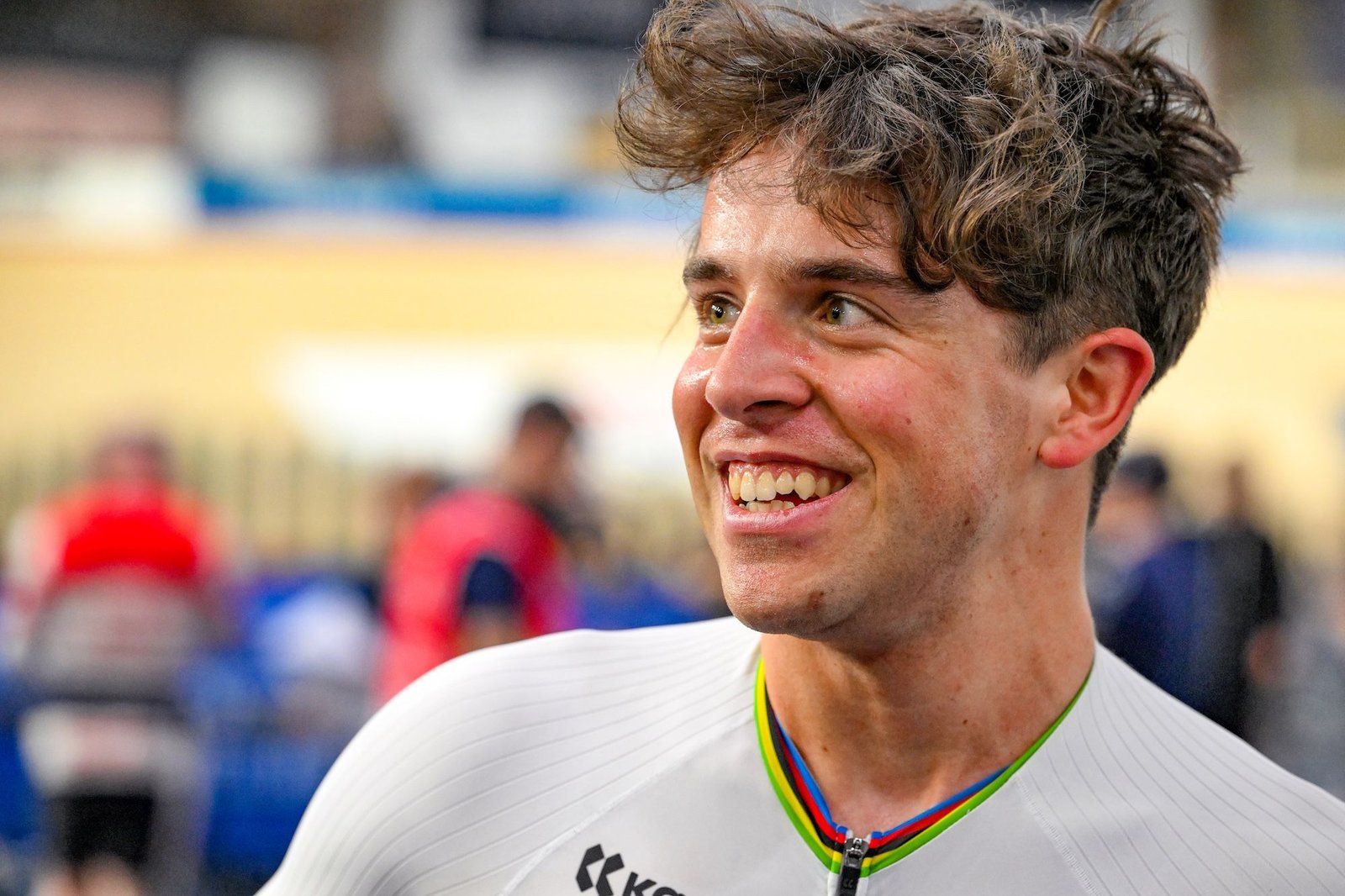
We’re speaking in February at the British Track Championships in Manchester velodrome. There’s a break in the action, and Atkinson and I have retired to sofas inside an empty hospitality cabin at the top of the velodrome banking. He’s wearing the fruits of his recent successes: white bibshorts with rainbow world champion piping, and a national champion’s jersey. (Representing the first of two titles he’ll win over the weekend.)
Latest Videos FromCycling Weekly
(Image credit: SWpix.com / Olly Hassel)
When Atkinson left school at 17, his parents agreed he had until he was 21 to “make it” in cycling; otherwise, he would have to pursue something else. He’s now two weeks shy of his 22nd birthday, which he’ll celebrate as a three-time world champion, a world record holder in the individual pursuit, and a Paralympic silver medallist. “I only frame gold medals,” he says, pulling his Paralympic silver out of an off-white sock for his photoshoot. The medal is chipped at the bottom because “some French kid dropped it”, he explains.
There’s a cheekiness to Atkinson, but also, as his email to his teacher showed, a deep sensitivity and determination. They’re qualities that have earned him a place on Great Britain’s para-team, and drive him towards his overarching goal – a dream that, if realised, would be history-making: Atkinson wants to be the first para-cyclist to join a men’s World Tour road squad.
To date, only a handful of para-cyclists have ever ridden in professional road races. Dame Sarah Storey, Britain’s most decorated Paralympian, competed in women’s World Tour events in 2016, but no male rider has reached cycling’s top tier, let alone signed for one of its teams. Atkinson wonders whether that’s due to prejudice or the underestimating of para-riders’ abilities.
“Will Bjergfelt, one of my GB team-mates, rode the Tour of Britain [in 2021],” he remembers. “Seeing that, just coming into para-sport, I thought, ‘OK, if he can go to the Tour of Britain, what more can I do? What are the boundaries?’ From then, I was like, ‘I’m going to be the first World Tour rider.’ Why not be the first one? Someone has to be.”

(Image credit: Getty Images)
Brought up in the suburbs of Manchester, Atkinson was 10 years old when he was told he had autism and attention deficit hyperactivity disorder (ADHD). It was around that time, too, that he was introduced to track cycling, remarkably by Olympic great Sir Chris Hoy in a one-to-one session set up by Atkinson’s father, Matthew, a long-time employee at Evans Cycles. “It’s a wild thing to have,” the 21-year-old says of that Hoy masterclass. It left him with vivid dreams of becoming a cyclist himself.
When Atkinson was 16, he was diagnosed with cerebral palsy. His condition means he rides under a C4 para-cycling classification, the second-least severe on the C1-5 scale, indicating his impairment is deemed to be ‘mild’. “As a kid, I had to work a lot on my balance and coordination,” he says, but he never wanted to be treated differently. He went to a mainstream school, where he was a “mischievous” student, often distracted and sent out of class. “I didn’t get much help around my ADHD,” he says. “I’d much rather have been out on my bike.”
So that’s what he decided to do when school went online during the Covid lockdowns; Atkinson would put his phone in his jersey pocket, plug in his headphones, and join the class Zoom call from his jaunt around the lanes. “If they asked why my camera was off, I’d say my computer doesn’t work,” he laughs.

(Image credit: Andy Jones)
Coach’s view: “I wouldn’t rule him out”
John Hewitt has been Archie Atkinson’s coach at British Cycling for more than three years. He is well versed in Atkinson’s hope to become a road pro. “As an ambition and a goal, it’s one I support,” Hewitt says. “Having that purpose of trying to achieve it is very admirable – if it comes off, it will be just amazing.”
Hewitt is aware that the competition for contracts is fierce. “There are lots of people out there in the world who have got the same goals. Archie’s really determined, really focused. I wouldn’t rule him out.” For Hewitt, the reason we haven’t already seen para-cyclists on pro teams is due to a lack of field depth and regular road racing opportunities in their development.
The severity of impairment plays a role, too, with high-speed bunch racing unsafe for some riders. Atkinson, Hewitt feels, has the resolve to break the glass ceiling. The clearest sign came at the 2024 Paris Paralympics, where, ahead by six seconds in the individual pursuit final, Atkinson slipped off his saddle and crashed on the penultimate lap. He remounted but had to settle for silver. Atkinson’s response was characteristic: “I’ve learnt more from losing than I have from winning.”
Atkinson had big ambitions but few plans when he left school. With no coach, he sat at home watching YouTube videos on how to train, and copied pro riders’ workouts from their Strava files.
It seemed to work: the following year, his power tests caught the attention of British Cycling, who offered him a guest spot on the para-track team for the 2023 Glasgow World Championships. He went on to shock everyone, including himself, by winning the scratch race at the age of 19.
That result is the one he’s still proudest of today. It’s also his most poignant, dedicated to his friend, American cyclist Magnus White, who was killed by a car driver just a week before. White remains vividly present to Atkinson. When things get tough, he looks down at the ‘Ride For Magnus’ sticker on his bike frame, and faithfully powers on.
“There have been many cyclists who have passed away, but when it’s one of your close friends, it makes me think I can’t miss training sessions. He’d want me to do them,” he says.
Atkinson joined the GB squad full-time in 2024. Since then, his mantra has been simple: if I want to become a World Tour pro, I need to train like one. “Our racing is getting faster, especially in the lower impaired categories; it’s becoming more like the AB [able-bodied] side, where the gears are bigger and more watts are needed,” he says.
“If you train like a World Tour rider, and you’re able to absorb that training and use it, you may as well.” For Atkinson, that means 300km-plus weeks, and camps abroad to Calpe, Spain, where he spent most of last winter.
He lives like a pro, too; his Instagram page is a patchwork of photos of Specialized bikes (he has a personal sponsorship deal with the brand), alongside riding shots with pro cyclist friends. “When I first meet them, I don’t tell them I’m a para-rider,” he smiles. “Then I end up telling them, and they normally use a bad word because they’re quite impressed. I think there’s a weird respect around it; they’re like, ‘Fair play. You’re overcoming adversity, you’re overcoming a disability that hinders your cycling, and you’re not letting it stop you.'”
Far from it, in fact. Atkinson tells me his power numbers are growing every year, so naturally I enquire as to his current FTP. “Undisclosed,” he replies. “I can’t tell you that.” A ballpark figure, then? “It’s between zero and 450 watts,” he smirks, and I accept defeat, but not before asking if he thinks it’s high enough to land him a World Tour contract. “It’s getting there,” Atkinson responds. “I’ve spoken to team bosses over Instagram or over coffee in Spain, and they seem interested. It just takes one person to truly believe in it… But so far, no luck.”
Two months after our meeting, Atkinson had a breakthrough. Two breakthroughs, actually; he won his first UCI Para Road World Cup time trial title in Belgium, averaging almost 50kph (31mph), and the following week, did the same in Italy, this time going closer to 53kph. The victories remind me of a story he told me of “caning it” down a Manchester high street on his time trial bike – a commute that earned him an admonishing lecture from his coaches. But the hard work is clearly paying off.

(Image credit: Andy Jones)
That’s why he’s trying to break the stigma. “If I’m not the first [male para-cyclist on a pro team], but I can help a new rider or a kid coming through who’s powerful and strong enough to make it, because I’ve made it into a big thing, I’m happy,” he says, and it’s clear he means it.
After all, to the teacher who told him cycling would never get him anywhere, Atkinson’s career already stands as an emphatic rebuttal. Whether she ever replies to his email – or whether a World Tour team eventually does – cannot take that away from him.
Explore More
