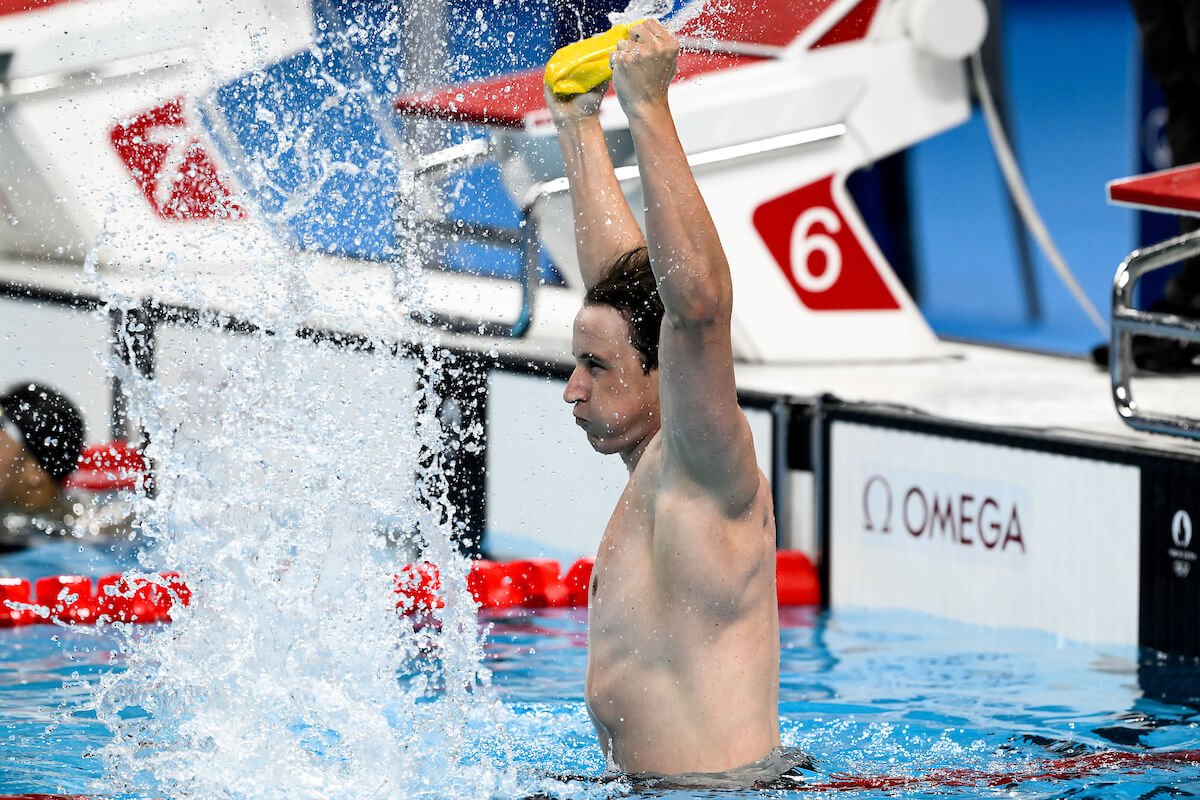
At World Short Course Champs, Cam McEvoy Set for Next Step in Revolutionary Journey
By Nicole Jeffery
Not content with being the world’s fastest swimmer over 50m freestyle, Cam McEvoy’s flirtation with the 100m freestyle will enter a new phase at next week’s World Short Course Championships in Beijing (December 1-6), where he will add the 4x100m freestyle relay to his program.
McEvoy, who was honoured by the Sport Australia Hall of Fame with the Dawn Award at a gala dinner in Melbourne last week (November 24), has focussed exclusively on the 50m freestyle since radically redesigning his training program to reboot his career after the 2020 Tokyo Olympic Games, where he appeared to be a fading force.
While he was developing his new program in 2022 with his coach Tim Lane, the physics graduate was entirely focused on the technical requirements of the 50m, and loath to muddy the water by trying to add the 100m skillset to his arsenal.
However, with the Olympic gold medal, two world titles, the Commonwealth Games gold medal and the world record (20.88 in March this year) in his keeping, the 32-year-old sprinter is now comfortable exploring how his gym-based program (he does only about 2km of race pace swimming a week) can be adapted for the 100m ahead of the Los Angeles Olympic Games in less than two years. He remains the Australian long-course 100m record-holder, 10 years after he clocked 47.04 at the 2016 Olympic Trials.
He has settled for the sprint relay in Beijing because he thinks the six-day program, with the individual 100m coming before the 50m, is too compressed for him to do both individual events at his best, and the 50m has priority.
“I’m hoping to do the leadoff (leg of the relay) so I can get a (100m) time, but I also want to protect the 50 to be fresh for that,’’ he confirmed.
He experimented with combining the 50m and 100m at the recent World Cup series, winning all three 50m events, and setting a 100m personal best of 45.11 to win the final round in Astana, which ranks him 10th on the world all-time list and underlines the potential he still has in that event.
But he also believes the 100m took the edge off his 50m performance there, primarily on the first lap, and is planning to tweak his training to allow for the longer event going forward.
At this stage he is looking seriously at doing both the relay and the individual 100m in Los Angeles, primarily because the 50m will precede the individual 100m there, so he will be fresh for his main event. The longer sprint would become a bonus event at the end of his schedule
“Because LA is day one for the 4 by 1 and I think day four for the 50, there’s much more of a gap, it’s not back-to-back days, so there is scope that by then, with that gap, I would be ready to go,’’ he said.
“I just really need to know that, because I don’t get to just walk into the final, I’ve got to do the rounds, and it being the Olympics, there’s a much larger emotional toll. And then let’s say we win the 4 by 1, then we will be on Cloud Nine and you’ve got to come down and then go again.
“But I feel like if I do choose to do 4 by 1 in LA, and then I’m top two (in the 100m at the Australian Olympic trials) so I get an individual berth, then I’ll give it a go because the 100 freestyle is after the 50.”
McEvoy’s second coming as a swimmer has been much more successful than the first half of his early international career, not only because of his revamped training program, but because of the confidence it has given him in his ability to perform under pressure, something he lacked as a younger swimmer doing a traditional high-volume training program.
He revealed that a program in which he never hit race pace until the final weeks before a major championship, left him struggling for belief that he could produce his best in competition.
“Now I can dive in any week of the year and know within .1 of a second how I will go, and that gives me a lot of confidence,’’ he said.
Every year the Sport Australia Hall of Fame seeks a “courageous ground breaker, who achieved against the odds and challenged the status quo” to present with the Dawn Award, named in honour of Australian sport’s rebel champion Dawn Fraser.
McEvoy has been brave enough not only to pursue a revolutionary training program inspired by athletics and cycling sprinting, but to reveal the “McEvoy Method” to the world via his website where he documents all his training to subscribers.
“At the World Cup some of the coaches from other nations told me that they are part of my community there, which was really surreal in that sense, but it’s really good,’’ he said.
In the highly-competitive world he inhabits, such training details are usually treated like state secrets, and in particular are kept away from direct competitors. But McEvoy is not concerned that others may use his work against him in Los Angeles.
“It’s a risk I am willing to take,’’ he said.
“It’s one thing to see my sessions and my ideas and it’s another to execute them, and I am several seasons ahead of everyone else in this. Of the elite competitors, the likelihood of them dropping what’s worked for them is lower. The faster they are, the less likely I feel that they would pivot (to his methods). That doesn’t mean they couldn’t take ideas and implement it into their existing framework. And that’s a risk, but I enjoy putting this stuff out there and trying to improve the sport from that perspective as well.”
These days McEvoy sees his mission as twofold. The first is to get the best out of himself (“My full potential is unrealised,” he says) and the second is to provide an “alternative pathway” for swimmers whose passion for the sport is dimmed by gruelling traditional training mileage.
He’s delighted that the Dawn Award primarily recognised his courage in forging his own direction.
“This is the first time there’s been recognition of the path I have taken, rather than the end result, so that’s really special to me,’’ he said. “I feel really honoured and I didn’t expect it. It really is a privilege.’’
