Obesity is a major public health problem. According to the World Health Organization (WHO), it affects 1.1 billion people worldwide – around 1 in 7. The number of adults living with obesity has more than doubled since 1990, and adolescent obesity has quadrupled. Obesity is defined as a body mass index that’s greater than or equal to 30.
There are multiple reasons for the increase. According to WHO: “It is driven by complex interactions between environmental, social, biological and behavioural determinants.”
One thing we know for sure is that physical activity – such as cycling – is effective for combatting obesity when combined with a healthy diet. Cycling is especially good because it’s a low-impact aerobic activity that puts less stress on the joints than running, for example.
So why, since 1990, does cycle clothing appear to have become increasingly skin tight, figure-hugging and highly unflattering on anyone who isn’t a WorldTour pro in their twenties? Where are the jerseys and shorts for those who want to fight obesity by riding bikes, but don’t want to wear Lycra that accentuates or exaggerates every contour?
(Image credit: Simon Wilkinson/SWPix)
“My blunt opinion is that, unfortunately, I don’t think enough of the big brands particularly care,” says Amy Curran, founder of new British brand Cycle Wear Central. “Cycling is still a very elitist sport in many ways, and I think the clothing on offer reflects that.”
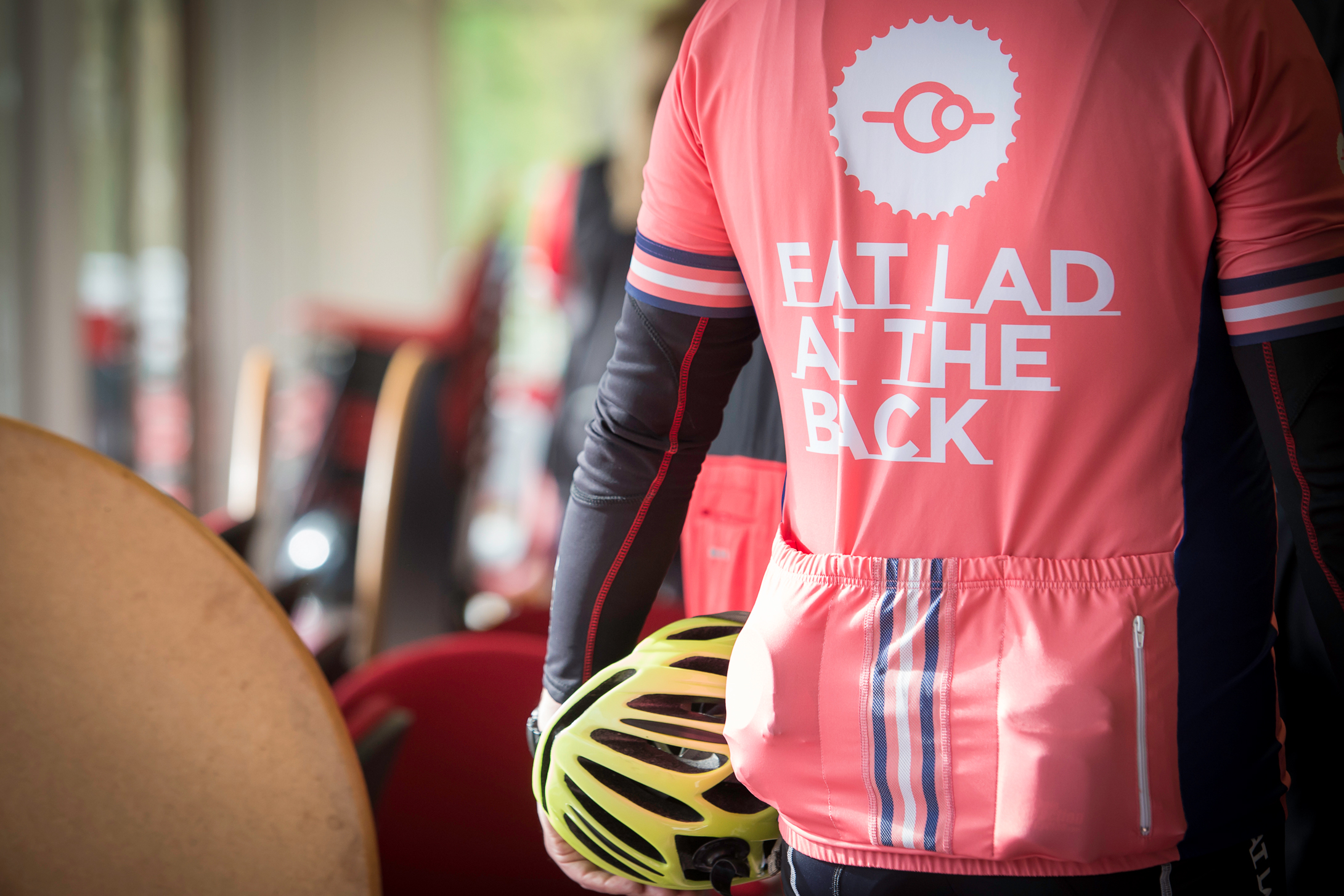
Before starting her own company, Curran spent nine years working with Fat Lad At The Back (FLAB), joining as a junior designer straight out of university. The size-inclusive clothing company was founded by Lynn and Richard Bye in 2013 to dress a “global community of glorious misfits who proudly wear their kit (and their curves) with pride”. When they closed FLAB last year, Curran says she saw an opportunity, decided to use everything she’d learnt and, with the Byes’ blessing, launched Cycle Wear Central to carry on.
“A lot of my customers are incredibly loyal, and many have followed me over from FLAB,” she says. “They’re buying clothing they know works for their bodies, often after struggling to find it elsewhere. I’m also continuing to attract new customers across the entire size range, which I think reinforces the point that there’s demand from all sorts of body shapes and sizes.”

(Image credit: Simon Wilkinson/SWPix)
Cycle Wear Central’s sizing typically goes up to size 8XL in men’s and UK size 28 in women’s clothing. The description for the new autumn/winter range begins: “Cold-weather cycling kit shouldn’t dig in, roll down or make you feel like you have to squeeze yourself into somebody else’s idea of a cyclist’s body.”
CWC’s men’s jerseys are cut with longer bodies and extra room around the belly, and its bib tights are designed with taller and bigger riders in mind. The women’s kit comes in “flattering, female-specific cuts with room for busts, waists, hips and thighs, plus longer lengths and supportive high waists that help everything stay where it should while you ride.”
However, rather than condemning other brands for stopping at 2XL or UK 14, Curran says she completely understands the practical and financial challenges of developing and stocking a genuinely inclusive size range. “It’s not as simple as scaling a size medium up to an 8XL, and doing it properly takes considerable investment, which I’m fortunate FLAB made.”
However, she suspects there’s a bigger issue. “Why would a successful brand invest in a demographic that doesn’t necessarily fit the aspirational, performance-driven image they’ve spent years building? Particularly when the image they’re already selling is clearly working for them. It’s not that larger cyclists don’t exist or aren’t interested in buying good-quality kit, it’s that they’re not the people many brands are choosing to represent.”
She continues: “Having lived through the body positivity movement, which now feels like a rather brief moment in time, I think we’ve seen quite a significant shift backwards over the past couple of years. We’re watching public figures and people in the media seemingly shrink before our eyes, and I think that affects everyone.
“The more we’re exposed to increasingly smaller bodies, the more that becomes normalised, and the less space there seems to be for bodies that don’t fit that ideal.”
While the WHO data says humans aren’t getting smaller, Curran says the bodies we’re seeing represented certainly seem to be. “I don’t think cycling exists in isolation from any of that. If anything, it’s an industry where pressures around body image and appearance have always been particularly prominent.”

(Image credit: Simon Wilkinson/SWPix)
Most of the mainstream cycle clothing brands that we approached for comment declined to get involved, but Castelli’s product line manager Andrew Montgomery believes it’s an important issue that warrants transparency and honesty.
The Italian brand has just signed a partnership with ASO to be the Tour de France’s official jersey partner from 2027, which means it will make the iconic maillot jaune. Arguably that couldn’t be further from the topic we’re talking about here.
“I look after product that has to serve the entire world and there is considerable variation in obesity rates,” Montgomery points out. Digging deeper into the WHO data, the average adult obesity rate in the EU is 16.3 per cent compared with around 28 per cent in the UK and 41 per cent in the USA.
Montgomery, who is Scottish but has lived in Italy for almost half his life, says: “When I go back to the UK I see an unhealthy nation.
“Our biggest percentage of sales is in size large, and a Castelli large could be equivalent to a medium in other brands. That’s across all the categories – jerseys, shorts, jackets and so on. The second most popular size is medium. From our sales data, we’re not seeing that people are leaning towards 2XL or 3XL. In fact, the bigger sizes 2XL and 3XL sell in far fewer quantities than S and XS.”
Montgomery acknowledges that this is likely to be because Castelli has always positioned itself as a racing brand, serving a mostly European customer base rather than British or American.
“Our DNA is in racing and performance, so when people shop Castelli they’re looking for those things. That’s not to say we don’t also have clothes for the everyday cyclist, but if you have the mindset of a racer, it doesn’t matter whether you’re a small or an XL you’re still looking for the product to be tight, aero, comfortable. I’m happy with where Castelli is both in the size split, where we sell, and where we are positioned in the market.”

(Image credit: Andy Jones)
Castelli is the clothing sponsor of WorldTour teams Soudal Quick-Step and AG Insurance-Soudal but, Montgomery says, the clothing is not designed exclusively around pro racers’ bodies.
“Our development testing team is a group that consists of riders who are different ages and shapes across the size range. All ride a lot – one does 45,000 kilometres a year and is close to 100 kilos. We have some of the best pattern cutters in the world and a very detailed process from design to production.”
It’s not that Castelli is unwilling to invest in larger sizes for fear of being left with unsold inventory, Montgomery says. “We have people who analyse the data, predict the pre-order and the percentages. We don’t make the size curve blind. The sell-through rate is incredibly high. We don’t live in a world of wastage any more. After Covid we learnt a lot about controlling production to make sure that there was no excess stock in what we call the extreme sizes – the highs and lows.”
There’s no straightforward answer to the original question. Curran claims larger cyclists aren’t included in the aspirational racer image that the mainstream brands are selling, while Montgomery says Castelli isn’t seeing a demand for larger sizes and sells the sizes its customers ask for.
As he points out, Castelli’s customers choose its clothing because they’re looking for racing and performance, so it’s perfectly understandable that this is where the brand invests. He says the product development team is made up for different body shapes and not just for the stereotyped skinny pro – although he does concede that the 100-kilo test rider he mentioned earlier is “solid muscle”.

(Image credit: Simon Wilkinson/SWPix)
Curran responds: “I think there’s a big difference between simply offering larger sizes and genuinely designing clothing for larger bodies. I’ve spent my career doing the latter, and that’s what I want to continue doing at Cycle Wear Central – offering the kit people need and want.”
If we want to see more people on bikes as well as a healthier, leaner population, there’s an argument for going beyond selling premium-priced performance apparel to the same people.
Maybe the cycle clothing industry as a whole could widen its net to encompass a broader range of body types rather than leaving it to a very small number of specialist brands to cater for a potentially huge untapped market of future cyclists who don’t feel comfortable wearing the kit on offer at the moment. Who will be the first mainstream brand to step up and expand out?
