Another moment from Saturday offered a reminder of Rees-Zammit’s extraordinary pace when Joseph-Aukuso Sua’ali’i intercepted a Welsh pass and set off downfield.
The Australian, a formidable athlete in his own right, had a head start of at least five metres.
One commentator confidently declared he would not be caught.
Rees-Zammit caught him.
The speed has always been there. The numbers reveal how much more there is to his game now.
Rees-Zammit scored five tries in 10 Premiership appearances for Bristol last season. This season he has matched that tally in five games, beating 28 defenders and making 12 clean breaks.
Against Japan earlier in November, he beat 13 defenders and made more line breaks in 80 minutes than in the entire Six Nations, when he started all five games at full-back.
But Rees-Zammit is not the only thing that has changed since March, Wales have changed too
Even the quickest wing in the world is of limited use if he receives the ball standing still with two defenders in front of him.
“But as a winger, you do rely on your boys inside you,” said Cuthbert.
With Wales generating more momentum up front, Cuthbert highlights Blair Murray’s ability to engage defenders before releasing Rees-Zammit.
Wales are also deploying both wings on the same side of the field. Rees-Zammit and Josh Adams combining for full-back Murray’s try was a fine example.
Scrum-half Tomos Williams has perfected the art of the sharp, accurate pass that bypasses players and gets the ball into the wider channels early.
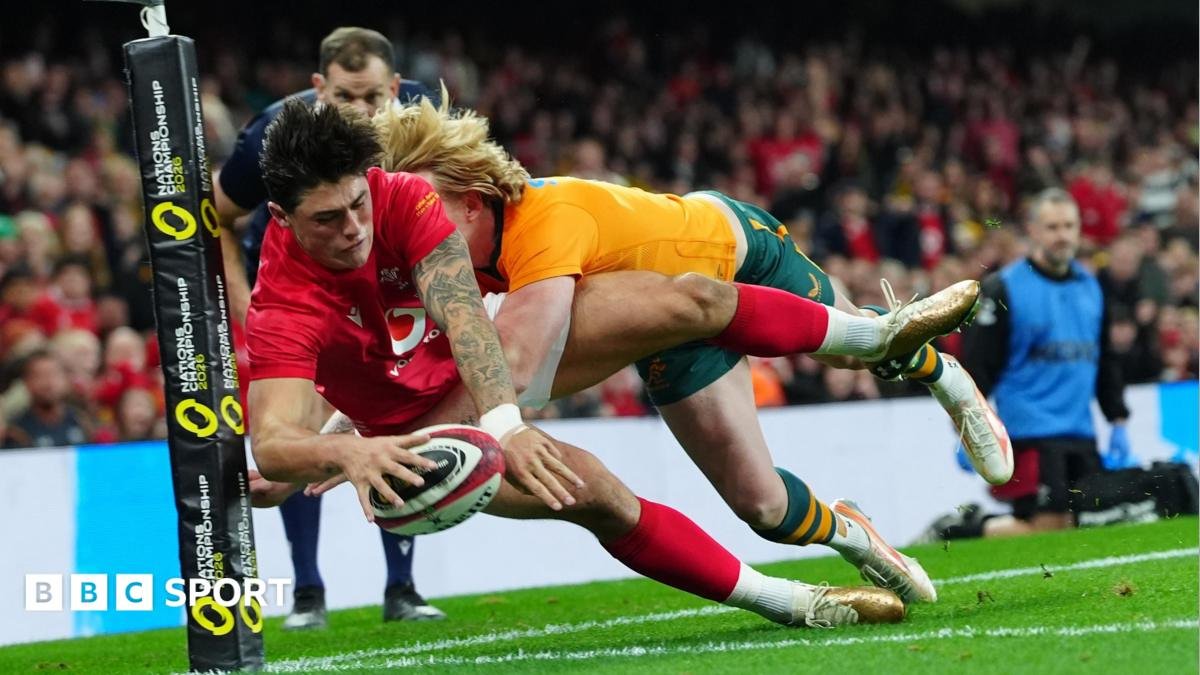
It helped create Rees-Zammit’s try against New Zealand and, eight minutes into Saturday’s game against the Wallabies, looked to have created another.
Having dived for the corner, Rees-Zammit’s first instinct on getting to his feet was not to celebrate or appeal to the referee, but to fix his hair.
The try would not survive the television replays. The hair had survived the tackle.
Image matters to Rees-Zammit. He is Welsh rugby’s most marketable player, its biggest draw. He puts bums on seats and gets people out of them.
There is a lovely soundtrack to Rees-Zammit receiving the ball in space at the Principality Stadium. A low hum of excitement followed by the rattle of thousands of seats folding up almost simultaneously.
The thrill is in the anticipation, and these days there is rather more to anticipate.
