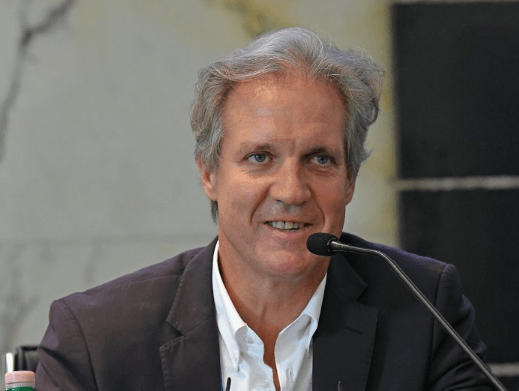
President Antonio Silva Discusses Future of European Aquatics on Road to LA28
Next year will mark the 100th anniversary of European Aquatics, which formerly was recognized as LEN. Ahead of that centennial celebration, Swimming World presented European Aquatics President Antonio Silva with several questions concerning the current and future status of the organization.
In his responses, Silva emphasized the success of the recent European Championships in Paris, where para swimming joined the program. Additionally, Silva discussed the need for European Aquatics to ensure successful transitions for athletes from the junior level to the senior level, and for the organization to continue to develop approaches that promote visibility for athletes and competitions. There is also a focus on development within European countries that may not have the same resources available as the top nations.
Here are Silva’s responses to Swimming World’s questions:
1) At the midway point to the 2028 Olympic Games in Los Angeles, can you comment on the current state of European Aquatics?
European Aquatics is in a strong and increasingly ambitious position. The European Aquatics Championships in Paris brought together 1,268 athletes across five disciplines, supported by 615 volunteers, with more than 100,000 tickets sold. It was also our first fully inclusive European Aquatics Championships, with para swimmers competing within the same overall event.
From a sporting perspective, Europe continues to be a leading global force, with our athletes regularly setting world and European records and winning medals at the highest level. However, our responsibility extends beyond the next competition. The two years leading to LA28 must be used to strengthen athlete pathways, coaching, sports science and support for our National Federations, while continuing the long-term modernization of European Aquatics.
2) What are your current priorities for European Aquatics? Are there specific goals you have identified for the organization?
Our priorities are clearly defined in the European Aquatics Strategic Plan 2024–2030: good governance, athlete development, education, inclusion, professionalization, digital innovation and greater visibility for our athletes and sports.
We represent 52 National Federations with very different resources and development needs. It is therefore essential that we provide targeted support and share Europe’s considerable technical, scientific and organizational expertise more effectively.
Strengthening the transition from junior to senior competition is another priority. The U23 category can play an important role in closing this gap. At the same time, we are investing in coach education, certification, continuing professional development and sports science through the European Aquatics Academy and our wider development programs.
3) What are two or three accomplishments achieved during your tenure of which you are most proud?
I would highlight three achievements.
First, the progress made in governance. European Aquatics has completed two annual SIRVS reviews and retained its Bronze certification. This demonstrates that good governance is no longer simply an ambition; it is becoming measurable progress. Our next objective is to work towards Silver certification.
Second, the Paris 2026 European Aquatics Championships. The event brought together 1,268 athletes across five disciplines, sold more than 100,000 tickets and delivered the first fully inclusive European Aquatics Championships. It demonstrated our organizational capacity and our commitment to inclusion.
Third, we have strengthened athlete and workforce development. This includes the introduction of the European Aquatics U23 Swimming Championships, which will form part of the 2027 European Games in Istanbul, together with the expansion of coach education, certification and development support for our National Federations.
4) What challenges and opportunities does European Aquatics face heading into the future?
One of our principal challenges is the transition from junior potential to sustained senior success. At the 2026 European Aquatics Junior Swimming Championships in Munich, 599 athletes competed and 17 nations won medals. Europe clearly has an exceptional talent base, but we must ensure that young athletes receive the right competitions, coaching, education and sports-science support to continue progressing.
A second challenge is the significant difference in resources and infrastructure among our 52 Member Federations. This is also an opportunity. Europe possesses enormous technical, scientific, and organizational expertise, and we can achieve much more by sharing that knowledge through structured cooperation and targeted development programs.
We must also respond to changing audience expectations. Paris showed how innovative presentation, inclusive formats and iconic locations can increase the visibility and relevance of aquatic sport. Our opportunity is to combine sporting tradition with Innovation.
5) What are European Aquatics’ goals for LA28 in terms of competitive success?
Our objective is for Europe to remain the leading continental force in Olympic aquatic sport. We want European athletes to compete for medals and reach finals across all aquatic disciplines on the LA28 program.
However, success cannot be measured only by the total number of medals. We also want more European nations to be internationally competitive and more young athletes to make a successful transition to senior sport.
The 599 junior athletes who competed in Munich are part of the generation that will shape LA28 and the years beyond. Our responsibility is to provide them—and their coaches and federations—with the appropriate pathway, competitive opportunities, and support environment.
6) What is European Aquatics doing to enhance the visibility of its athletes and sports? How can it promote growth and improve event presentation?
Paris demonstrated the scale of the opportunity. The Championships generated 7,958 media mentions, achieved a media reach of 93 million and recorded 95 million social-media views across European Aquatics platforms. These figures show that aquatic sport can engage audiences well beyond its traditional specialist community.
We must build on this by placing athletes and their stories at the centre of our communications. We also need to improve sports presentation, digital content, broadcasting, fan engagement and the consistency of the experience across all our competitions.
High diving and open water swimming in the Seine demonstrated how iconic locations can transform the presentation and storytelling of our sports. Growth will come from combining elite competition with compelling stories, accessible digital content, inclusive participation and events that connect with their host cities and communities.
7) Is there anything additional you would like to highlight about European Aquatics?
European Aquatics is undergoing an important period of transformation. We have 52 Member Federations, an outstanding sporting tradition and athletes who consistently perform at the highest international level. Paris 2026 demonstrated what we can achieve together: 1,268 athletes, five disciplines, more than 100,000 tickets sold, 93 million in media reach and 95 million social-media views.
However, Paris was not the destination. It was a platform for the next stage of our development.
Our ambition is to build a stronger, more inclusive, and more professional organization; support every National Federation according to its needs; develop the next generation of athletes and coaches; and make aquatic sport safer and more accessible through initiatives such as Swim Safe Europe.
We want European Aquatics to be recognized not only for producing champions, but also for good governance, education, inclusion, social responsibility, and the modernisation of aquatic sport.
