It was one of the most iconic moments of the season. The sight of Mathieu van der Poel, walking back against the race on the Trouée d’Arenberg at Paris-Roubaix, to get back to his original bike, after the wheel had been changed. He still managed to finish fourth.
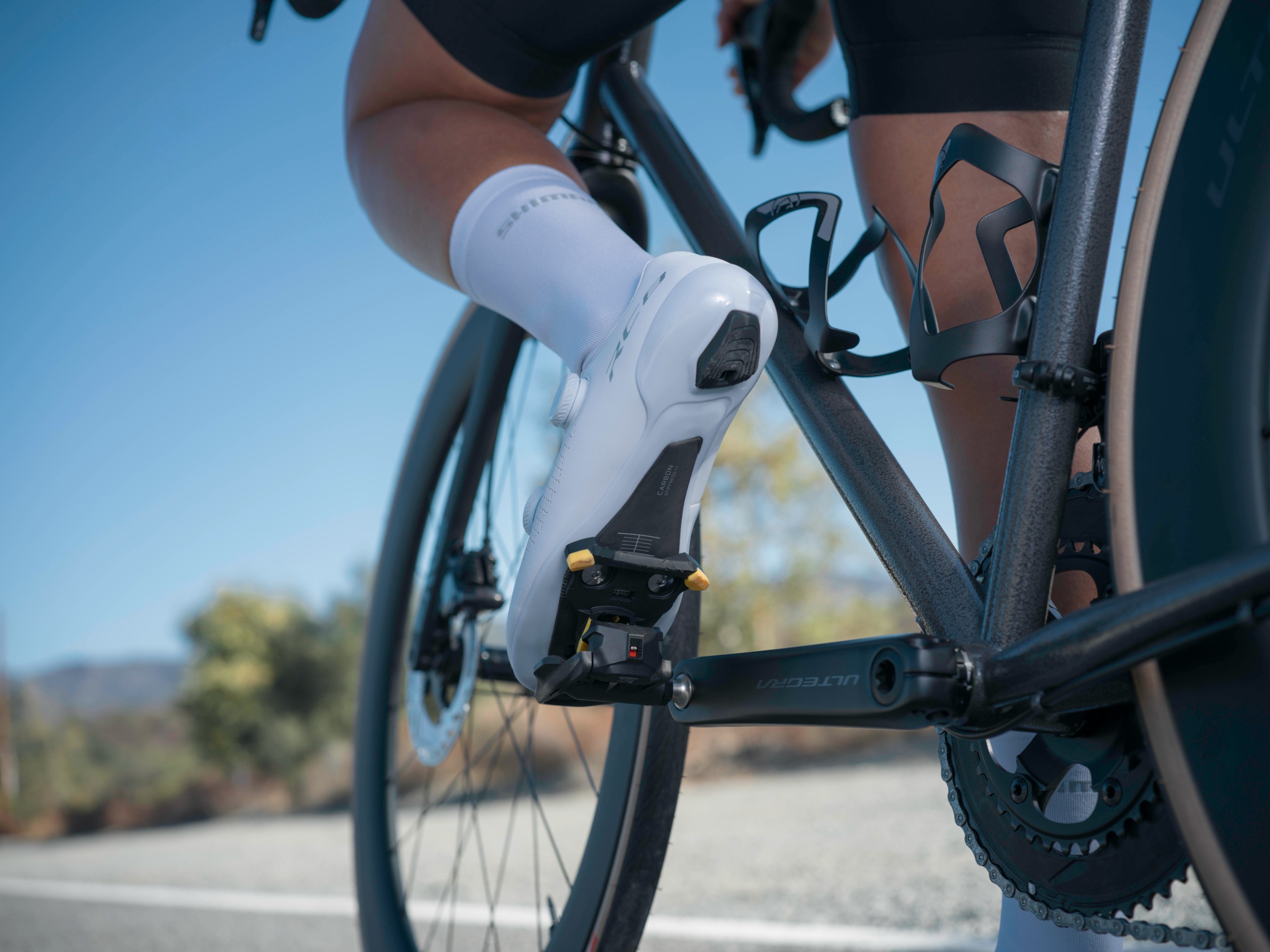
In between puncturing at the start of the five-star sector and remounting his bike, Van der Poel had attempted to get on his Alpecin-Premier Tech teammate Jasper Philipsen‘s bike, not realising in the mayhem that there was a cleat-compatibility problem. You see, Philipsen was running what we now know are the new Shimano Dura-Ace pedals, with SPD-SLR cleats, while Van der Poel was on the old model, and still using SPD-SL, which we know and love.
The new Dura-Ace pedals, R9300, do not work with your old SPD-SL cleats, but instead with the new SPD-SLR versions. Hence the merry dance Van der Poel went on on the cobbles. There is an element of backwards compatibility, with SPD-SLR cleats fitting into SPD-SL pedals, but it is not recommended, and doesn’t feel great.
Latest Videos FromCycling Weekly
The reason why Van der Poel’s chaos matters is that it could happen to you, too. Obviously, you’re unlikely to be swapping bikes with a teammate in a high pressure situation at the biggest one-day race of the year, but plausibly, you could find yourself in a bind if you have multiple bikes and want to use the new Shimano SPD-SLR ecosystem.
(Image credit: Shimano)
Essentially, if you want to make the most of the stack height advantages, and make sure everything matches up, you need to get new Dura-Ace or Ultegra R8200 pedals to go with the new cleats. These don’t necessarily require the new S-Phyre or RC810 shoes, but if your shoes do not have a lot of aft and fore adjustment built in underneath, then your preferred cleat position might not be possible.
Of course, you could use the new grey cleats, which retain adjustment, but that then negates any advantage that the new lower stack height brings. If you’re also willing to deal with the worse nature of using SPD-SLR cleats with your old-style pedals, then you can do that too.
Do the advantages of reduced stack height mean every rider should be rushing out to the shops for the new system, though?
I asked Andy Turner, performance coach and wind tunnel optimisation expert, for a bit more info: “I’ve tested the SRM pedals and they do feel a bit better connected and maybe a bit more direct for sprinting but a couple of millimetre reduction is not going to be something particularly tangible to most consumers. It does help a little bit and also reduces the centre of mass as well as the coefficient of drag by a minuscule amount. There is essentially is no downside to it. But it’s not something that I think people need to flock to to see some magical gain and improvement.”
Therefore, it might be the sort of thing that you update when you need new pedals, or get a new bike, rather than something ride-changing that needs to be sorted now. However, be warned, that if you start changing pedals on one bike, then you probably should do it for all, unless you want to have different shoes for different bikes. At £199.99 / €229.99 / $300 for the Dura-Ace pedals, or £139.99 / €160.99 / $200 for Ultegra, however, it might start to add up.
One other thing that should be of comfort to Van der Poel, does he find himself walking along the Trouée d’Arenberg again, is that the new cleats are easier to walk in. With their lower height, and slightly-redesigned rubber grippers, I’ve found the new cleats the best road versions I’ve ever trotted around in. It’s not revolutionary, but it is better, just like the whole new SPD-SLR ecosystem.
Explore More
