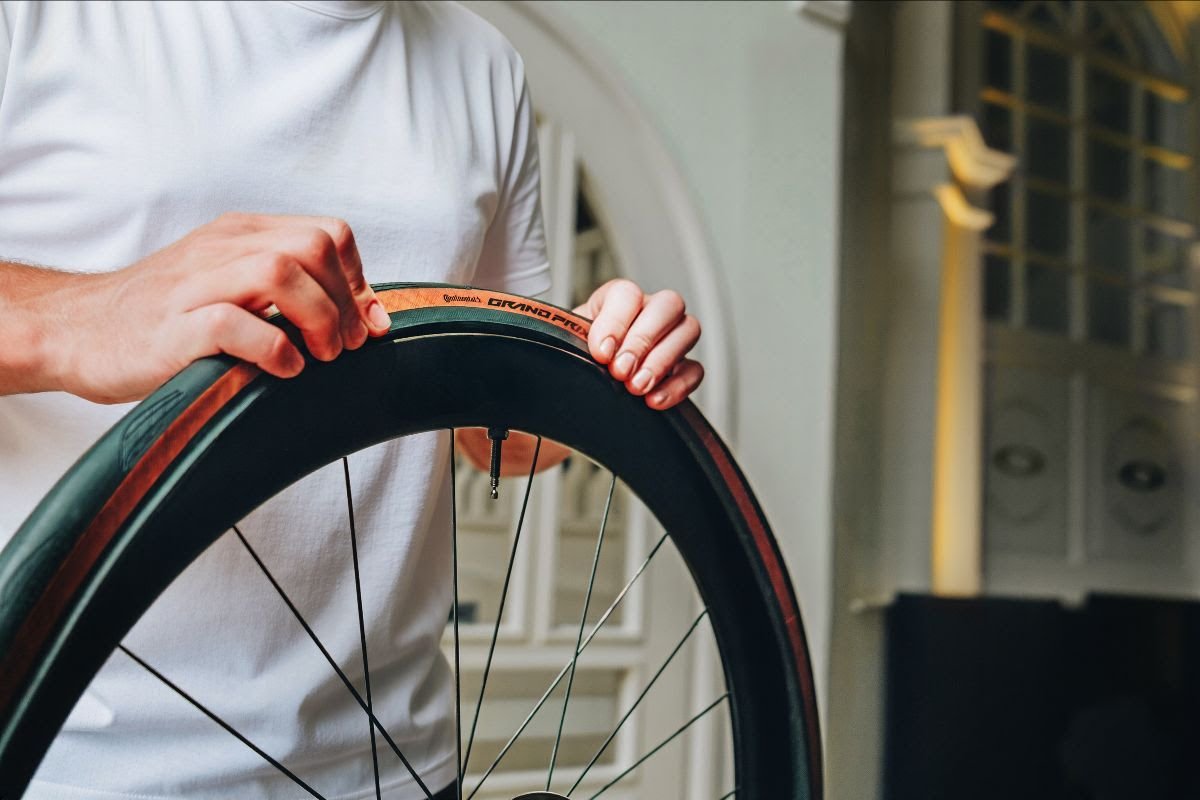
Continental has launched a new 32mm version of its Grand Prix tyre, recognising “the shift in consumer behavior and industry trends”.
First of all let’s establish that the Grand Prix is a different tyre from the Grand Prix 5000, the flagship road race model ridden in the WorldTour. According to Conti, it “inherits proven technology from the iconic Grand Prix 5000 range to offer cyclists the ultimate blend of performance and durability. The robust three-ply construction and Continental’s BlackChili Compound deliver an optimal balance of reliable puncture protection, exceptional grip, and low rolling resistance.” You could say it’s what we used to call a training tyre. It’s obviously much cheaper, too. The Grand Prix 5000 S TR, as used by the Conti’s WorldTour teams, is listed at £84.95 on the brand’s own website, whereas the Grand Prix is around £30 cheaper.
It’s not exactly news that a tyre is now available in a wider size – this is something that’s been happening over the last few years, with the pros now routinely riding 30mm tyres. The Grand Prix 5000 S TR is even available in 35mm. Perhaps what’s interesting here is the ambiguity in Continental’s press release. Does the “shift in consumer behaviour” that Continental talks about refer to the growing frustration with tubeless tyre tech – the faff, the mess, the compatibility issues and so on – by everyday riders rather than the ever-increasing width?
Latest Videos FromCycling Weekly
Continental launched the affordable all-rounder Grand Prix range last year, but it clearly lavished all the attention on the tubeless Grand Prix TR version, making it available in 25mm, 28mm, 30mm and 32mm sizes while the standard tube-type Grand Prix was only available in 28mm and 30mm. It seemed to be something of an afterthought, there to pay lip service to the ‘old’ technology. But now, with the growing popularity and accelerated development of lightweight, durable TPU tubes, Conti appears to have realised – without exactly spelling it out in the press release – that there is now a strong case for tube-type again, and it shouldn’t be ignored.
It’s not only that tubes take away the faff, the mess and the compatibility issues – the construction of the tyre also generally results in a lower system weight. Look at the claimed weights of the tubeless-ready Grand Prix TR in 32mm compared with the new 32mm Grand Prix. The tubeless tyre weighs 395 grams while the tube-type is 340 grams. Add 30ml of sealant per tyre – about 30 grams – to the Grand Prix TR and Continental’s own ContiTPU tubes for 25-35mm tyres – 35 grams each – to the Grand Prix and you’re saving about 100 grams per pair. And there’s arguably no better place to save weight than in the wheels.
There’s obviously a much wider debate to be had that goes beyond weight and has to account for rolling resistance. In its independent testing of the Grand Prix TR, Bicycle Rolling Resistance found that Continental managed to get a respectable performance from a relatively heavy, robust casing. So just because it’s lighter, the 32mm Grand Prix will not necessarily be faster. The new tube-type tyre is as yet untested, but it will be interesting to see how it performs.
The other potential downside of tube-type compared to tubeless is, of course, the risk of pinch flats at low pressures. However, the Grand Prix is a road tyre, not an all-road tyre, and it’s unlikely many consumers would run it ridiculously soft for riding on tarmac. And the bigger the volume – 32mm is quite voluminous for the road – the less likely the pinch flat.
So for many riders, the balance is tipping back in favour of tubes, and for them, having the same width options as tubeless is only right and proper.
