In recent years, shorter crank lengths have been in the spotlight. Back in 2024, Tadej Pogačar switched to 165mm cranks, a change that coincided with a run of victories that has yet to cease. Perhaps in response, Jonas Vingegaard was spotted using 150mm cranks at various races in 2025, although not at every event. Now 170mm, and shorter, are commonplace, if not quite the rule.
So, is shorter better?
Well, as with most factors relating to individuals, it really depends. There is no single correct crank length for every rider, and here I’m going to look into why that is. I’ll also delve into the purported benefits and potential drawbacks. But first off, let’s get a bit of the background science out of the way.
Latest Videos FromCycling Weekly
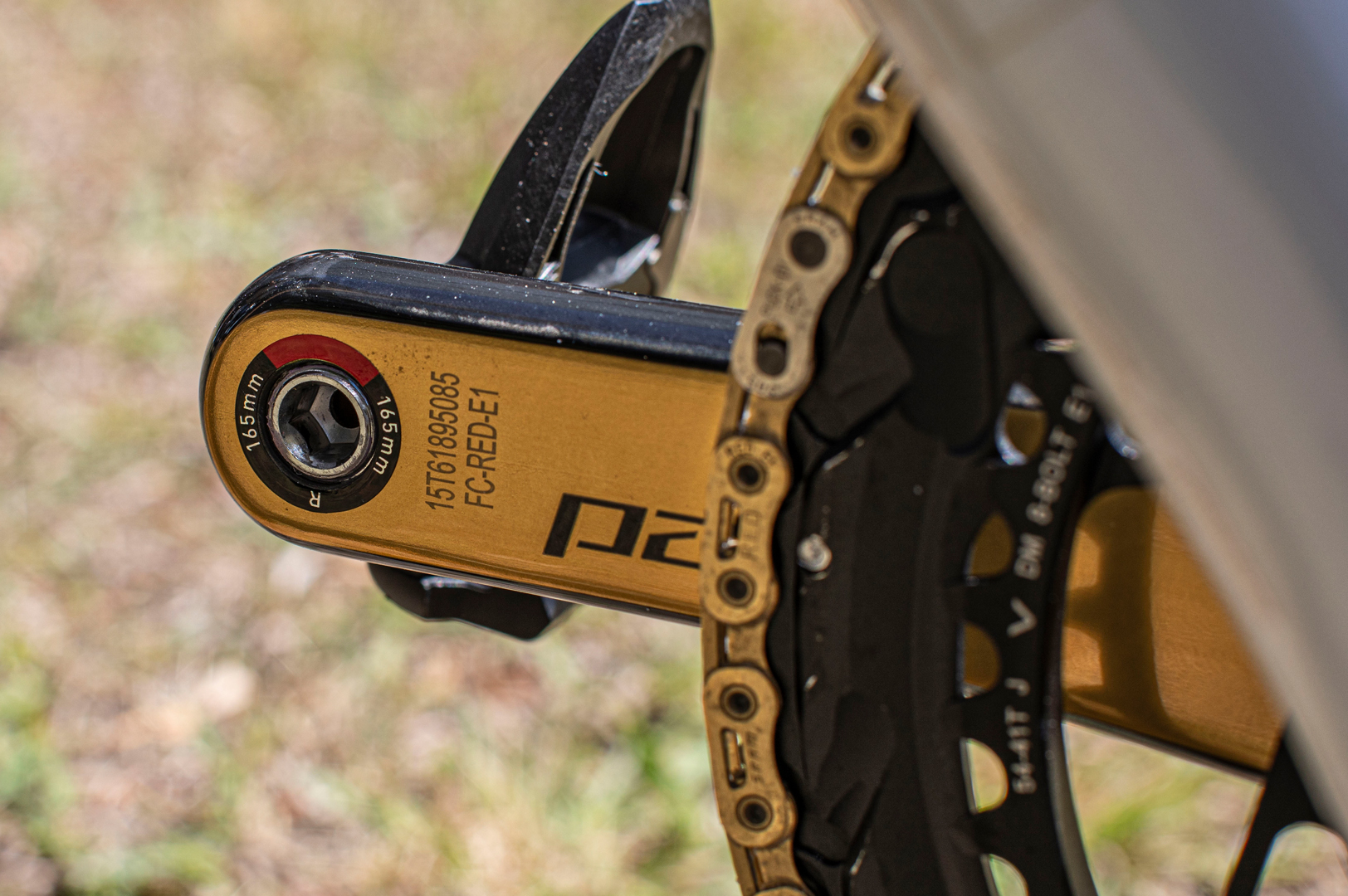
A closer look at Remco Evenepoel’s 165mm crankarms from the Tour de France
(Image credit: Aaron Borrill)
Power (watts) is made up of two components. There’s angular velocity, measured in cadence, and force, which is the torque we produce. An example equation would be 300W at 80RPM requires 35.81Nm of force (Power/Cadence) x 9.5492968).
But an interesting factor regarding crank length is that, although it doesn’t change the cadence at which you pedal, it does change the speed at which your legs move. This is due to the circumference of the pedal revolution changing as you alter crank length. Shorter cranks actually slow the foot, as it travels a shorter distance to complete each pedal revolution.
This has an interesting side effect: more pedal force is required with shorter cranks to achieve the same torque at the spindle, due to the reduced lever length. This has been suggested as a reason for higher self-selected cadences with shorter cranks, so as to reduce the pedal force required, increase the angular velocity of the foot, and still achieve the same power.

Kasper Asgreen is using 172.5mm as opposed to 175mm that other taller riders still employ
(Image credit: Aaron Borrill)
So why would a WorldTour rider use cranks that mean more force is required at the pedals? There are several reasons why, some of which we will discuss later. But first, smaller cranks change how the foot and leg move, which can affect efficiency and psychology. Since the foot is moving more slowly, there is an argument that higher cadences become more efficient because the legs do not need to move as fast or as much. This drop in angular velocities at the joints can help make repeated accelerations at higher cadences more sustainable, as at higher power outputs, higher cadences can also be more efficient.

Pogačar is a leading advocate of going shorter
(Image credit: Aaron Borrill)
Indeed, part of the supposed reason for Tadej Pogačar switching to shorter cranks has been to allow for the rapid accelerations he produces to effectively fly away from the bunch en route to one of his signature solo victories. It becomes somewhat easier to ‘spin up’ the gear with a shorter crank, even if torque can be reduced. It used to be assumed that longer cranks meant a longer lever, which resulted in more watts, but with higher cadence at higher power outputs being more efficient and excessive torque application being a limiting factor for fatigue accumulation, shorter cranks make sense for elite riders.
With bikes such as the Factor One and its innovative take on bike geometry, there has been a clear shift in the WorldTour toward riders being positioned further forward over the bottom bracket, akin to a time-trial ‘lite’ fit. Shorter cranks can assist here as the hip angle does not get as closed off at the top of the pedal stroke, and can make pedalling and power production more efficient. This, in turn, can allow for a lower front-end position without impeding the pedal stroke, possibly creating a more aerodynamic position. So far, it’s looking like the benefits of shorter cranks are endless.
But they are not without their flaws.
Firstly, from a performance perspective, they do have some downsides. Shorter cranks mean your legs do not extend as much at the end of the pedal stroke if saddle height remains the same. To counter this, you need to raise your saddle or get a lower-stack-height cleat and shoe options, which is not cheap. This, in turn, results in a larger frontal area, and I’ve seen wind-tunnel testing showing that shorter cranks and adjusting your position to accommodate the change in fit often add a small amount to the coefficient of drag. Raising the saddle also has a small impact on the centre of mass, raising it, which can marginally reduce stability when cornering. Visma – Lease A Bike addresses this by using Nimbl Shoes with four-bolt cleat mounting for Speedplay pedals, which results in a stack height of about 8.5mm vs 14.6mm for Shimano Dura-Ace pedals.
Shortening the cranks also reduces the total torque production possible. It’s not a problem for the most part, but for sprinters, it has been found that shorter cranks can reduce peak power production.
We also have to consider that the majority of us are not professional road riders, spinning up climbs at 90-100RPM at 400+ watts. In addition to that, what is going to be most efficient for one rider is not necessarily going to be the most efficient for every rider.

Paul Seixas uses 170mm cranks on his Van Rysel race bike
(Image credit: Aaron Borrill)
An expert’s view on crankarm length
To get more insight into this, I spoke with Phil Burt, an expert bike fitter who has worked with Team Sky/Ineos and British Cycling over the years.
His view on shorter crank arms is that there is very little downside, as long as riders adjust their bike fit to account for the changes shorter cranks make to hip and knee angles, as well as saddle height and setback.
“People who bought 165mm crank arms are not taking advantage of that, likely keeping their saddle height the same level and therefore compromising position and power. The benefit of short cranks is moving up and forwards, getting over the BB more without compromising knee angle. It loosens up the psoas muscle, and you don’t really pull up on the pedal angle anyway, which is what this muscle can help with, but you can limit stiffness with a wider hip angle.
The problem with really small cranks, such as 150mm, is that the bike ends up in quite a high position. Potentially 25mm higher than what many bikes are designed around.”
This is a very interesting point, as frames are designed around certain crank ideals, so the BB drop is designed to accommodate crank lengths of 170-175mm. Short cranks and the higher saddle will impact the centre of mass and handling.
“The big benefit with these shorter cranks is more inclusivity for fit for women and shorter-stature people. They are also better for people with biomechanical issues or injuries; especially as you age, it is more important to optimise fit as the optimal fit window shifts and gets smaller. Short cranks reduce impact on the hip and knee joints which just makes sense as you get older. It also reduces asymmetry, as you don’t have the extreme angles where imbalances are more prevalent. A good crank length rule of thumb is that 5mm shorter opens up the hip angle by 2-3%.
Negatives? It’s trendy, but it’s only a problem if you don’t address the changes needed when you switch to shorter cranks. You also need to ensure it will fit within your optimal fit window. The only real performance downsides are at 0-30RPM, then short cranks are not as good, so team sprint off the line, maybe super steep MTB, but not much, if any, impact on road performance.”
As a fun analogy for how shorter cranks have had positive performance gains right away, Phil shared this story about Bradley Wiggins before his Hour Record attempt.
“Back in 2015, we were looking to optimise the team pursuit squad. They were low and super aero with their thighs in their chest. We dropped them down to 165mm cranks across the board for aero and power, and it helped instantly. Bradley Wiggins was training for his Hour Record attempt, three weeks out, and came to talk with us. He changed from 177.5m down to 170mm, and was able to get a 30mm drop in front height and over 3% drop in CdA. The rest is history.”

Tom Pidcock uses 160mm cranks on his Pinarello Bolide F time trial bike
(Image credit: Aaron Borrill)
Beyond performance
As Phil mentioned, one very important aspect of shorter cranks being more readily available is greater fit accommodations for a wider range of people. Cycling has traditionally been very male-focused, with all bikes coming with 172.5 or 175mm cranks. Fine for the average global male height 171cm. But the average global female height is 160cm, and you wouldn’t set up a bike fit for a 171cm person the same as for a 160cm person.
With the release of cranksets down to 150mm, SRAM has taken a great step towards greater fit inclusivity, be that for female riders, younger riders, or riders with conditions such as dwarfism. It may be coming off the back of a 175cm rider dabbling in short cranks for professional bike racing, but the wider implications of this release are highly positive. Perhaps just don’t switch to 150mm cranks on a whim, hoping it will make you climb as fast as Jonas Vingegaard. Instead, get a bike fit and select the correct crank length for your individual biomechanics and specific cycling goals.
