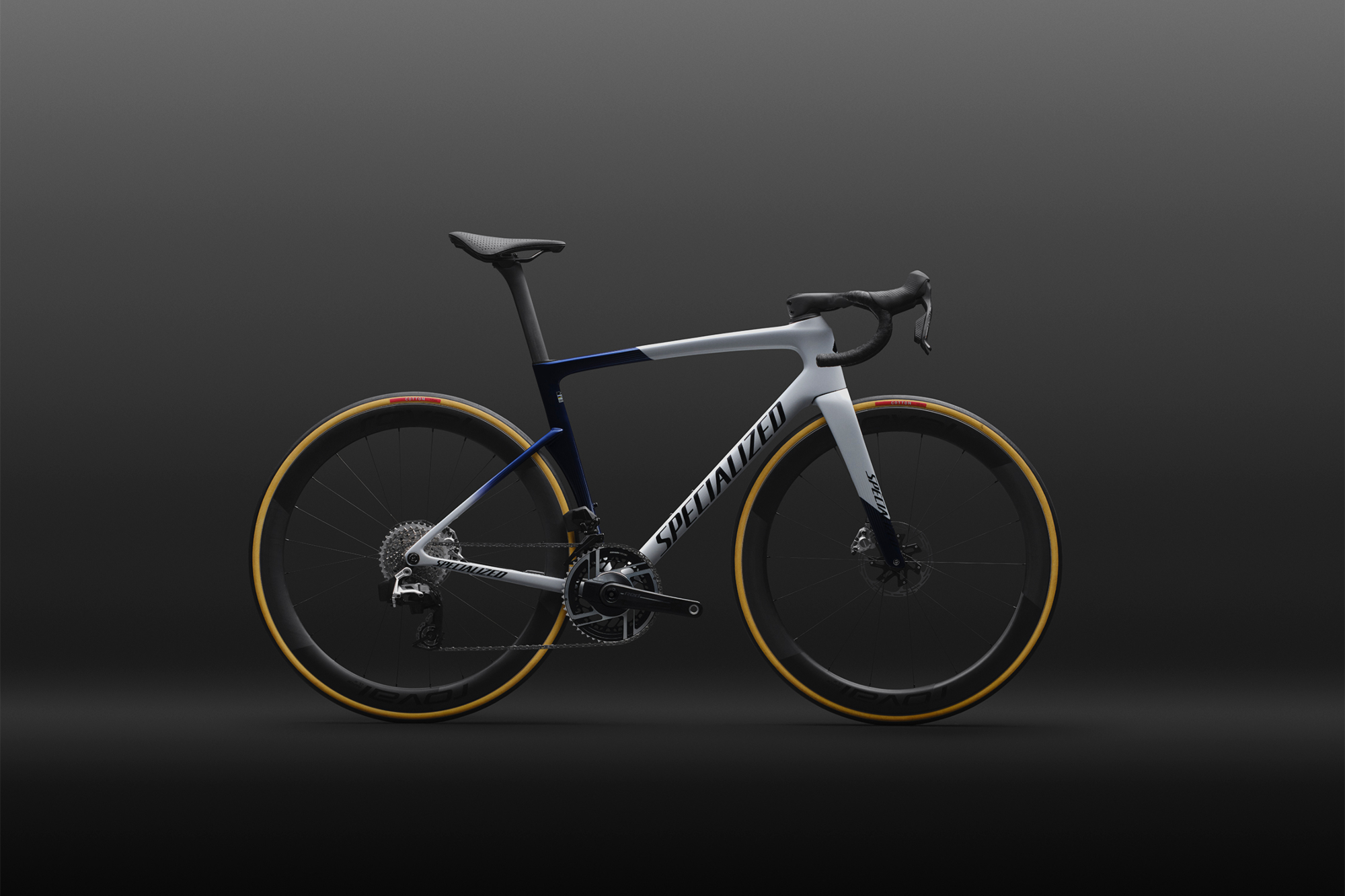
When Specialized launched the S-Works Tarmac SL9 ahead of the Tour de France, it proclaimed it “the fastest road bike ever made.” While Remco Evenepoel couldn’t prevent Tadej Pogačar from securing his fifth win at the race, his second-place showing, achieved largely aboard the SL9, did no harm to the US brand’s bold claims.
And now it’s time for the Tarmac SL9 S-Level, a more affordable version of the WorldTour-proven machine with an equally persuasive moniker: “the second fastest bike ever made”.
(Image credit: Specialized)
Unsurprisingly, then, the S-Level SL9 shares much in common with the more expensive S-Works model. Essentially, the bikes’ DNA is a match. That means the S-Level is shaped by the same aerodynamic blueprint that informed much of the S-Works version’s development.

(Image credit: Specialized)
Here’s a quick 101 in case you missed the details at launch. In creating its ‘Time to Finish’ metric, the Specialized engineers used the kind of computational race simulation data (inputs include aerodynamics, weight, rolling resistance, surface roughness, environmental conditions, and rider power) that pro teams typically rely on to fine-tune bike set-ups and race tactics to help them design a faster bike. Using a moving-legs mannequin in the wind tunnel, they were able to better understand how a cyclist in motion impacts airflow across the bike. From here, they redesigned tube shapes accordingly.
Latest Videos FromCycling Weekly

(Image credit: Specialized)
Like the S-Works Tarmac SL9, the S-Level version features the redesigned Speed Sniffer headtube, seatpost and WinFin, the reconfigured seat tube and rear triangle junction. A quick recap on these design details. The headtube is now slimmer than its predecessor the SL8, made possible by a combination of rerouting the rear brake hose and an offset steerer tube. The result is a refined hourglass shape that reduces the bike’s frontal area by 10%.

(Image credit: Specialized)
Similarly, the new seatpost is more streamlined, with a thinner, deeper design to improve airflow from the rider’s legs into the space between the legs and the frame before it hits the seatpost.

(Image credit: Specialized)
As for the WinFin, it’s a product of Specialized’s analysis of racing behaviour. In this case, breakaway riders ditching a water bottle. By losing the second bottle, airflow around the seat tube and rear triangle changes, so Specialized re‑engineered the rear of the bike around this real‑race configuration. It says the change saves 0.5 watts compared to the SL8. A marginal gain for sure, but if true, a gain nonetheless.

(Image credit: Specialized)
So if the similarities are plentiful, what are the differences? In short, material, weight, and price. The most impactful of those is likely price. To bring “world‑tour‑level performance to more riders than ever,” Specialized needed to reduce the cost. While an S-Works SL9 with SRAM Red AXS or Shimano Dura-Ace Di2 will set you back £11,999 or $14,000/ $13,500 in the US, an S-Level with the same groupsets retails at £8,799/ $10,500. It’s a significant chunk of change, achieved in no small part by the first two measurables mentioned above: material and weight.
While the S-Works model uses Spesh’s top-of-the-line Fact 12r carbon across the frameset, the S-Level adopts Fact 10r for the frame and 12r for the forks. It’s a recipe that comes with a weight penalty, but not as great as you might imagine given the price differential. The claimed frame weight of the S-Works SL9 is 687 grams. The S-Level version tips the scales at 882g. With less than 200 grams between them, complete builds for the cheaper bike are still suitably svelte, with options as light as 7.13kg.

(Image credit: Specialized)
Lower price. Competitive weight. It makes the Tarmac SL9 S-Level a compelling new entry in the second-tier race bike category. It also raises the question of why anyone who pays for their kit might choose the S-Works over the S-Level? For amateur racers, a few hundred grams is negligible and can be made up with a bit of componentry switcheroo, especially when you have £3,200 more cash in your pocket; the S-Level complete builds come equipped with Roval CL III and a Power Pro Mirror saddle, while the S-Works uses CLX III wheels and the S-Works version of the saddle. Both share the same integrated Roval Rapide carbon cockpit.

(Image credit: Specialized)
Yes, the S-Works marque carries a certain cachet, and for the finely tuned athlete, there might also be a discernible difference in performance between the two models. But for many cyclists this won’t be the case, and the design attributes that are likely to positively impact your performance are those shared by the S-Works and S-Level.
If your purse strings are tighter still, the Expert and Comp versions of the Tarmac SL9 are available, starting at £3,999/ $4,500, and rising to £5,999/ $7,000 for an Expert model (built using Fact 10r carbon) with SRAM Force AXS, Roval C38 wheels and a two-piece Specialized cockpit.
S-Level specs
- Frame: Fact 10r carbon
- Forks: Fact 12r carbon
- Wheels: Roval Rapide CL III
- Saddle: Specialized Power Pro w/Mirror Saddle
- Bars/stem: Roval Rapide Cockpit
- Groupset: SRAM Red AXS or Shimano Dura-Ace Di2
- Price: £8,799/ $10,500/ $10,000
